
—Barrington Williams, B1Daily
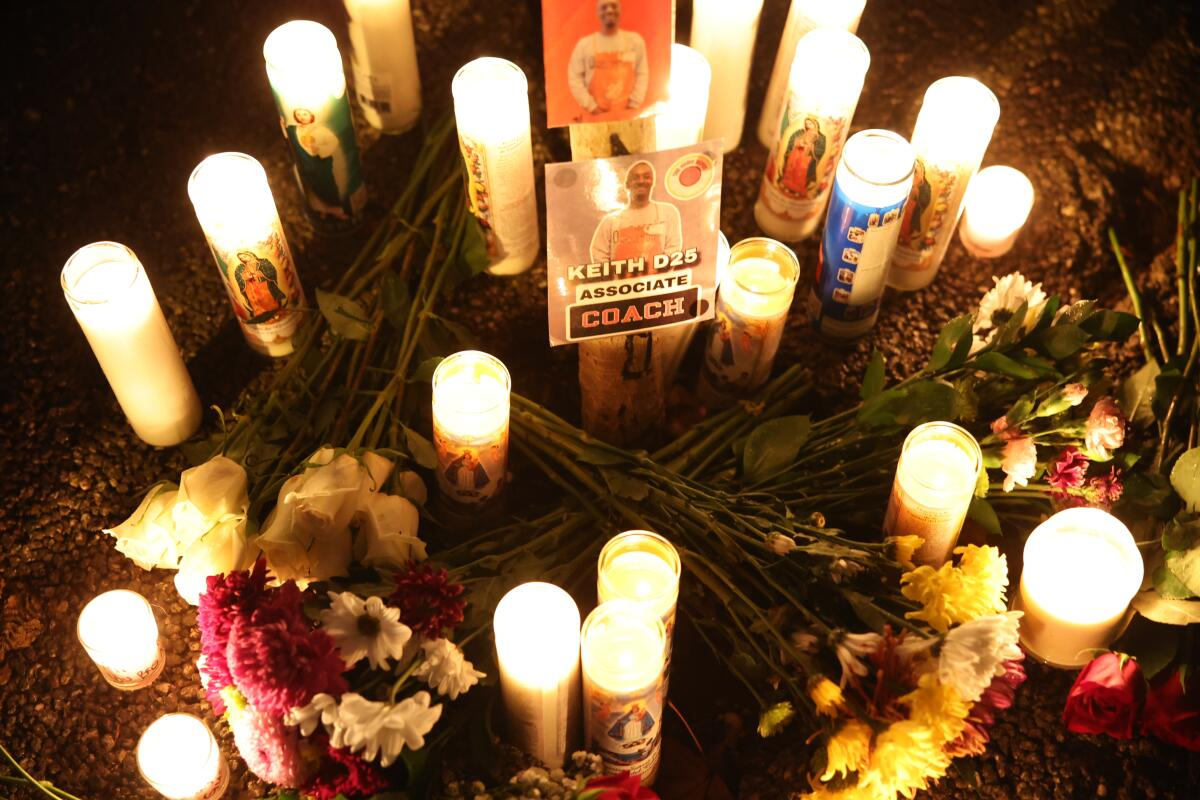
The killing of Keith Porter Jr. by an off-duty ICE agent on New Year’s Eve is already being treated by federal authorities as a closed-and-shut case of justified self-defense. But the more closely the facts are examined, the less coherent that conclusion becomes. At its core, this case raises fundamental legal questions about authority, necessity, and the boundaries of lawful force—questions that have not been answered and, so far, do not appear to be taken seriously.
Porter, a 43-year-old father, was shot outside his apartment complex by a federal immigration agent who was off duty, out of uniform, and acting as a private citizen. That fact alone matters. An off-duty federal agent does not possess automatic law-enforcement authority over general criminal matters, nor does he have a legal obligation to intervene in situations unrelated to his duties. Whatever rights the agent had in that moment were the same rights any armed civilian would have had. That framing is critical, because self-defense law is far more restrictive than federal use-of-force policy.
According to the government’s account, the agent heard gunfire, armed himself, left his residence, and encountered Porter holding a rifle. The agency has characterized the situation as an “active shooter” scenario. But that label carries legal weight, and it cannot simply be asserted after the fact to justify lethal force. An active shooter, in legal and practical terms, is someone presenting an immediate and directed threat to others. Reckless celebratory gunfire—while dangerous and often illegal—does not automatically meet that standard. If Porter was not targeting anyone, not advancing on anyone, and not threatening anyone, then the predicate for deadly force becomes far weaker.
Self-defense law hinges on imminence and necessity. Lethal force is justified only when there is no reasonable alternative to prevent immediate death or serious bodily harm. That is where the official narrative begins to unravel. The agent was inside his home when he heard shots. He was not under direct threat. He could have remained inside, called local police, and allowed on-duty officers—those with jurisdiction and authority—to respond. Instead, he chose to arm himself and insert himself into the situation. That decision matters legally because courts have long scrutinized what is known as officer-created jeopardy. If a person creates the conditions that lead to the use of deadly force, their claim of self-defense is substantially weakened.
The question then becomes unavoidable: what justified leaving a place of safety to confront a civilian with a firearm? There is no clear legal answer. Private citizens are not empowered to investigate gunfire by confronting armed individuals, and off-duty officers do not gain special immunity simply because of their employment status. If an ordinary neighbor had done what this agent did—armed themselves, exited their home, confronted another armed neighbor, and killed them—the legal analysis would be immediate and unforgiving. The shooting would be presumed criminal until proven otherwise. Here, the presumption has been reversed.
Equally troubling is the lack of transparency. The agent’s identity has not been released. There is no publicly available body camera footage, no audio recordings, and no independent witness testimony that corroborates the claim that Porter aimed his weapon at the agent. The entire justification for the killing rests on the word of the person who pulled the trigger. In any other homicide investigation, that would be unacceptable. The Constitution does not carve out exceptions for federal agents when lethal force is used against civilians.
There is also a jurisdictional problem that has not been adequately addressed. ICE agents are not general law enforcement officers tasked with policing neighborhoods. Their authority is limited, and their training is specific. When federal agents operate outside their mandate, especially while off duty, the legal protections they rely on begin to erode. This case risks setting a dangerous precedent: that federal agents may act as armed vigilantes in civilian spaces and later cloak their actions in the language of official duty.
At the heart of this case is a simple but devastating question. If Keith Porter had survived, would he have been arrested, cited, or warned—or would he still have been dead by design? The answer matters because the law does not permit execution for reckless behavior. It permits lethal force only to stop an immediate threat to life. So far, nothing publicly established demonstrates that threshold was met.

Until there is a transparent, independent investigation that treats this shooting as what it is—the killing of a civilian by another civilian who happened to be a federal agent—public skepticism is not only justified, it is legally warranted. When the state asks the public to accept that a man had to die, the burden is on the state to prove it. In the case of Keith Porter, that burden has not been met.
—Barrington Williams, B1Daily

 B1Daily
Leave a comment