
—Michael Lyles, B1Daily
Robert Mercer is not a household name, yet his influence on modern politics rivals that of elected officials. A billionaire mathematician turned political power broker, Mercer sits at the intersection of data science, ideological media, and electoral manipulation, quietly shaping outcomes in the United States and abroad. His role in Brexit, his funding of alt-right media ecosystems, and his opposition—direct and indirect—to policies harming Black voters reveal how wealth and algorithms now drive democracy.
From Algorithms to Billions
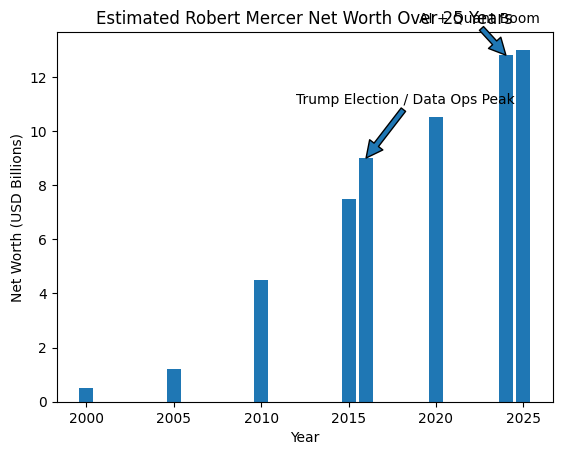
Mercer made his fortune as a senior figure at Renaissance Technologies, one of the most secretive and successful hedge funds in history. Renaissance relies on advanced mathematical models, machine learning, and massive datasets to exploit market inefficiencies. Mercer’s background in artificial intelligence and computational linguistics made him a natural fit for this data-driven operation, and his success there provided the capital for his political ambitions.
What Mercer learned in finance—how patterns predict behavior—became the foundation of his political strategy.
Building the Alt-Right Information Machine
Unlike traditional donors, Mercer did not limit himself to campaign checks. Instead, he built infrastructure.
He became a major financial backer of Breitbart News, transforming it into a central node of the alt-right media ecosystem. Under this model, Breitbart was not simply a news site—it functioned as a narrative amplifier, pushing emotionally charged content on immigration, race, nationalism, and anti-establishment politics, optimized for social media virality.
Mercer’s partnership with Steve Bannon was key. Bannon understood that elections were no longer won through persuasion alone, but through information dominance. Together, they fused media, data analytics, and ideology into a coordinated strategy.
Mercer’s daughter, Rebekah Mercer, became an operational force, embedding herself in conservative political networks, super PACs, and Republican party decision-making.
Cambridge Analytica and the Weaponization of Data
The most controversial piece of Mercer’s empire was Cambridge Analytica, a political data firm he financed and controlled behind the scenes.
Cambridge Analytica specialized in psychographic profiling—using personal data harvested from social media to model voters’ fears, motivations, and emotional triggers. Rather than convincing voters with policy, the firm aimed to manipulate behavior, often by discouraging turnout among targeted groups or inflaming social divisions.
This strategy was deployed in:
- The 2016 U.S. presidential election
- The Brexit referendum, where Mercer helped introduce the firm to Leave-aligned political figures
Data extracted from millions of unsuspecting users was fed into algorithmic models, producing hyper-targeted political messaging delivered through social platforms where oversight was minimal and accountability nearly nonexistent.
Brexit: Exporting the Model Overseas
Mercer’s influence was not confined to American politics. Through his financial backing and strategic introductions, Cambridge Analytica became entangled in the Brexit campaign.
The same techniques used in U.S. elections—micro-targeting, emotional manipulation, and algorithmic amplification—were applied to British voters. Brexit demonstrated that data-driven political warfare could be exported, bypassing national borders and election laws alike.
Lobbying, Ideology, and Black Voter Issues
Mercer’s political spending overwhelmingly supports hard-right, libertarian, and nationalist causes. While he has occasionally funded Black conservative organizations, these efforts have aligned with messaging that discourages systemic civil-rights policy, voting-rights expansion, or economic redistribution.
His broader record shows:
- Opposition to civil rights legislation
- Financial support for institutions that resist voting rights protections
- Alignment with narratives that minimize structural racism
Rather than empowering Black voters, Mercer’s investments tend to reshape the information environment, amplifying skepticism, disengagement, or division—strategies that disproportionately harm marginalized communities.
How Information Is Sold—and Democracy Shaped
Mercer’s success exposed a deeper truth: user data is the most valuable political commodity of the digital age.
Social media platforms collect behavioral data—likes, shares, time spent, emotional reactions—and sell access to this information through advertising and targeting tools. Political operatives feed this data into algorithms designed to:
- Predict voter behavior
- Identify emotional vulnerabilities
- Deliver tailored messages that feel organic but are strategically engineered
This feedback loop—data → algorithm → influence → more data—creates an environment where elections are no longer contests of ideas, but battles of information control.
Visual Timeline: Robert Mercer’s Political Influence & Data Strategy
? 1970s–1990s│├─Mercer works in AI & computational linguistics│? Early 2000s│├─Joins Renaissance Technologies├─Amasses billionaire fortune via algorithmic trading│? 2010–2012│├─Begins funding conservative causes├─Invests in Breitbart News│? 2013–2015│├─Breitbart becomes alt-right media hub├─Alliance with Steve Bannon solidifies│?ᄌマ2015–2016│├─Funds Cambridge Analytica├─Data harvested from social media users├─Psychographic voter profiling deployed│?゚ヌᄃ2016│├─Cambridge Analytica tied to Brexit campaigns├─Micro-targeted messaging spreads across UK voters│?゚ヌᄌ2016 Election│├─Data-driven voter suppression & persuasion├─Alt-right media amplification peaks│⚖️2017–2019│├─Cambridge Analytica exposed & collapses├─Mercer retreats publicly, influence persists│? 2020–Present│├─Data-driven political tactics normalized├─Algorithmic influence embedded in campaigns
Why Mercer Still Matters
Even after Cambridge Analytica’s downfall, its methods live on. Political campaigns, consulting firms, and social platforms now routinely deploy Mercer-style strategies—algorithmic targeting, emotional manipulation, and narrative warfare.
Robert Mercer didn’t just fund political movements.
He helped rewrite the rules of democracy, proving that in the digital era, control of data is control of power.
—Michael Lyles, B1Daily




 B1Daily
Leave a comment