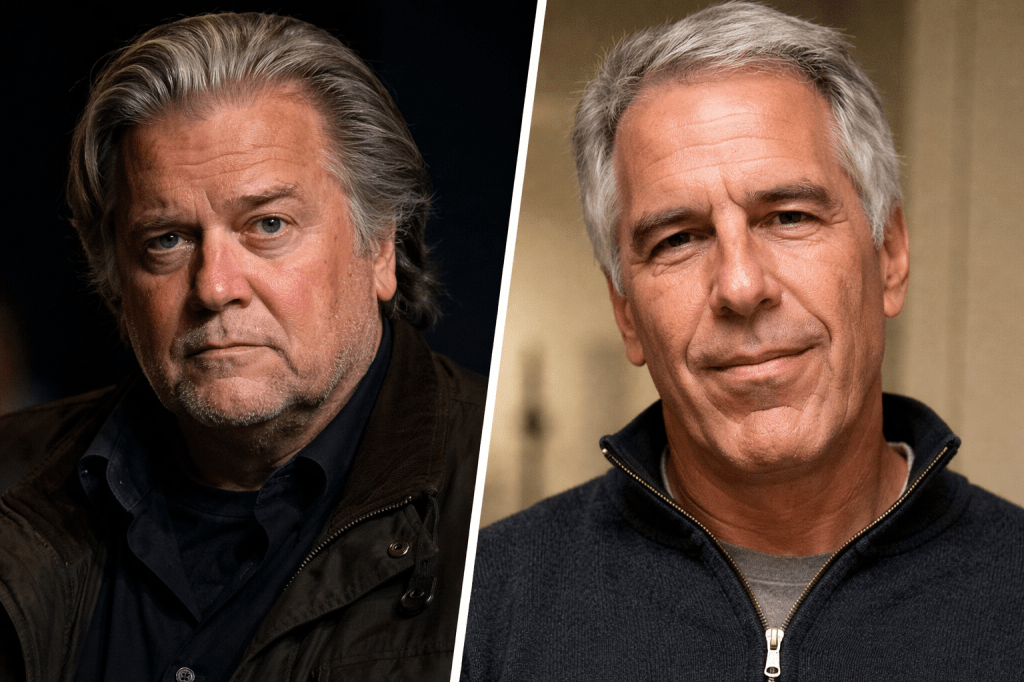
—Barrington Williams, B1Daily
Jeffrey Epstein’s downfall in 2019 exposed one of the most grotesque criminal networks of the 21st century. Yet the true breadth of his connections and the influence he wielded through those connections, has only come into focus with the release of the full Epstein Files. Among the most unsettling threads in that trove of documents is the repeated appearance of Steve Bannon, the former chief strategist to Donald Trump, not as a peripheral acquaintance but as a co-conspirator in political strategy, influence operations, and elite networking.
What emerges from the files isn’t simply a social relationship between two controversial figures; it’s a portrait of mutual utility and political engineering that stretches from U.S. domestic media strategy to attempts to reshape European politics — all with Epstein’s financial and strategic backing.
Not Casual Acquaintances, Strategic Partners
Before Epstein’s arrest, Bannon and Epstein engaged in regular communication, including email exchanges and private meetings in 2018 and 2019. These communications were not trivial: Epstein repeatedly offered assistance, logistical support, and even attempted to host Bannon during his travels. In one exchange, Epstein joked that he was the “highest paid guide in history” for Bannon, underscoring the transactional tone of their rapport. At times, Epstein sent details such as a Paris door code in anticipation of meetings during Bannon’s European travels.
Far from being idle chit chat, the correspondence reveals that Epstein was actively invested in Bannon’s political endeavors. seeing in him a conduit to extend his influence into global strategy long after the public scandal engulfed him.
Political Engineering: Europe as a Laboratory
One of the most striking revelations in the Epstein files is how Epstein and Bannon plotted to influence European elections and the rise of far-right political movements. In numerous messages from 2018–2019, Bannon outlined to Epstein his ambition to attract funding for figures such as Marine Le Pen in France and Matteo Salvini in Italy ahead of critical European Parliament elections.
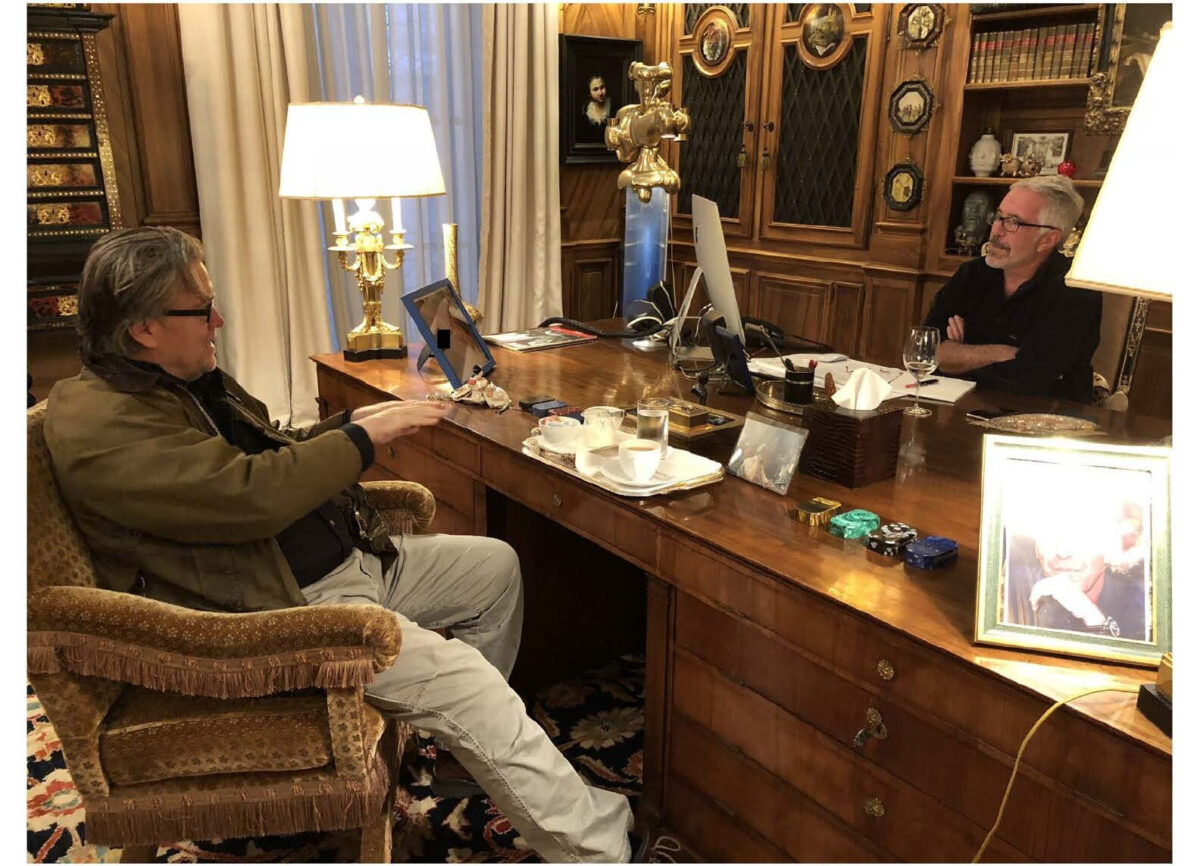
Bannon boasted to Epstein about his influence over emerging populist and eurosceptic forces across the continent, citing strategy sessions around coalition building and election outcomes. The files even show the pair discussing elements of messaging and electoral positioning for parties such as Alternative for Germany (AfD), expressing open hostility toward figures like former German Chancellor Angela Merkel and disparaging mainstream European political institutions as obstacles to their project.
This underscores what was always suspected but rarely documented so clearly: Epstein and Bannon were not merely observers of politics, they saw it as a manipulable system, and were prepared to deploy money, strategy, and social capital to shape it.
Public Messaging and Reputation Management
Independent reporting on the House Oversight Committee’s releases reveals that Epstein wasn’t just a financier in the background, he was actively advising Bannon on media strategy and public perception. Text messages from 2017 illustrate Epstein coaching Bannon on how to approach television appearances and narratives tied to Bannon’s work on pro-Trump media campaigns and related documentary projects.
In another tranche of unreleased interviews that Bannon himself has teased recordings of at least 15 hours of discussion between him and Epstein the dynamic appears to extend deeper: Bannon seems to have been helping Epstein craft his public story, potentially in an effort to rehabilitate the disgraced financier’s image, even as Epstein remained unindicted on broader trafficking charges at the time.
That Epstein regarded Bannon as a strategic asset, not just an ideological ally, marks a profound shift in how we understand Epstein’s post-scandal priorities: not withdrawal from power, but reintegration into it.
Power and Influence Without Limits
Perhaps most troubling is what the raw correspondence suggests about the flow of influence between the two men. Epstein wasn’t merely an adviser; in Bannon’s world, he was a connector to wealth, political funding, and elite networks, the very elements necessary to fund political movements that operate at the edges of legality and public scrutiny. Media analysis of the newly released emails highlights repeatedly that Bannon was comfortable leaning on Epstein’s networks for political leverage, even as he publicly decried elites and championed himself as an outsider.
Even now, while Bannon has called for full transparency of the Epstein files in the past, he has hoarded his own trove of interview footage that may shed further light on their interactions, footage he has delayed releasing for years.
Peter Thiel’s Politics Didn’t Matter, His Utility Did
Peter Thiel’s hostility toward labor, democracy, and progressive politics did not disqualify him from Democratic cooperation. It didn’t matter because Palantir was useful. The company promised data-driven governance, law-enforcement efficiency, immigration enforcement tools, and predictive analytics framed as neutral technology.
California Democrats embraced those promises while publicly distancing themselves from Thiel’s ideology. But public money has no ideology, only direction. And under Newsom and the Democratic Legislature, that direction flowed toward systems that expanded state surveillance capacity while simultaneously generating private profit.
Who Was Locked Out
While Palantir and similar firms enjoyed streamlined access to public funds, Black-owned and community-rooted tech companies were largely shut out. California’s procurement and innovation funding structures consistently favored firms with existing government relationships, deep legal and lobbying infrastructure, and venture backing from elite networks.
Equity initiatives were discussed endlessly in speeches and press releases, but rarely enforced through budgets or binding requirements. Inclusion became a talking point rather than a material commitment. Opportunity followed power, not merit.
Navigating the Moral and Political Fallout
It’s important to state clearly: there is no public evidence in the current files that Bannon was complicit in Epstein’s sex trafficking crimes. Recent DOJ reviews of the FBI’s investigations confirm that, despite extensive searching, investigators could not substantiate allegations of a broad trafficking ring involving powerful associates.
But that absence of legally actionable proof does not diminish the significance of the political and strategic link between Bannon and Epstein. Influence is not the same as indictment, and the files now demonstrate that Epstein’s reach extended far beyond the social parties and celebrity events that first brought him infamy.
Instead, the Epstein-Bannon relationship reveals a vision of power that transcends national boundaries, leveraging private wealth, opaque funding structures, and political insurgency movements to shape public life. That this relationship was nurtured during the very years Epstein was seeking to burnish his image and that Bannon participated willingly is a stain on all who traffic in influence without oversight.
In the end, we must ask ourselves: when influential figures use personal relationships with individuals like Epstein to shape global political movements, what does that say about the resilience of democratic institutions and the ease with which they can be subverted by those who operate above the public eye?
The Epstein files will continue to be mined for years. What they have already revealed about Steve Bannon and what he still refuses to disclose himself, should give every citizen reason to watch closely.
—Barrington Williams, B1Daily



 B1Daily
Leave a comment