—Kerry Hill, B1Daily
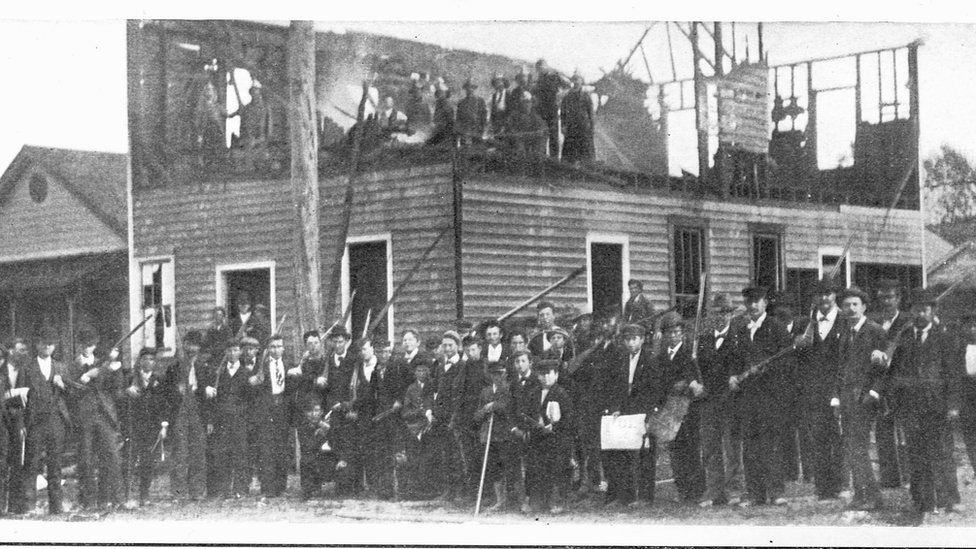
In 1898, Wilmington, North Carolina was not simply the site of racial violence — it was the site of a calculated political overthrow. A legitimately elected, racially integrated local government was forcibly removed by white supremacists who refused to accept Black political participation and economic progress. What happened there was not chaos. It was strategy.
At the end of Reconstruction, Black Americans in Wilmington had built something extraordinary. The city had a thriving Black middle class. Black professionals — lawyers, teachers, business owners — were shaping civic life. A Black-owned newspaper, The Daily Record, circulated ideas and defended Black citizenship. Through a coalition of Black Republicans and white Populists known as Fusionists, Black voters helped elect officials who reflected their interests. It was one of the clearest examples in the post–Civil War South of what multiracial democracy could look like.
That success made Wilmington a target.
White supremacist leaders did not merely object to Black political participation — they were enraged by Black prosperity. Political power and economic independence are intertwined. When Black citizens vote, hold office, own businesses, and control institutions, they alter the balance of power. And throughout American history, moments of Black advancement have often been met with organized backlash.
In Wilmington, white supremacists launched a coordinated campaign. They spread propaganda portraying Black leadership as illegitimate and dangerous. They weaponized racial fears to mobilize white voters. Armed paramilitary groups intimidated Black citizens at the polls. And when elections did not fully deliver the power shift they desired, they escalated to violence.
On November 10, 1898, a white mob destroyed Black businesses, burned down The Daily Record, killed Black residents, and forced elected officials to resign at gunpoint. The perpetrators installed their own leadership and rewrote the city’s political order. It remains the only successful coup d’état in United States history.
The destruction of Black financial and political infrastructure was not incidental — it was the objective.
The coup was followed by sweeping voter suppression laws across North Carolina: poll taxes, literacy tests, and constitutional amendments designed to eliminate Black political participation for generations. The message was clear: Black economic and political empowerment would not be tolerated.
Wilmington was not an isolated case. From the destruction of Tulsa’s Greenwood District in 1921 to the systematic dismantling of Reconstruction governments across the South, white supremacist movements have repeatedly targeted Black wealth, land ownership, voting power, and institutional control. Each time Black communities built independent economic bases — banks, newspapers, schools, business districts — those gains were treated as threats to racial hierarchy.
The pattern is unmistakable. When Black Americans accumulate capital, build institutions, and organize politically, opposition often intensifies.
While the methods have changed over time, the underlying tension between Black advancement and reactionary backlash remains part of the American story. Modern disputes over voting access, districting, public investment, and representation are not disconnected from the past. They exist within a long historical continuum in which power — who has it, who keeps it, and who is excluded from it — remains contested.
The tragedy of Wilmington is not only that a violent coup occurred. It is that for decades it was mischaracterized as a “riot,” implying mutual chaos rather than a deliberate seizure of power. Historical narratives matter because they shape how societies understand legitimacy, democracy, and justice. Calling something a riot obscures responsibility. Calling it a coup acknowledges intent.
If Wilmington teaches anything, it is that democracy is not self-sustaining. It depends on equal access to political participation and economic opportunity. When those foundations are undermined, whether through violence or structural barriers, the damage can last generations.
Black financial and political power has never advanced without resistance. But history also shows that suppression does not permanently erase aspiration. The struggle for representation, ownership, and civic influence continues — not as a relic of the 19th century, but as an ongoing chapter in the American story.
Understanding Wilmington is not about reopening old wounds. It is about recognizing patterns — and ensuring that political competition never again becomes a pretext for racialized power grabs.
—Kerry Hill, B1Daily



 B1Daily
Leave a comment