—Travis Luyindama, B1Daily
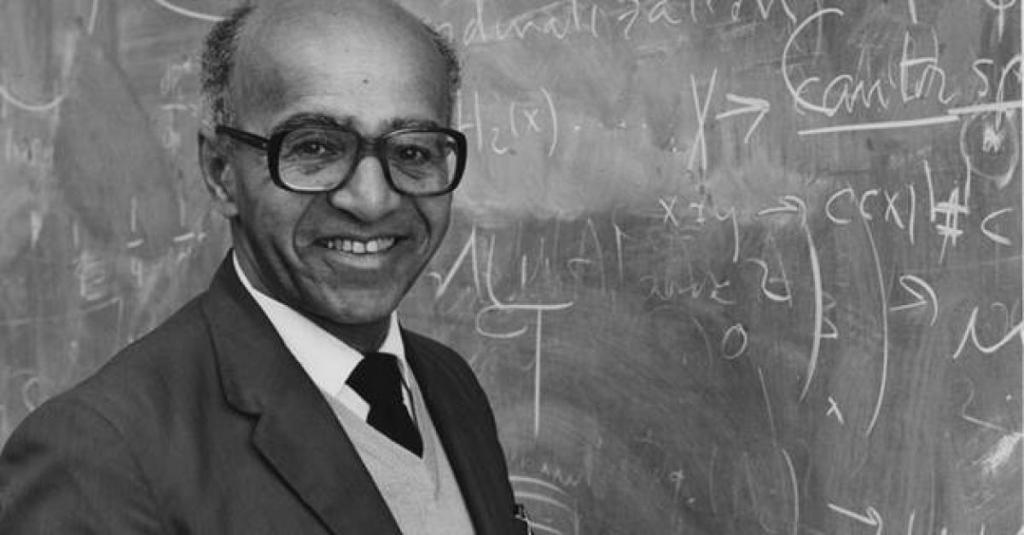
Long before artificial intelligence became a cultural flashpoint or a trillion-dollar industry, Dr. David Blackwell was quietly laying the mathematical foundations that would make it possible. A pioneering statistician, game theorist, and probabilist, Blackwell helped build the intellectual architecture of modern decision science — the very framework that underpins today’s AI revolution.
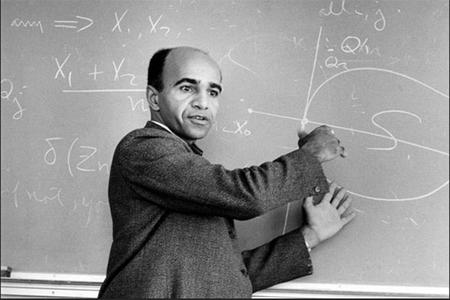
Blackwell created the mathematical tools that allow machines to learn, adapt, and make optimal decisions under uncertainty. In that sense, he stands as one of the architects of the new information age.
The Science of Decision-Making
Artificial intelligence at its core is about decision-making under uncertainty. How does a system choose the best action when it has incomplete information? How does it improve over time? How does it minimize error?
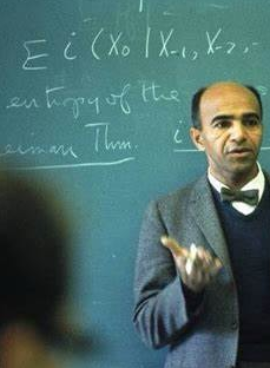
Blackwell’s groundbreaking work in dynamic programming, Bayesian statistics, and game theory addressed precisely these questions. His famous “Blackwell Approachability Theorem” formalized how agents can adjust strategies over time to achieve optimal long-term outcomes — a principle that now lives at the heart of reinforcement learning, one of AI’s most powerful techniques.
Reinforcement learning systems — from recommendation algorithms to autonomous vehicles — rely on repeated trial-and-error learning, guided by probabilistic models and payoff optimization. Blackwell’s mathematics provided early blueprints for this iterative logic.
Information as Power
The 20th century was defined by the industrial economy. The 21st is defined by the information economy — and Blackwell helped shape the transition.
His work in statistical decision theory emphasized that information itself has measurable value. The question isn’t just what we know, but how additional information changes optimal action. This concept is fundamental to AI systems that constantly update predictions as new data arrives.

Today’s machine learning models function through continuous statistical updating — essentially living inside the mathematical universe Blackwell helped design.
Breaking Barriers While Building Science
Beyond his scientific contributions, Blackwell also broke historic barriers. He became the first Black scholar elected to the National Academy of Sciences and the first tenured Black professor at the University of California, Berkeley. His presence in elite mathematical circles challenged exclusionary norms while expanding the intellectual frontier.
His legacy is therefore dual: intellectual and institutional. He reshaped statistical science while also widening who could participate in it.
From Theory to the AI Era
Modern AI systems — from predictive analytics engines to adaptive robotics — are built on layered mathematical disciplines: probability theory, optimization, stochastic processes, and game theory. Blackwell’s work sits at the intersection of these fields.
When algorithms learn from uncertainty, optimize long-run rewards, and update beliefs based on new evidence, they are operating inside frameworks he helped formalize decades ago.

The current information age — dominated by data, predictive modeling, and algorithmic decision-making — rests on foundations constructed by mathematicians like Blackwell. His contributions may not trend on social media, but they power the invisible infrastructure of modern intelligence systems.
A Quiet Architect of the Future
In an era captivated by tech founders and AI startups, it is easy to forget the mathematicians who built the scaffolding. Dr. David Blackwell’s work reminds us that revolutions often begin not in garages, but on chalkboards.
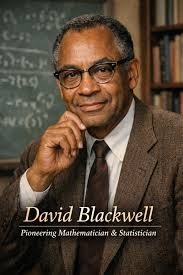
The algorithms shaping our world — optimizing logistics, personalizing media, diagnosing disease, and guiding autonomous systems — echo the principles he helped define.
The new information age did not appear overnight. It was calculated. And in many ways, David Blackwell wrote the equation.
—Travis Luyindama, B1Daily




 B1Daily
Leave a comment