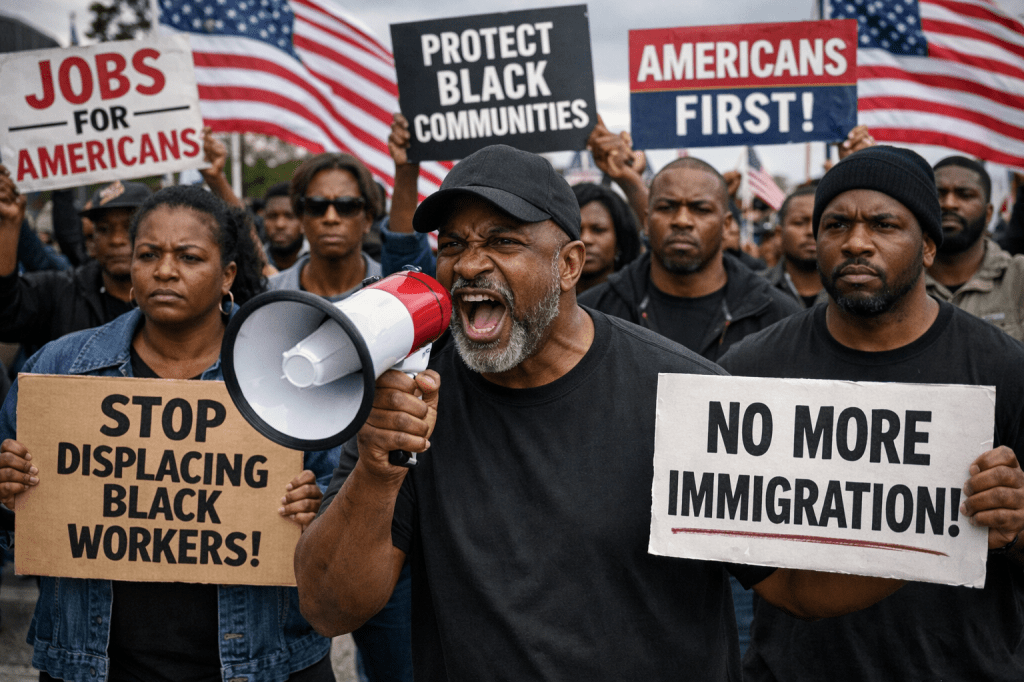
—Barrington Williams, B1Daily
They came for the jobs, but who got displaced?
For decades, America’s immigration policies have been framed as a moral obligation—a beacon of hope for the world’s tired, poor, and huddled masses. Yet beneath this narrative lies an uncomfortable truth: mass immigration has disproportionately harmed Black Americans, exacerbating economic stagnation, wage suppression, and political marginalization.
The Economic Squeeze
Black workers, particularly those without college degrees, have borne the brunt of labor market competition from low-wage immigrant labor. Studies from the Economic Policy Institute and Harvard economist George Borjas confirm that immigration has suppressed wages in industries like construction, hospitality, and service work—sectors where Black Americans historically found stable employment.
The argument that “immigrants do jobs Americans won’t do” collapses under scrutiny. In reality, they often do jobs **Black Americans used to do**—but for lower pay, fewer benefits, and under exploitative conditions that drive down standards for all workers.
Political Displacement
Immigration has also reshaped America’s political landscape, often sidelining Black priorities. Urban centers with large immigrant populations have seen Black political influence diluted, as coalitions shift to cater to newer arrivals. Policies like affirmative action, criminal justice reform, and economic investment in Black communities now compete with demands for pathways to citizenship and expanded visa programs.
Cultural and Social Pressures
Beyond economics and politics, rapid demographic change has strained social cohesion in historically Black neighborhoods. Gentrification, often fueled by affluent immigrants and foreign investors, has displaced Black families from cities like Washington D.C., Atlanta, and Los Angeles. Meanwhile, tensions over jobs, housing, and cultural differences have created fractures where solidarity should exist.
A Call for a Pause
If America truly values racial equity, it must confront the unintended consequences of unchecked immigration. A temporary moratorium—not out of xenophobia, but out of economic necessity—could allow Black communities to stabilize, rebuild, and regain lost ground.
The alternative? Continuing a system where Black America foots the bill for a policy marketed as progress—but functions as displacement.
Is it time to hit pause?
—Barrington Williams, B1Daily



 B1Daily
Leave a comment