—Michael Lyles, B1Daily
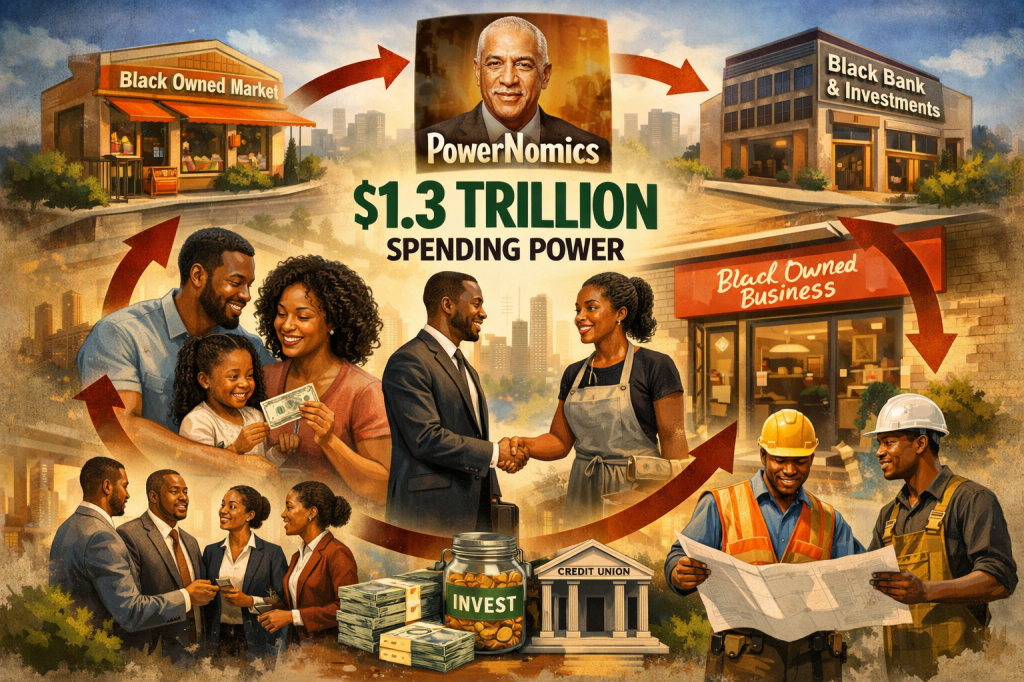
Black America commands enormous economic influence. Estimates frequently place Black consumer spending power at nearly $1.3 trillion annually in the United States. Yet despite this immense buying power, a persistent economic challenge remains: much of that money quickly leaves the Black community instead of circulating within it to build long-term wealth, businesses, and institutions.
Financial analysts, economists, and community leaders have long pointed out that the issue is not simply income levels, but economic circulation. When dollars move repeatedly between businesses, workers, and institutions within the same community, they create jobs, strengthen businesses, and expand local ownership. When those dollars leave immediately, the long-term economic impact is dramatically reduced.
One of the most well-known frameworks addressing this issue comes from Dr. Claude Anderson, whose economic philosophy, outlined in his book PowerNomics: The National Plan to Empower Black America, argues that economic empowerment requires strategic control over production, distribution, and consumption within the Black community.
According to the PowerNomics framework, the central problem is that the Black community often participates heavily in consumption but less in ownership. In practical terms, Black consumers spend large amounts of money each year, but a relatively small portion of that spending goes toward Black-owned businesses or institutions.
The Importance of Economic Circulation
In many thriving communities around the world, money circulates multiple times before leaving the neighborhood. Each transaction creates another opportunity for business growth, employment, and reinvestment.
When economic circulation is weak, communities often experience:
- Fewer locally owned businesses
- Reduced access to capital
- Limited job creation
- Greater dependency on outside institutions
For the Black community, increasing the circulation of its $1.3 trillion spending power could significantly strengthen economic independence.
Supporting Black-Owned Businesses
One of the most direct ways to increase economic circulation is consistent support for Black-owned businesses. This includes everyday spending such as:
- Grocery stores
- Restaurants
- Clothing brands
- Professional services (lawyers, accountants, contractors)
- Media and technology platforms
Even modest shifts in spending patterns can have major economic effects when applied across millions of consumers.
If just a small percentage of Black consumer spending were redirected toward Black-owned businesses, the resulting capital could finance expansion, hiring, and new enterprise development.
Building Financial Institutions
Another key pillar discussed in PowerNomics is the importance of financial infrastructure. Communities with strong economic circulation often rely on locally focused financial institutions such as credit unions and banks that reinvest deposits into local businesses and housing.
Strengthening financial institutions that prioritize community reinvestment allows capital to remain accessible within the community rather than flowing outward.
Access to capital remains one of the largest barriers facing entrepreneurs. Increasing deposits, investments, and participation in community-oriented financial institutions could significantly expand lending opportunities for Black business owners.
Collective Economic Strategy
A recurring theme in the work of Dr. Claude Anderson is collective economic coordination. Economic progress rarely occurs solely through individual success stories. Instead, it often requires coordinated action among consumers, businesses, and community organizations.
Examples of collective strategies include:
- Organized “buy Black” campaigns
- Cooperative ownership models
- Community investment groups
- Business mentorship networks
- Local supply chains connecting Black-owned producers and retailers
These strategies help create a self-reinforcing economic ecosystem, where businesses buy from each other, hire locally, and reinvest profits into the community.
Entrepreneurship and Ownership
Another key component of economic circulation is increasing the number of Black-owned businesses themselves. Consumer support alone is not enough if there are limited businesses available to support.
Encouraging entrepreneurship in sectors such as technology, manufacturing, logistics, and media can help expand the economic footprint of Black-owned enterprises.
Ownership also means controlling assets, land, intellectual property, infrastructure, and distribution networks. These assets generate long-term wealth and influence economic outcomes for future generations.
The Long-Term Impact
If the Black community could significantly increase the internal circulation of its $1.3 trillion spending power, the effects could be transformative. Stronger business ecosystems, greater employment opportunities, and expanded community investment would create a foundation for generational wealth.
The ideas outlined by Dr. Claude Anderson in PowerNomics emphasize that economic power is not just about how much money a community earns, but how strategically it spends, invests, and circulates that money.
Ultimately, building stronger economic circulation within the Black community is less about short-term spending campaigns and more about developing long-term systems of ownership, cooperation, and financial strategy.
With coordinated effort and strategic investment, Black America’s massive consumer power could become not just a statistic, but a powerful engine for sustained economic development.
—Michael Lyles, B1Daily




 B1Daily
Leave a comment