
—Michael Lyles, B1Daily
Public discussions about welfare programs in the United States often contain misconceptions about who actually receives government assistance. Data on the Supplemental Nutrition Assistance Program (SNAP), commonly distributed through Electronic Benefit Transfer (EBT) cards, shows that White Americans represent the largest share of recipients in total numbers across the country.
SNAP is the largest anti-hunger program in the United States and provides food assistance to millions of low-income individuals and families each year. The program helps households purchase groceries and basic food items while addressing food insecurity in communities throughout the nation.
Demographic data consistently shows that White Americans make up the largest group of SNAP and EBT recipients in absolute numbers. This reality largely reflects the broader demographic makeup of the United States, where White Americans remain the largest population group overall.
However, economic analysts often point out that understanding welfare statistics requires looking beyond raw totals. While White Americans represent the largest number of participants overall, per-capita participation rates tell a more complex story about economic inequality and poverty.
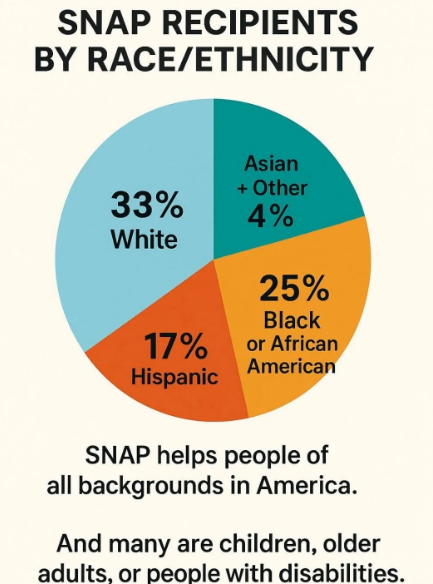
Per-capita analysis examines how frequently individuals from different demographic groups participate in the program relative to their population size. In that context, some groups may appear overrepresented because poverty rates differ across communities.
Another important factor shaping SNAP participation is the economic structure of many American households. A large share of recipients are families with children, elderly individuals living on fixed incomes, or workers earning low wages that do not fully cover the rising cost of living.
In many cases, people receiving SNAP benefits are already employed but work in sectors with low pay, unstable hours, or limited benefits. The program therefore functions not only as a safety net for the unemployed but also as a supplement for working households struggling to meet basic needs.
Geography also plays a role in determining participation levels. States and regions with higher poverty rates, limited job opportunities, or high living costs tend to see greater enrollment in food assistance programs.
Ultimately, SNAP participation reflects broader economic challenges that cut across multiple communities in the United States. While White Americans make up the largest share of EBT recipients in total numbers, the overall picture of food assistance participation highlights the widespread impact of poverty and economic hardship throughout the country.
—Michael Lyles, B1Daily




 B1Daily
Leave a comment