—Kerry Hill, B1Daily
There are moments when the justice system speaks loudly, with verdicts, convictions, and consequences that echo across the country. And then there are moments like this one, where it doesn’t speak so much as… step back.
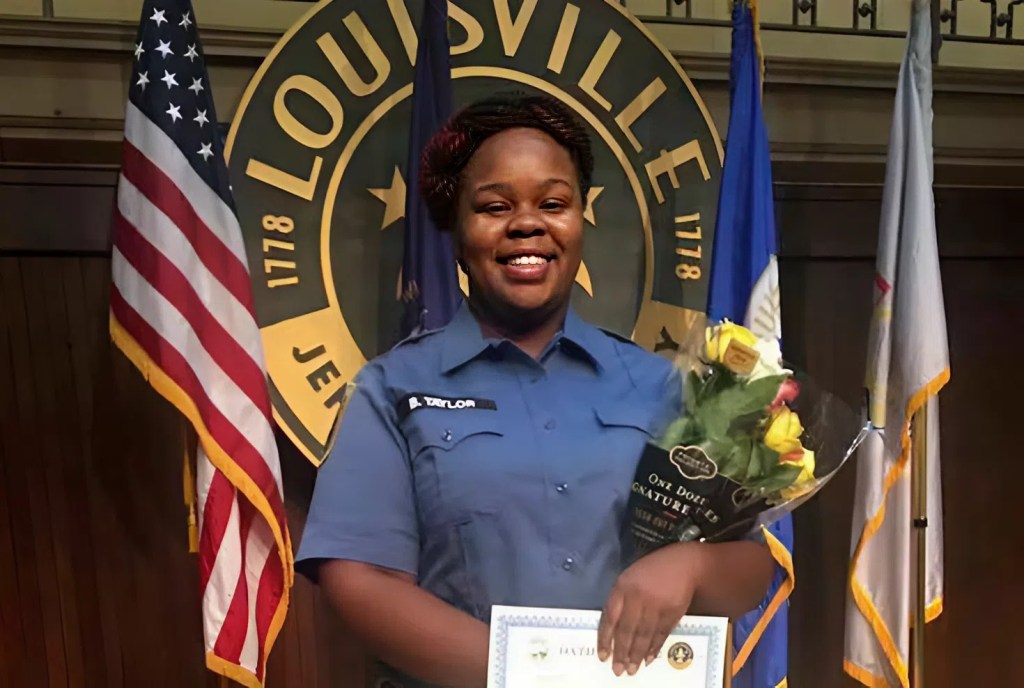
The United States Department of Justice is now asking to drop its remaining charges against officers connected to the raid that killed Breonna Taylor. Not reduce them. Not reshape them. End them.
No courtroom crescendo. No final reckoning. Just a quiet legal exit labeled “in the interest of justice.”
That phrase is doing a lot of work.
Because to the public, this case was never just about legal thresholds or procedural hurdles. It was about whether the system could stretch far enough to hold itself accountable. Whether a death that sparked global protest could produce something more than symbolism.
For a time, it looked like it might.
Federal charges against former officers Joshua Jaynes and Kyle Meany were framed as a second path to accountability. If the shooting itself proved too legally complex to prosecute, then perhaps the foundation of it all, the warrant, could be scrutinized. The idea was simple but powerful: if the raid was built on faulty or misleading information, then responsibility didn’t begin at the trigger. It began on paper.
Now even that thread is being cut.
And here’s the uncomfortable truth threading through all of it: the law is not built to answer every moral question. It has thresholds, definitions, burdens of proof that don’t bend easily, even under national pressure. Federal civil rights cases, especially against police, require proving intent, not just error, not just negligence, but willful violation. That’s a high bar. High enough that many cases never clear it.
So the DOJ steps back, not necessarily declaring innocence, but conceding something just as consequential, that it cannot prove guilt in a way that would survive the courtroom.
Legally, that’s restraint. Institutionally, it’s procedure.
Publicly, it lands like disappearance.
Because this case did not live in legal briefs alone. It lived in streets, in murals, in chants, in a collective demand that something, finally, would be different. That a line had been crossed that could not be quietly erased.
And yet, here we are, watching one of the most closely watched federal prosecutions in recent memory dissolve not with a bang, but with a filing.
There is still a record, of course. Brett Hankison was convicted on federal charges tied to reckless gunfire. But even that outcome sits in a strange place, accountability that exists, but not in direct proportion to the loss that brought the world’s attention here in the first place.
So what remains?
A case that reshaped national conversation, but now underscores a familiar boundary. The difference between what the public sees as justice and what the legal system can actually deliver.
This is the quiet part that often goes unsaid. The system is not designed to satisfy collective grief. It is designed to test evidence. And when those two things collide, evidence usually wins.
Still, something lingers.
Not just frustration, but a kind of erosion. Each step back in a case like this doesn’t just close a legal door. It narrows belief. It makes future promises of accountability feel a little more conditional, a little more fragile.
The file may close. The case may end.
But the question it leaves behind does not: if even this moment could not produce a full measure of accountability, then what kind of moment ever will?
—Kerry Hill, B1Daily

 B1Daily
Leave a comment