—Barrington Williams, B1Daily
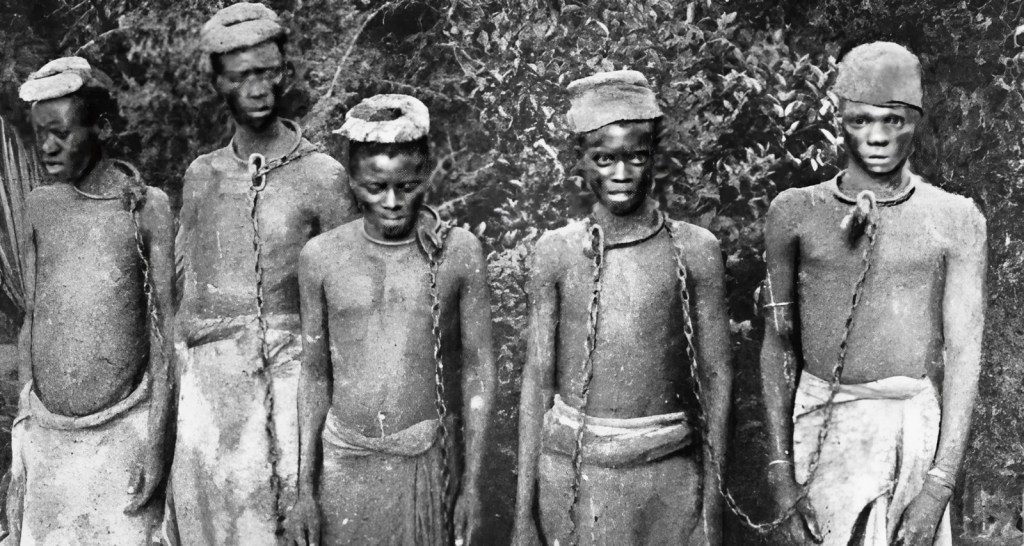
The global conversation around reparations for slavery often centers on European empires and the United States, but a fuller historical accounting requires a wider lens. It is an uncomfortable truth that parts of West Africa, including what is now Ghana, were not just victims of the transatlantic slave trade but active participants in it.
Long before European ships anchored along the Gold Coast, complex African societies were already engaged in systems of warfare, captivity, and human exchange. When European traders arrived, they did not invent slavery in the region, but they industrialized and globalized it. African intermediaries, including powerful kingdoms such as the Ashanti Empire, played a significant role in capturing, trading, and selling other Africans to European merchants.
Coastal forts like Cape Coast Castle and Elmina Castle became major hubs in this system. While these structures were built and controlled at various times by European powers, they relied heavily on African supply networks that brought captives from inland regions to the coast. The machinery of the slave trade functioned through cooperation, coercion, and mutual economic interest.
This historical reality complicates modern calls for reparations from African nations like Ghana. Reparations, at their core, are about redress for harm inflicted. In the context of American slavery, the argument for reparations is most often directed toward the United States government and institutions that legally codified, enforced, and benefited from chattel slavery over centuries.
Within that framework, many advocates argue that reparations in the U.S. should be specifically targeted toward the descendants of the formerly enslaved, often referred to as Freedmen, whose ancestors endured generations of legally sanctioned bondage, segregation, and systemic exclusion. This lineage-based approach emphasizes continuity of harm, tracing the economic and social disadvantages that persist today directly back to slavery and its aftermath.
By contrast, applying the same reparations logic to Ghana raises difficult questions. If a society or its historical predecessors were complicit in the capture and sale of enslaved people, can it claim victim status in the same way? Or does its role in the system complicate or even undermine such claims?
This is not to suggest moral equivalence between African societies and European colonial powers. The scale, structure, and global impact of the transatlantic slave trade were driven largely by European demand and colonial expansion. European nations built the ships, financed the voyages, and constructed the plantation economies that defined the system. However, acknowledging this does not erase the agency of African actors who participated in and profited from the trade.
In recent years, Ghana has positioned itself as a cultural and historical destination for members of the African diaspora, promoting initiatives like heritage tourism and the “Year of Return.” These efforts have been powerful in reconnecting descendants of enslaved people with the African continent. At the same time, they have also sparked debate about historical accountability and the narratives being presented.
Critics argue that any discussion of reparations or historical justice must include a candid acknowledgment of Africa’s internal dynamics during the slave trade era. Without that, the story risks becoming incomplete, shaped more by modern political goals than historical complexity.
Ultimately, the question of reparations is not just about who suffered, but about who bears responsibility and how that responsibility is defined across time. In the United States, the case for reparations is often rooted in a clear line of legal and institutional continuity, from slavery to Jim Crow to present-day disparities. This is why many argue that reparations should be directed specifically toward descendants of Freedmen, whose historical experience is tied directly to American systems of exploitation.
The history of Ghana, while deeply connected to the transatlantic slave trade, occupies a different position in that equation. It is a history that includes victimization, participation, and survival all at once.
And perhaps that is the most important point: the past is rarely simple. But any serious conversation about reparations must be grounded in its full complexity, not just the parts that are most convenient to remember.
—Barrington Williams, B1Daily


 B1Daily
Leave a comment