—Barrington Williams, B1Daily
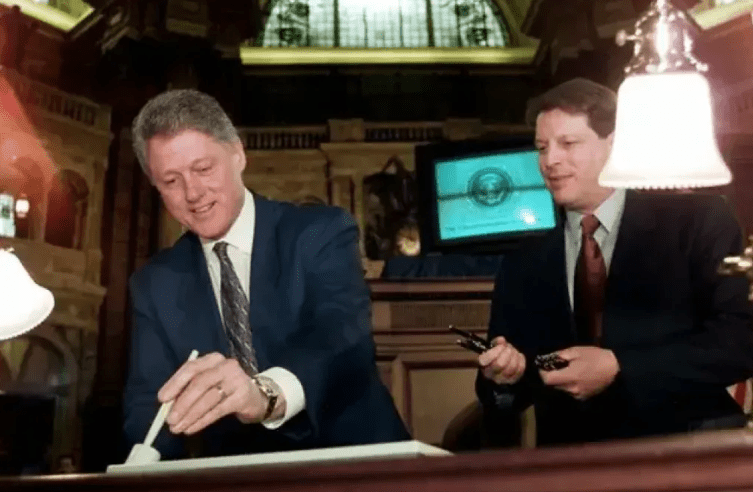
In 1996, under President Bill Clinton, Washington passed what was billed as a modernization miracle: the Telecommunications Act of 1996. It promised competition, innovation, and lower prices in a fast-evolving digital age. Instead, it opened the floodgates for consolidation, allowing a handful of corporations to swallow vast swaths of American media and reshape how information flows across the country.
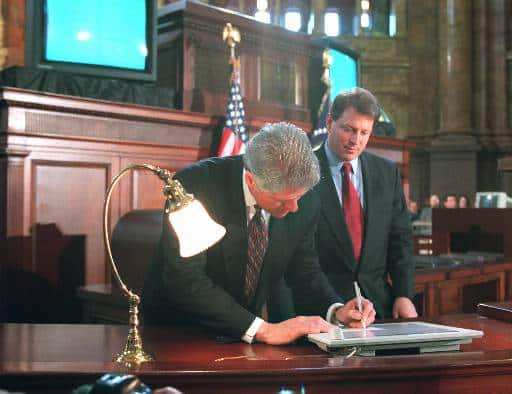
At the time, the internet was still a frontier, cable was expanding, and radio remained a dominant force in local culture. Lawmakers argued that outdated ownership rules were stifling growth. The solution, they said, was deregulation. Backed by a Democratic administration and passed with bipartisan support, the Act loosened or eliminated caps on how many radio stations, TV stations, and media outlets a single company could own.
What followed looked less like a competitive renaissance and more like a feeding frenzy.
Before the law, strict limits kept ownership relatively dispersed. After it passed, companies moved with astonishing speed. Radio chains consolidated almost overnight. Within a few years, Clear Channel Communications grew from owning a few dozen stations to more than 1,200, becoming a near-ubiquitous presence on American airwaves. Local stations that once reflected regional voices were folded into national programming pipelines, their playlists and talk segments increasingly dictated from corporate headquarters.

Television followed a similar trajectory. Ownership caps were relaxed, enabling major networks and conglomerates to expand their reach across markets. Over time, a small cluster of firms came to dominate not just distribution, but content creation itself. News, entertainment, and advertising began to orbit the same corporate centers of gravity.
The logic behind these changes was economic efficiency. Larger companies could scale operations, reduce costs, and compete globally. But that efficiency came with trade-offs. When fewer companies control more outlets, diversity of viewpoint tends to narrow. Local journalism weakens. Independent creators face higher barriers to entry. The marketplace of ideas starts to resemble a gated community.
The Act also accelerated vertical integration, where companies control multiple layers of media production and distribution. A corporation could produce content, own the channels that broadcast it, and control the infrastructure that delivers it to audiences. This level of control transforms media from a competitive landscape into an ecosystem dominated by a few powerful gatekeepers.
Critics argue that this wasn’t an unintended consequence but a predictable outcome of policy shaped by corporate lobbying and political compromise. While Democrats championed the bill as forward-looking reform, they also helped dismantle regulatory safeguards that had been designed to prevent exactly this kind of concentration. The result was a system where scale became the ultimate advantage, and smaller players were either absorbed or pushed aside.
Supporters of the Act counter that it enabled the growth of new technologies and services, laying groundwork for broadband expansion and the modern internet economy. They argue that consolidation was a natural response to technological change, not solely the product of legislation. In their view, the law helped American media companies compete in an increasingly globalized world.
Both perspectives contain elements of truth. The Act did help accelerate technological progress. But it also reshaped the structure of media ownership in ways that concentrated power and reduced competition at the local level.
Three decades later, the consequences are difficult to ignore. A handful of corporations dominate radio, television, film, and large segments of digital media. Local newsrooms have shrunk or vanished. National narratives often drown out community-specific issues. And the promise of a decentralized, competitive media landscape has largely given way to centralized control.
The 1996 Telecommunications Act was sold as a bridge to the future. It did build that bridge, but it also determined who would own the road, collect the tolls, and decide which voices get to travel across it.
In the end, the law didn’t just change media. It changed who gets heard.
—Barrington Williams, B1Daily



 B1Daily
Leave a comment