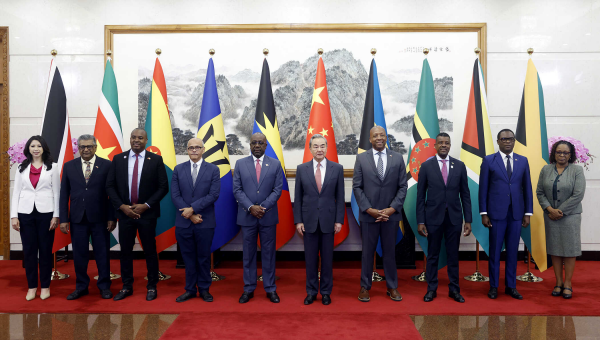
—Michael Lyles, B1Daily
At the core of China’s Caribbean strategy is development finance. Through institutions like the Export-Import Bank of China, billions have been extended across Latin America and the Caribbean, at times surpassing traditional Western lenders in scale.
Between 2019 and 2023 alone, Chinese policy banks issued roughly $1.3 billion annually to the region.
In Barbados, one of the clearest examples is the Sam Lord’s Castle redevelopment, financed by a $170 million Chinese loan with:
- ~2.5% interest
- 20-year maturity
- 5-year grace period
These terms are often marketed as “concessional,” making them attractive to small island economies with limited borrowing options.
But here’s the catch: these loans are frequently tied to Chinese contractors, Chinese labor, and Chinese supply chains.
Infrastructure for Influence
China’s footprint in Barbados alone spans:
- Major tourism infrastructure (Sam Lord’s Castle resort)
- Government office complexes
- Road rehabilitation projects
- Public facilities like gyms and educational expansions
A separate road rehabilitation initiative tied to Chinese financing reached approximately $115–128 million, again executed by a Chinese firm.
This model repeats across the Caribbean:
- Government borrows from China
- Chinese state-owned firms build the project
- Chinese labor is often imported
- Debt repayment stretches decades into the future
It’s a closed-loop economic system where capital rarely circulates locally.
Labor Dynamics: The Displacement Effect
The tension becomes visible on the ground.
At the Sam Lord’s project, nearly 200 Chinese workers were imported, sparking complaints from local contractors who argued they were being undercut or excluded.
Even when agreements mandated local participation (such as a 60/40 split favoring local firms), enforcement remained uneven.
Reports also indicate:
- Wage suppression pressures on local contractors
- Cultural and operational conflicts
- Payment disputes and project friction
The economic implication is straightforward: infrastructure is built, but local multiplier effects are weakened when labor and profits flow outward.
Debt Reality: Dependency or Diversification?
Critics often frame Chinese lending as “debt-trap diplomacy,” but the data complicates that narrative.
In Barbados, Chinese loans account for less than 2.5% of total external debt.
That suggests China is not the dominant creditor. However, its role is strategically concentrated in visible, high-impact sectors like infrastructure and tourism.
Elsewhere in the Caribbean:
- Antigua has taken on $186+ million in Chinese-financed infrastructure, including ports and airports
- Governments often defend these loans as manageable and essential for development
So the question shifts from “ownership” to influence density. China may not hold most of the debt, but it often finances the most visible national assets.
The Belt and Road Blueprint
China’s engagement is not random. It aligns with the broader Belt and Road Initiative, which emphasizes:
- Infrastructure connectivity
- Trade route expansion
- Long-term geopolitical positioning
In small island economies, infrastructure equals leverage. Ports, roads, tourism hubs, and government buildings are not just economic assets; they are strategic anchors.
Social Friction and Cultural Undercurrents
Economic penetration has also produced social tension.
Caribbean observers have raised concerns about:
- Lack of transparency in agreements
- Preference for Chinese labor
- Growing cultural and economic influence
Beyond the Caribbean, similar criticisms have emerged globally, including reports of discrimination against Black populations in Chinese contexts, fueling skepticism about the relationship’s long-term equity.
So, Did China “Buy” the Caribbean?
Not exactly in a literal sense. No deeds were signed over, no flags replaced.
But economically, something more subtle has happened:
- China finances the projects
- China builds the projects
- China sometimes staffs the projects
- Caribbean nations repay the loans over decades
That creates a form of structural dependence without formal ownership.
It’s less like buying a house outright and more like holding the mortgage, supplying the builders, and furnishing the rooms.
Final Analysis
China’s rise in the Caribbean reflects a broader shift in global power: from colonial domination to financial integration. The region is not owned, but it is increasingly interwoven with Chinese capital, labor, and strategy.
For Caribbean nations, the equation remains delicate:
- Access to critical infrastructure vs. long-term financial obligations
- Development speed vs. domestic economic participation
- Sovereignty vs. strategic alignment
The real question isn’t whether China has bought the Caribbean.
It’s whether the Caribbean can leverage China’s presence without becoming economically orbit-bound around it
—Michael Lyles, B1Daily


 B1Daily
Leave a comment