—Travis Luyindama, B1Daily
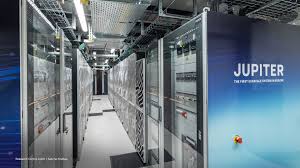
In the quiet industrial corridors of western Germany, something extraordinary hums, not loudly, but with the kind of restrained power that could redraw the map of global AI.
Meet JUPITER supercomputer, Europe’s bold answer to the silicon arms race dominated by the United States and China. But this isn’t just another machine stuffed with chips and ambition. It’s something stranger, sleeker, and more strategic: an AI supercomputer designed to run at planetary scale… while sipping energy like a monk with a solar panel.
A Machine That Thinks in Quintillions
JUPITER belongs to an elite species of machines known as exascale supercomputers. That means it can perform at least one quintillion calculations per second—a number so large it feels fictional until you realize it’s already crunching real-world problems.
To visualize that: imagine every human on Earth doing math nonstop… then multiply their effort by millions. That’s the tempo JUPITER operates at.
Technically, it’s powered by roughly 24,000 advanced AI superchips and a hybrid architecture that fuses high-performance computing with machine learning workloads.
This fusion matters. Older supercomputers were like calculators on steroids. JUPITER is closer to a thinking engine, capable of training massive AI models, simulating entire ecosystems, and modeling reality itself.
Solar Power Meets Supercomputing
Now for the twist that makes this machine truly futuristic.
JUPITER is designed to run on 100% renewable energy, making it one of the most energy-efficient AI systems ever built.
In a world where AI data centers are increasingly criticized for devouring electricity like digital black holes, Germany took a different route:
- Renewable-powered infrastructure
- Advanced liquid cooling systems
- Waste heat recycling to warm buildings
Instead of burning energy, JUPITER recycles it, like a computational ecosystem with no wasted breath.
Even at peak operation, the system consumes around 17–18 megawatts, but does so with industry-leading efficiency measured in performance per watt.
Think of it as a Formula 1 car that runs on sunlight and reuses its exhaust to heat the garage.
The AI Factory Europe Has Been Waiting For
JUPITER isn’t just about speed, it’s about sovereignty.
For years, Europe has lagged behind in AI development. In 2024, the U.S. produced dozens of influential AI models, while Europe produced only a handful.
JUPITER is meant to change that.
Backed by a €500 million investment from Germany and the EU, the system is a cornerstone of Europe’s push to build its own AI ecosystem, less dependent on Silicon Valley or Beijing.
Its mission reads like a sci-fi to-do list:
- Train next-generation large language models
- Build “digital twins” of Earth for climate prediction
- Simulate human brain activity
- Accelerate quantum computing research
- Optimize renewable energy systems
In short, it’s not just computing data, it’s modeling reality at scale.
Architecture: A Two-Brained Giant
JUPITER’s design is modular, almost biological.
It consists of two main components:
- A Booster module packed with GPUs for raw AI horsepower
- A Cluster module designed for complex, data-heavy tasks
Together, they function like a left and right brain, one specializing in speed, the other in depth.
This dual-architecture allows researchers to run everything from neural network training to climate simulations on the same platform, seamlessly.
Why This Matters: The AI Cold War Gets a European Player
Let’s not pretend this is just about science.
JUPITER is geopolitical.
The global AI race has been dominated by the U.S. and China, both pouring billions into compute infrastructure. Europe, until now, has been more of a spectator than a contender.
JUPITER changes that equation.
It gives Europe:
- Strategic computing independence
- A platform for domestic AI innovation
- Leverage in global tech competition
German leadership has been explicit: this is about catching up—and staying in the race.
Here’s the paradox.
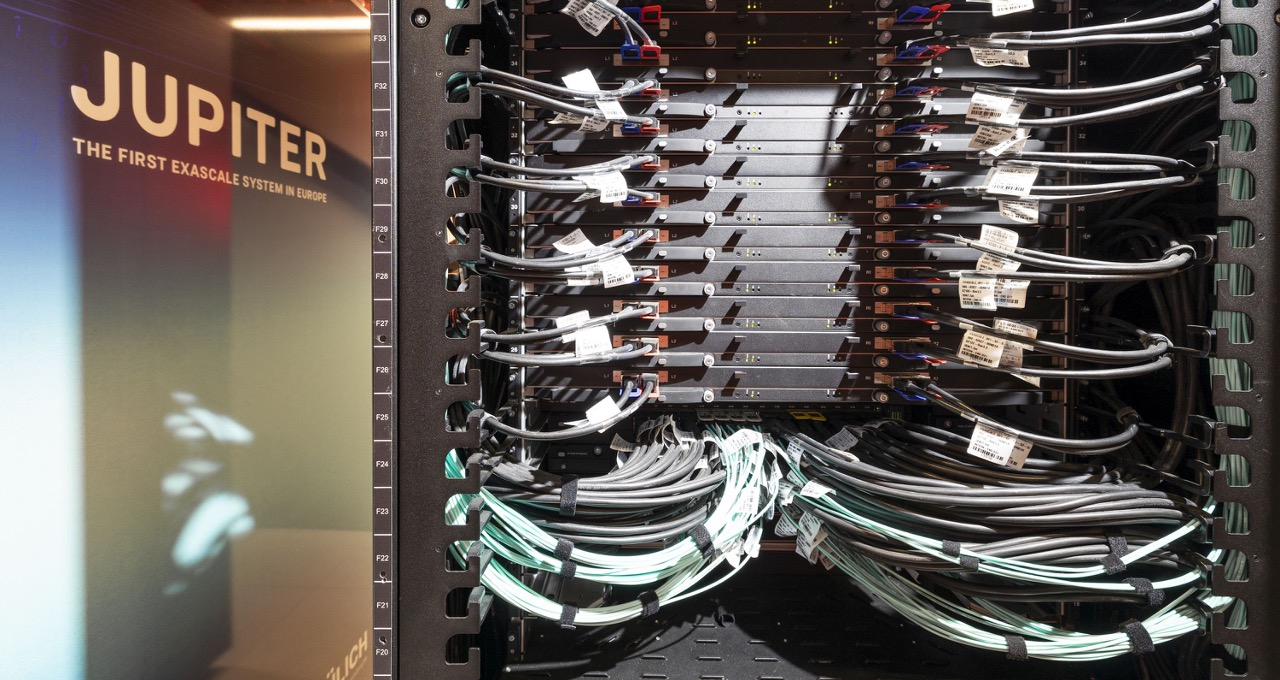
The most powerful machine in Europe doesn’t roar. It hums quietly inside modular containers, cooled by water, powered by renewables, and recycling its own heat.
But inside that quiet hum is something immense:
A system capable of simulating storms before they form, designing materials before they exist, and training AI before the rest of the world catches up.
JUPITER isn’t just a supercomputer.
It’s a signal.
Europe is no longer content to rent intelligence from abroad. It’s building its own, powered not just by silicon, but by sunlight.
—Travis Luyindama, B1Daily



 B1Daily
Leave a comment