
—Michael Lyles, B1Daily
There’s a quiet law of economics that doesn’t care about politics, slogans, or hashtags. It’s as cold and mechanical as gravity:
When supply rises faster than demand, prices fall.
In the labor market, wages are the price.
And for decades, a body of economic research has wrestled with a difficult question: what happens when the supply of low-skilled labor expands rapidly in an economy where Black workers are disproportionately concentrated in that same segment?
The answer, depending on the data set and methodology, ranges from modest effects to measurable displacement. But one thing is clear: the impact is not evenly distributed.
The Supply Shock at the Bottom of the Labor Market
Immigration into the United States has been heavily weighted toward lower-skilled labor markets, particularly in sectors like construction, agriculture, food service, and low-wage service work.
Economists describe this as a labor supply shock.
When a large number of workers enter the same skill bracket, competition intensifies. And according to multiple studies, Black workers—especially low-skilled Black men—have historically been positioned in direct competition with that incoming labor.
A widely cited analysis by economists George Borjas, Jeffrey Grogger, and Gordon Hanson found that:
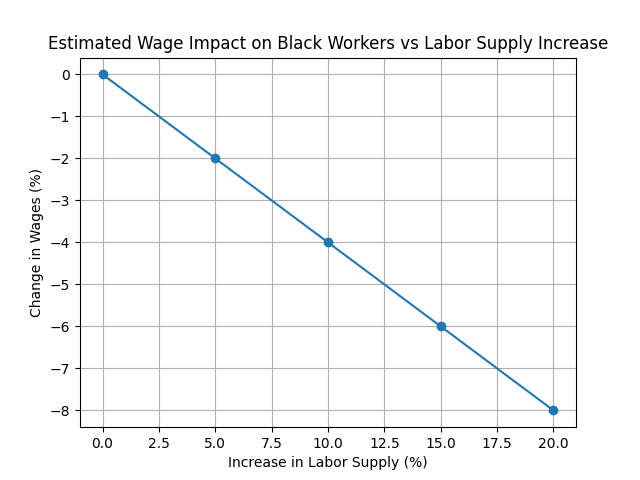
- A 10% increase in labor supply due to immigration reduced Black wages by about 4%
- Black employment rates fell by 3.5 percentage points
- Incarceration rates rose alongside declining employment opportunities
Another version of the same research estimated:
- A 2.5% wage decline for Black workers per 10% labor supply increase
- A 5.9 percentage point drop in employment for Black men
Those are not rounding errors. Those are structural shifts.
Why Black Workers Are Disproportionately Affected
This isn’t random. It’s structural.
Black workers in the U.S. are statistically more likely to be:
- Concentrated in lower-wage occupations
- Impacted by historical barriers to education and capital access
- More vulnerable to labor market fluctuations
So when immigration increases the number of workers in those same categories, the competition isn’t abstract. It’s direct.
Economists call this “substitutability.” If two groups of workers can be easily substituted for one another, an increase in one group puts downward pressure on the other.
And in many low-wage sectors, that substitutability is high.
Historical Evidence: When Immigration Slows, Black Wages Rise
History offers a natural experiment.
During the 1920s, the U.S. imposed strict immigration quotas. The result? A reduction in foreign labor supply.
What followed was one of the most significant internal labor shifts in American history: the Great Migration.
Research shows that:
- Black workers moved into northern labor markets
- They experienced higher wages and improved economic outcomes in areas where immigrant labor declined
In other words, when competition from immigrant labor decreased, Black workers filled the gap—and benefited.
That’s not ideology. That’s observable economic behavior.
The Modern Data: A Divided Research Landscape
Here’s where the story gets complicated.
Not all economists agree on the magnitude—or even the direction—of immigration’s impact.
Some modern studies suggest immigration has small or even positive overall effects on wages:
- One analysis found immigration increased wages of less-educated workers by 1.7% to 2.6% over time
- Another dataset shows cumulative wage gains of 2–3% for workers without a high school diploma since 2000
But these findings come with an important caveat:
They measure average effects across all workers.
Averages smooth out disparities. They don’t eliminate them.
Even studies that find neutral or positive overall effects often acknowledge that specific subgroups—particularly low-skilled, native-born workers—can experience localized wage pressure.
And Black workers are disproportionately represented in that subgroup.
Occupational Crowding and Wage Compression
Another mechanism at play is occupational crowding.
Immigrants often cluster in certain industries. When those industries overlap with sectors where Black workers are already concentrated, wages can compress.
Research during the COVID-era labor market found:
- Immigrant workers were heavily concentrated in frontline, lower-wage jobs
- Black workers were also disproportionately present in these sectors, increasing exposure to labor competition and economic volatility
This creates what economists call a “crowded ladder”—too many workers standing on the same rungs, pushing each other downward.
The Unemployment Gap: A Persistent Vulnerability
Layer this onto an already fragile baseline.
Recent labor data shows:
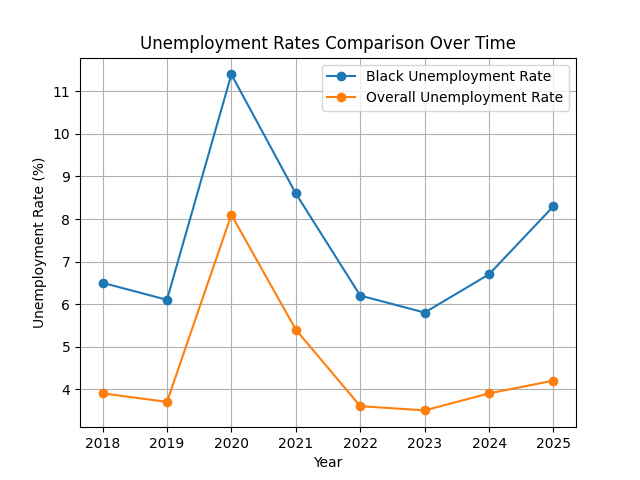
- Black unemployment rates consistently exceed national averages
- In late 2025, Black unemployment reached 8.3%, significantly higher than overall levels
This matters because when competition increases, the most vulnerable workers are usually the first to be displaced.
In economic terms, they are the “marginal workers”—the ones closest to the edge of the labor market.
The Counterargument: Complementarity vs Competition
To be fair, there’s a competing school of thought.
Many economists argue that immigrants and native-born workers don’t compete directly. Instead, they specialize in different roles:
- Immigrants fill manual or lower-wage positions
- Native-born workers move into higher-paying supervisory roles
This complementarity effect can increase productivity and even raise wages over time
But here’s the tension:
That upward mobility assumption doesn’t always hold for Black workers, who often face structural barriers that limit occupational mobility.
So while complementarity may benefit the broader economy, its gains are not always evenly distributed.
The Bottom Line: Distribution, Not Just Growth
The economic debate over immigration isn’t really about whether it grows the economy.
It often does.
The real question is who benefits—and who absorbs the cost.
The data shows:
- Immigration can increase overall economic output
- It can modestly raise average wages
- But it can also depress wages and employment for specific vulnerable groups, including low-skilled Black workers
That’s not a contradiction. It’s a distributional reality.
Think of the labor market like a crowded subway platform.
When more passengers arrive, the system doesn’t collapse. The train still runs.
But the people already standing closest to the edge feel the pressure first.
For many Black workers in America’s low-wage economy, that edge has always been closer than it should be.
—Michael Lyles, B1Daily



 B1Daily
Leave a comment