—Barrington Williams, B1Daily
By any honest reading, the Fourteenth Amendment to the United States Constitution was forged in the fire of emancipation, not drafted as a catch-all mechanism for modern immigration disputes. Yet today, it’s routinely invoked as if the architects of Reconstruction had future border crises in mind. That interpretation isn’t just historically thin, it stretches the text, context, and intent of the Amendment well beyond its legal spine.
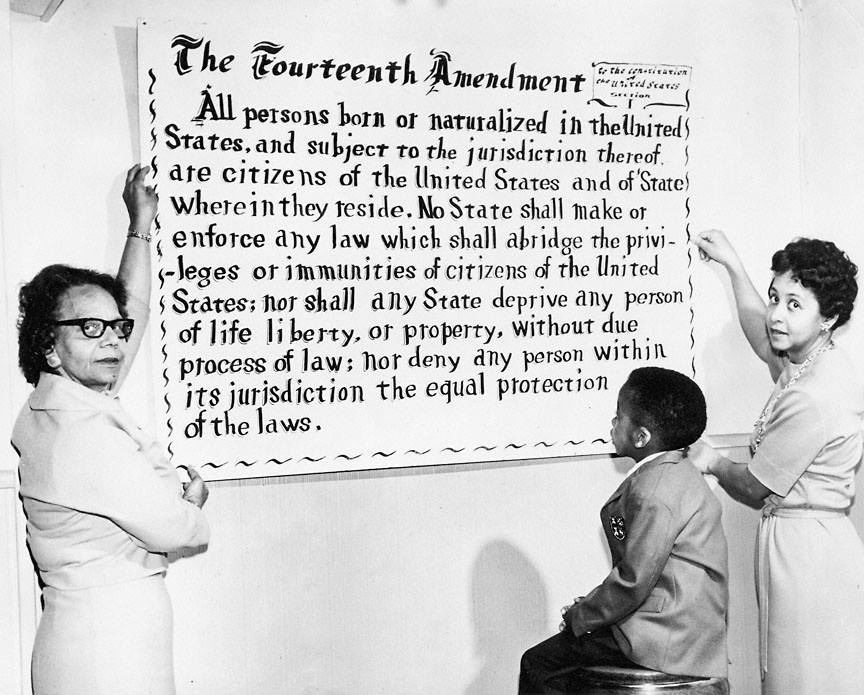
Let’s start with the language itself: “All persons born or naturalized in the United States, and subject to the jurisdiction thereof, are citizens…” That last clause, subject to the jurisdiction thereof, is doing heavy lifting. It wasn’t decorative. It was deliberate.
The Amendment emerged in 1868 as a direct response to Dred Scott v. Sandford, which infamously declared that Black Americans could not be citizens. Congress, led by figures like John Bingham and Jacob Howard, sought to constitutionalize citizenship for formerly enslaved people, freedmen who had been born on American soil yet denied legal recognition.
Howard himself clarified the jurisdiction clause on the Senate floor, stating it excluded those who owed allegiance to another sovereign, such as foreign diplomats or members of sovereign tribal nations at the time. The key idea was complete political allegiance. The framers weren’t merely concerned with geography; they were concerned with loyalty and legal subjection.
That’s where the modern debate sharpens.
Proponents of birthright citizenship for the children of undocumented immigrants argue that anyone born on U.S. soil automatically satisfies the jurisdiction requirement. They often cite United States v. Wong Kim Ark, where the Court affirmed citizenship for a man born in San Francisco to Chinese parents who were legally residing in the U.S. But that case hinged on lawful, permanent domicile, not unlawful presence.
That distinction matters. The Court in Wong Kim Ark repeatedly emphasized the parents’ legal status and their established residence under U.S. law. It did not squarely address children born to individuals who entered or remained in the country in violation of federal immigration statutes. In other words, it answered a narrower question than today’s policy debate suggests.
Previous rulings did not squarely address children born to individuals who entered or remained in the country illegally.
Critics of expansive birthright interpretations argue that individuals who are in the country unlawfully have not fully submitted to U.S. jurisdiction in the constitutional sense. They are physically present, yes, but their legal relationship to the state is contested, incomplete, and often temporary. The framers’ use of “jurisdiction” arguably implies more than mere presence; it implies lawful authority and reciprocal obligation.
There’s also the structural argument. Immigration policy, under Article I of the Constitution, is vested in Congress. If the 14th Amendment is interpreted to grant automatic citizenship to anyone born on U.S. soil regardless of parental status, it effectively overrides congressional authority by constitutional default. That creates a policy outcome the framers of Reconstruction never debated and likely never envisioned.
None of this is to say the issue is simple or that courts have definitively closed the door on broader interpretations. They haven’t. But the historical record leans heavily in one direction: the 14th Amendment was a corrective instrument aimed at a specific injustice; the exclusion of freed Black Americans from citizenship, not a universal doctrine designed to govern future immigration patterns.
The 14th Amendment was a corrective instrument aimed at a specific injustice, not a universal doctrine designed to govern future immigration patterns.
To treat it otherwise is to retrofit a 19th-century guarantee into a 21st-century policy tool, bypassing the legislative process in favor of constitutional improvisation.
The question, then, isn’t whether birthright citizenship should exist in its current form. Reasonable people can disagree on that. The question is whether the 14th Amendment, as originally understood, compels that outcome.
History suggests it does not.
—Barrington Williams, B1Daily




 B1Daily
Leave a comment