—Kel McKnight, B1Daily
There are moments in geek culture when you can feel the timeline shift. Not explode. Not reboot. Just… tilt slightly, like a pinball table nudged at the exact right second.
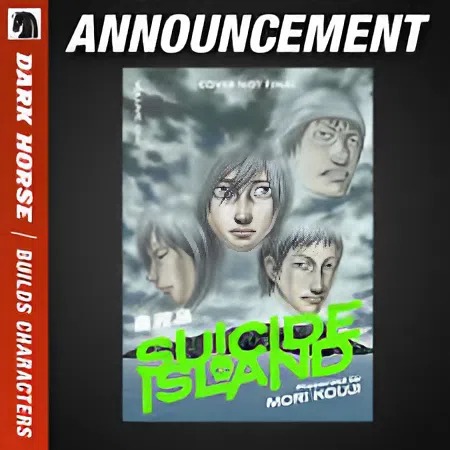
This week, Dark Horse Comics gave that table a shove by licensing four wildly different manga titles for English release, headlined by Suicide Island, and if you’re even mildly invested in the manga ecosystem, you should be paying attention.
Because this isn’t just a pickup. It’s a party composition.
Suicide Island (Yes, It Hits That Hard)
Let’s start with the heavy hitter.
Suicide Island isn’t here to entertain you in the traditional sense. It’s here to sit you down, dim the lights, and ask uncomfortable questions about survival, purpose, and whether humanity is a feature or a bug.
Created by Kouji Mori, the story drops a group of suicide survivors onto a remote island and basically says: “Congrats, you’re alive. Now what?”
No power-ups. No chosen one arc. Just raw, psychological endurance.
This is the kind of manga that doesn’t just live on your shelf, it stares at you from it.
And Dark Horse choosing this as the flagship title? That’s not safe. That’s deliberate.
Asobi Asobase
Then, like a perfectly timed critical fail, we get Asobi Asobase.
If Suicide Island is existential dread, Asobi Asobase is pure chaotic energy bottled and weaponized. It starts as a cute school comedy and then mutates into something that feels like your group chat at 2 a.m. after too much caffeine and zero supervision.
The faces alone deserve their own museum exhibit.
Dark Horse releasing this in omnibus form is basically them saying: “We trust you to handle the madness.”
I respect that.
Babanba Banban Vampire
Now we get weird. Not regular weird. Manga weird.
Babanba Banban Vampire reads like someone spun three genre wheels, supernatural, comedy, and Boys’ Love, and decided to just… not stop spinning.
A centuries-old vampire trying to “preserve” a teenager’s purity for future feeding? That’s not a pitch, that’s a dare.
And yet, this is exactly the kind of title that thrives in today’s fandom ecosystem. It’s memeable, discussable, and just unhinged enough to stick.
Every good lineup needs a wildcard. This is it.
Forget-Me-Not
Finally, we get the stealth pick: Forget-Me-Not.
Set in Venice and dripping with atmosphere, this one trades chaos for craft. It’s a detective story that moves like jazz, smooth, deliberate, and occasionally unpredictable.
Created by Kenji Tsuruta, it’s the kind of manga you read with a cup of coffee instead of an energy drink.
Every party needs a rogue. Quiet. Precise. Probably carrying the whole mission while everyone else is setting things on fire.
This Isn’t Random, It’s Strategy
Here’s where the inner geek starts connecting the dots like a conspiracy theorist with a corkboard.
Dark Horse didn’t just scoop up four random titles like a kid grabbing candy in a checkout line, they assembled a balanced roster with intention.
You’ve got psychological survival dragging readers into the deep end, absurdist comedy detonating tonal expectations, a genre-chaos supernatural pick that refuses to sit still, and an atmospheric mystery that slows everything down to a cool, calculated simmer.
It mirrors how modern manga fans actually consume content. We don’t just read one genre anymore, we bounce between emotional damage, unhinged humor, and slow-burn storytelling like it’s a curated playlist.
Dark Horse gets that.
Why This Actually Matters
For years, the manga scene in the West has been dominated by the same gravitational giants, battle shonen, big-name franchises, rinse and repeat.
This move feels different.
It’s riskier. More eclectic. A little more… confident.
It says: “The audience has leveled up. Let’s give them something worth their XP.”
And maybe that’s the real story here.
Not just that Suicide Island is finally getting a wider release. Not just that Asobi Asobase is about to melt new brains. Not just that we’re getting vampires with questionable life choices and Venetian detectives with impeccable vibes.
It’s that a major publisher is betting on range instead of repetition.
If manga publishing were an RPG, this lineup wouldn’t be min-maxed.
It would be fun.
And honestly? That’s the build that usually wins.
—Kel McKnight, B1Daily

 B1Daily
Leave a comment