—Kerry Hill, B1Daily
There’s a version of theft in New York that doesn’t bother with breaking doors. It doesn’t need crowbars or getaway cars. It uses ink, timing, and a system that’s a little too trusting of stamped documents. By the time anyone realizes what happened, the house is gone—legally, on paper—and the real owner is left fighting to prove they exist in a file that’s already been rewritten.
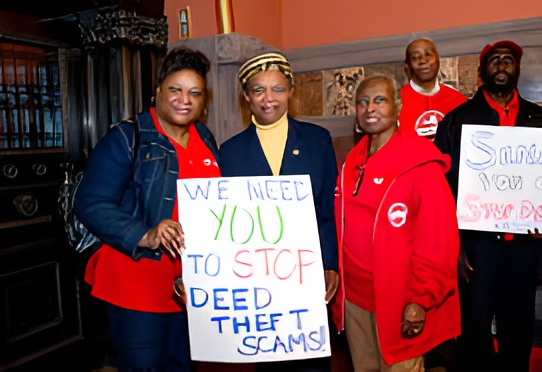
This is deed theft. And it’s not creeping through the city—it’s moving with purpose.
Officials, including the New York State Attorney General’s Office, have been flagging the trend for years. The pattern is consistent: scammers forge documents, file them through legitimate channels, and quietly transfer ownership of homes they never paid for. No dramatic showdown. Just a bureaucratic ambush.
And the fallout? People losing homes they’ve owned for decades. Families getting blindsided by eviction notices from strangers. Elderly homeowners watching their life’s biggest asset vanish into a stack of fraudulent paperwork.
If this sounds surreal, it should. But it’s happening in one of the most regulated real estate markets in the country.
The mechanics are almost offensively simple. A bad actor forges a deed, often routing it through a shell company to muddy the trail. The paperwork gets filed. The system processes it. Suddenly, the “new owner” appears—sometimes renting out the property, sometimes attempting to sell it, always acting with the confidence of someone holding official documents.
Meanwhile, the actual owner is stuck in legal quicksand.
And here’s where the story stops being just about fraud and starts looking like a pattern.
The targets aren’t random. They rarely are in schemes like this. Many victims are older homeowners, people who’ve held property for decades, often passed down through families. Others live in neighborhoods where property values have exploded, turning once-overlooked homes into high-stakes assets overnight.
Think places like Harlem or Bedford-Stuyvesant—communities that have long histories and, more recently, rapidly rising real estate prices. That combination makes them attractive not just to developers, but to fraudsters looking for high reward with minimal resistance.
The racial dimension isn’t always spelled out in the crime itself. Nobody files a deed that says “this is racially motivated.” But outcomes tell their own story. Black homeowners are disproportionately represented among victims, not by coincidence, but by structure—historical, economic, and geographic.
For generations, homeownership has been one of the few reliable ways Black families in America could build and pass down wealth. That didn’t come easy. It came through navigating redlining, discriminatory lending, and housing policies that were designed to exclude.
Now, in a twist that feels almost too on-the-nose, that same wealth is being stripped away not through denial—but through deception.
And the system, for all its paperwork and procedures, hasn’t been fast enough to stop it.
Lawmakers in New York have started tightening the screws. Deed theft is now treated as a serious felony, giving prosecutors more leverage. There are efforts to strengthen verification processes and give homeowners more tools to challenge fraudulent filings.
But legislation tends to move at the speed of committees. Fraud moves at the speed of opportunity.
That gap matters.
Because for every case that gets prosecuted, there are others still tangled in court. Cases where the rightful owner is spending years and money trying to reclaim what should have never been taken. Cases where the stress alone is enough to force people out before the legal system catches up.
The deeper issue here isn’t just that deed theft exists. It’s that it exploits a fundamental assumption: that official records reflect reality.
When that assumption breaks, everything else wobbles with it.
Property ownership is supposed to be one of the most stable forms of security in America. A fixed point. A guarantee. When that guarantee can be rewritten with forged documents and a filing fee, it stops being security and starts being a risk.
And right now, that risk is landing hardest on people who already had the most to lose.
No broken windows. No alarms.
Just a signature you didn’t write and a system that believed it anyway.
—Kerry Hill, B1Daily



 B1Daily
Leave a comment