—Barrington Williams, B1Daily
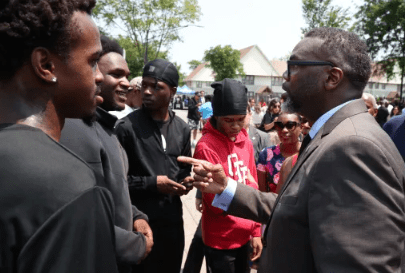
In a South Side barbershop where politics is dissected as sharply as fresh lineups, the conversation turned, again, to Brandon Johnson. The tone wasn’t furious. It was something arguably more dangerous for any elected official: disappointed.
“We thought he was going to be different,” said Marcus Reed, a 42-year-old small business owner, shaking his head as the clippers buzzed in the background. “It’s not just about talk. It’s about follow-through. And right now, I’m not seeing it.”
Across Chicago, similar sentiments are surfacing in living rooms, church basements, and community meetings. Interviews with residents from different neighborhoods reveal a pattern of unease, not tied to a single policy, but to a broader sense that campaign promises are colliding with governing realities.
For some Black voters, the frustration cuts particularly deep.
“He came into our neighborhoods, looked us in the eye, and talked about real investment, real change, even reparations conversations,” said Denise Holloway, a retired school administrator on the West Side. “Now it feels like that energy has shifted somewhere else. I’m not saying nothing’s happening, but it’s not what was promised.”
Johnson’s approach to the city’s migrant response has also become a flashpoint. While some residents support the humanitarian effort, others question whether the balance is right.
“I’m not against helping people,” said Luis Martinez, a logistics worker in Pilsen. “But I am asking, what about the people who’ve been here struggling for years? It feels like we’re being asked to wait again.”
That sense of “waiting” comes up repeatedly.
At a community meeting in Englewood, a younger resident, 28-year-old Jamal Carter, put it bluntly: “We’ve heard plans, we’ve heard intentions. But we need results. People are tired of timelines. They want to see change they can actually point to.”
The concerns aren’t limited to policy priorities. Questions about political alliances and campaign financing have also begun to filter into public conversations, particularly among voters who expected a clean break from traditional political dynamics.
“He talked about being for the people,” said Angela Brooks, a healthcare worker on the South Side. “So when you hear about ties to lobbyists, it makes you pause. You start wondering how much influence regular people really have.”
City Hall allies of Brandon Johnson argue that the criticism overlooks the complexity of governing a city like Chicago. They point to budget constraints, inherited challenges, and the need to address multiple crises at once. In their view, progress is happening, just not at the pace some had hoped for.
But in neighborhoods where expectations were set high, patience appears to be thinning.
“It’s not that people have given up,” said Reed, back in the barbershop. “It’s that they’re paying closer attention now. And they’re asking harder questions.”
That shift, from hope to scrutiny, is a familiar arc in urban politics. The difference for Johnson is how quickly it seems to be unfolding, and how personal it feels for many of the voters who helped elevate him to office.
Because in Chicago, support isn’t just about ideology. It’s about delivery. And as the conversations happening across the city suggest, the verdict on this mayoralty is still being written, one conversation at a time.
—Barrington Williams, B1Daily
 B1Daily
Leave a comment