—Michael Lyles, B1Daily
There’s a eery silence in small-town America.
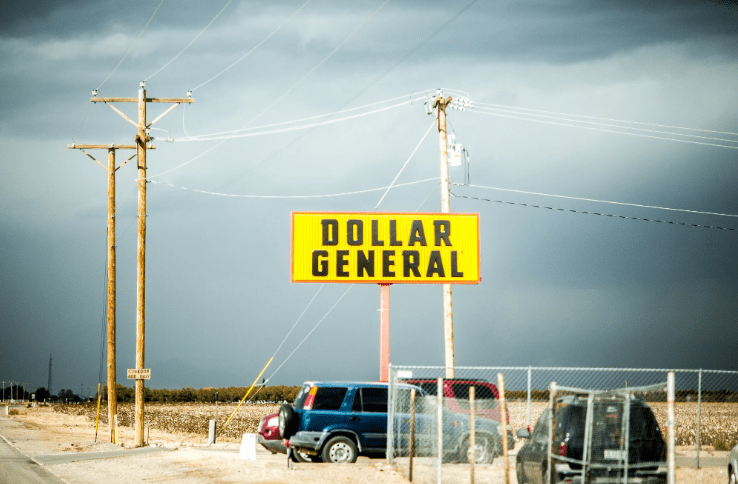
It hums between shuttered grocery stores and hollowed-out main streets, where opportunity packed its bags years ago and never sent a postcard back. Into that quiet vacuum marches Dollar General, planting bright yellow signs like flags of convenience. To some, it looks like salvation. To others paying close attention, it’s something closer to extraction.
Dollar General has built an empire not by chasing booming cities, but by strategically embedding itself in economically strained rural communities. These are places where big-box competitors never bothered to show up, where local grocers folded under pressure, and where residents often lack the luxury of choice. When Dollar General arrives, it doesn’t compete in a crowded marketplace. It becomes the marketplace.
And that’s where the illusion begins.
At first glance, everything screams affordability. Handwritten-style price tags, bold yellow labels, and “$1” messaging create a psychological shortcut. Customers assume they’re saving money. But a closer look reveals a different story unfolding in the fine print and shelf math. Unit pricing often tells a harsher truth: smaller package sizes sold at deceptively low sticker prices frequently cost more per ounce than larger alternatives found in traditional supermarkets, if those supermarkets are even within driving distance.
In other words, customers aren’t always saving. They’re spending less per trip, sure, but often paying more over time. It’s a retail sleight of hand, dressed up as accessibility.
For residents in these towns, the issue isn’t just pricing. It’s dependency. When Dollar General saturates an area, it can crowd out the possibility of full-service grocery stores returning. Why would a regional chain invest in a town already blanketed with discount outlets offering just enough to survive but never enough to thrive? Fresh produce becomes scarce. Healthy options shrink. Communities are left with aisles of processed goods and the creeping consequences that follow.
Then there’s the labor equation. Dollar General stores are often staffed with minimal employees, sometimes just one or two workers running the entire operation. It keeps costs low for the company, but it creates stressful, under-resourced working conditions. For towns already struggling with limited job opportunities, this isn’t economic revitalization. It’s economic maintenance at the bare minimum.
Critics argue that the company’s rapid expansion strategy resembles a modern form of retail colonization. Not with armies or banners, but with leases and logistics. The pattern repeats itself across the country: enter underserved area, dominate retail landscape, extract steady profit from a captive customer base, and move on to the next vulnerable zip code.
Dollar General, for its part, maintains that it provides essential access to goods in communities that would otherwise have none. And that’s not entirely wrong. The stores do fill a gap. The problem is that filling a gap is not the same as solving the underlying problem that created it.
Because what’s really happening in small-town America isn’t just a retail shift. It’s a restructuring of how poverty is monetized. Convenience is being sold at a premium, disguised as a bargain. And the people footing the bill are the ones with the fewest alternatives.
The yellow sign glows bright against the rural landscape, promising simplicity. But behind it sits a complex equation, one where the house always wins, and the town quietly keeps paying.
—Michael Lyles, B1Daily


 B1Daily
Leave a comment