—Kel McKnight, B1Daily
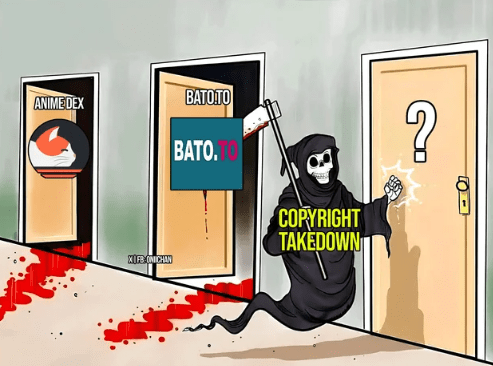
By the time the legal notices hit, it always feels like the opening scene of a high-stakes anime arc. Silent. Sudden. A whole library disappears overnight, like someone whispered a forbidden spell and poof, the panels are gone.
Across the globe, fans wake up mid-binge, mid-cliffhanger, mid-emotional breakdown, only to find their gateway to the medium wiped clean.
This is the ongoing saga of manga piracy crackdowns, a conflict that pits publishers and legal enforcers against the very communities that helped turn manga and anime into a worldwide cultural supernova. And while the official narrative frames it as a righteous battle against theft, the reality reads more like a morally gray arc straight out of Attack on Titan, where the lines between hero and antagonist blur the closer you look.
Let’s not pretend piracy is some noble, untouchable force. It isn’t.
But targeting scanlation sites without addressing the vacuum they fill is like blaming the river for flowing when you’ve dammed every other source of water. For millions of international fans, especially outside Japan, these sites are not just convenient. They’re essential.
Manga, unlike its anime counterpart, still suffers from a staggered global release system that feels like it’s stuck in a time loop. While anime episodes can drop worldwide through platforms like Crunchyroll, manga chapters often arrive late, inconsistently, or not at all in certain regions. Entire series remain untranslated officially, locked behind language barriers like secret boss fights nobody gave you the key to.
So what do fans do? They adapt. They find scanlation sites, communities of translators and editors who operate less like criminals and more like rogue guilds, piecing together stories so the rest of the world can experience them. It’s messy, unofficial, and legally shaky, sure. But it’s also passionate, grassroots, and deeply tied to the global explosion of manga fandom.
Take a series like One Piece. Its worldwide dominance didn’t happen in a vacuum. Years before simultaneous releases became standard practice, scanlations were the engine keeping international hype alive. Fans weren’t just reading. They were theorizing, discussing, building communities that stretched across continents like a digital Grand Line.
Now imagine pulling that away without replacing it.
That’s the core issue. When authorities shut down these sites, they aren’t just removing pirated content. They’re cutting off access. Legal alternatives exist, yes, but they’re often fragmented, incomplete, or region-locked. It’s like being told to support the official release while being handed a puzzle with half the pieces missing.
And here’s where the frustration mutates into something louder.
Fans aren’t asking to steal. They’re asking to participate. To be part of the story at the same time as everyone else. To not feel like second-class viewers in a medium they love just because of geography. When the system fails to deliver that, piracy doesn’t just appear. It thrives.
Targeting manga sites without fixing accessibility is like trying to defeat the final boss without leveling up your own party. It looks decisive on the surface, but underneath, it’s strategy without foresight. The demand doesn’t disappear. It just relocates, reshapes, and comes back harder to track.
If the goal is to truly combat piracy, the answer isn’t just enforcement. It’s evolution. Faster global releases. Wider translation efforts. Affordable, accessible platforms that meet fans where they are instead of scolding them for showing up through the wrong door.
Until then, this “war” will keep playing out like an endless shonen arc, full of dramatic takedowns and inevitable comebacks. And somewhere, in the quiet aftermath of another site going dark, a fan will still be searching, still refreshing, still chasing that next chapter like it’s the final page of their favorite story.
Because for them, it isn’t just content.
It’s connection.
—Kel McKnight, B1Daily

 B1Daily
Leave a comment