
—Kerry Hill, B1Daily
Georgia’s political landscape just delivered a result that feels like a warning flare shot into the sky, bright, loud, and impossible to ignore. The congressional seat once held by Marjorie Taylor Greene didn’t flip parties, but the ground beneath it shifted in a way that has both Democrats energized and Republicans quietly uneasy.
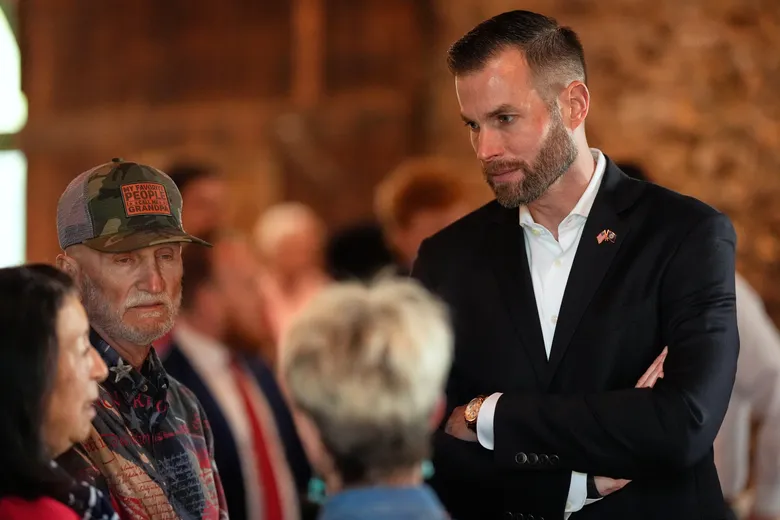
After Greene’s resignation in early 2026, a special election turned her deep-red 14th District into a national spectacle. Republicans rallied behind Clay Fuller, a Trump-endorsed candidate, while Democrats coalesced around Shawn Harris, a retired Army general who had already run in the district before. On paper, this wasn’t supposed to be close. This is Trump country, a district that had delivered massive margins for Republicans just two years prior.
And yet, when the votes were counted, the story wasn’t dominance, it was erosion.
Fuller ultimately held the seat for the GOP, winning the runoff and keeping the district in Republican hands. But the margin shrank dramatically, with Harris cutting the Republican advantage down to roughly the low double digits, a stunning shift compared to the blowout results of previous cycles.
In politics, margins are like cracks in a dam. One or two doesn’t mean collapse. But when they start spreading across elections, cycles, and regions, people start watching the waterline.
The deeper shock came earlier in the process. In the initial round of voting, Harris actually led the field, benefiting from a fractured Republican vote and a surge of Democratic turnout. That moment alone signaled something unusual: a Democrat briefly outpacing the GOP in one of the most conservative districts in the state.
Even in defeat, Harris’s performance is being read as a proof of concept. Democrats aren’t just competing in swing districts anymore, they’re probing deep-red territory, testing whether frustration over national issues like inflation and foreign policy can crack open seats that once felt permanently locked.
For Republicans, the result is a mixed bag. On one hand, they kept the seat and slightly boosted their already narrow House majority. On the other, the shrinking margin is a flashing indicator that the coalition holding these districts together may not be as solid as it once appeared.
And looming over all of it is the gravitational pull of Donald Trump. His endorsement helped push Fuller across the finish line, reinforcing his continued influence within the party. But the underperformance compared to past elections raises a more complicated question: is that influence still expanding, or is it starting to plateau?
Georgia, once a reliably red stronghold, has been slowly morphing into one of the most unpredictable political battlegrounds in America. From presidential races to Senate runoffs to now this special election, the state keeps sending the same message in different dialects: nothing here is guaranteed anymore.
The seat didn’t change hands this time. But the energy around it did. And in politics, energy is often the first domino.
With a full election looming later in 2026, both parties are already gearing up for a rematch. Republicans will try to reassert dominance. Democrats will try to finish what they started.
Because if this race proved anything, it’s that even the safest seats can start to feel… a little less safe.
—Kerry Hill, B1Daily



 B1Daily
Leave a comment