—Kerry Hill, B1Daily
The conversation around reparations has always been charged, emotional, and politically volatile, but beneath the noise sits a fundamental question that rarely gets addressed with precision: who, exactly, should receive them?
Too often, the debate gets flattened into a vague, global concept of “Africa” versus “the West,” as if the legacy of slavery were evenly distributed across continents. It wasn’t. The system of chattel slavery that defined the Transatlantic Slave Trade created a very specific lineage of harm, one rooted not just in displacement, but in generations of legally enforced dehumanization across the Americas.
That distinction matters.
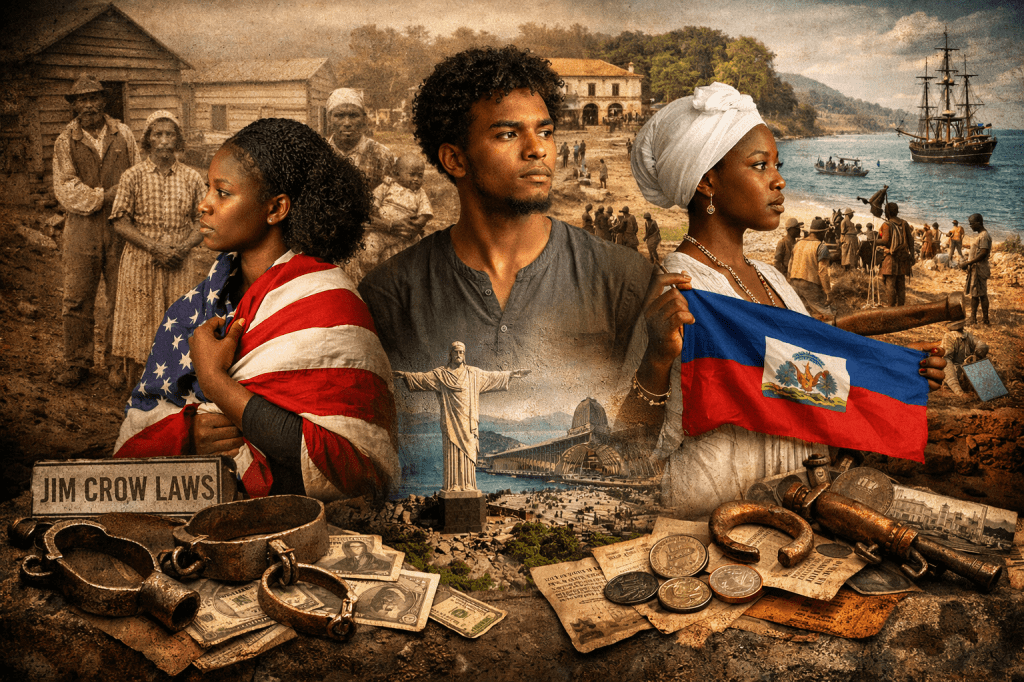
Descendants of enslaved people in the United States, Brazil, the Caribbean, and other parts of the Americas didn’t just experience slavery as an event, they inherited its aftermath as a system. Jim Crow laws, segregation, redlining, disenfranchisement, and structural economic exclusion didn’t occur in isolation. They were extensions of slavery’s original design, ensuring that the economic and social disadvantages persisted long after emancipation.
In places like the United States, this lineage is traceable. Families can point to ancestors who were enslaved on American soil and then subjected to a century of legalized discrimination afterward. The harm is not abstract. It is documented, generational, and embedded in wealth gaps, housing disparities, and institutional access.
In South America and the Caribbean, the pattern echoes with local variations. Countries like Brazil, Jamaica, and Haiti carry the demographic and economic imprint of plantation economies that relied on enslaved labor. The descendants of those systems still navigate the inequalities those structures produced.
This is where the reparations argument becomes more focused: if reparations are meant to address specific historical harm, then they must be directed toward those who directly inherited that harm in a continuous line.
That brings in a more uncomfortable layer of the conversation, the role of certain African polities and intermediaries during the slave trade itself. Historical records show that some African kingdoms and traders participated in the capture and sale of enslaved people to European powers. This does not equate their role with that of the transatlantic system’s architects, but it complicates the narrative of a single-directional injustice.
For critics of broad, undifferentiated reparations frameworks, this history reinforces the idea that reparations should not be distributed based on continental identity, but on lineage and lived historical consequence. The argument is not about denying Africa’s exploitation under colonialism, which is a separate and significant issue, but about maintaining clarity in what reparations are meant to repair.
Reparations, in this framing, are not a global payout. They are a targeted redress.
The argument is not about denying Africa’s exploitation under colonialism, which is a separate and significant issue, but about maintaining clarity in what reparations are meant to repair.
That means prioritizing descendants of enslaved people in the Americas, those whose ancestors were subjected to chattel slavery and whose families remained within systems that extended that oppression for generations. It also means acknowledging that the economic benefits extracted from that labor were concentrated in Western nations, which bear primary responsibility for addressing the legacy.
Opponents of this narrower approach argue that the global African diaspora is interconnected and that colonial exploitation across Africa and the Caribbean is part of the same historical continuum. They warn that drawing lines between groups risks fragmenting solidarity and oversimplifying a deeply entangled history.
But supporters counter that without specificity, reparations risk becoming symbolic rather than material. If everyone is included, then the direct descendants of slavery, those with the clearest historical claim, may see the least tangible benefit.
Without specificity, reparations risk becoming symbolic rather than material.
At its core, this debate is about precision versus generalization.
If reparations are meant to function as justice, not just acknowledgment, then they must answer a simple question with clarity: who was harmed, how were they harmed, and who inherited that harm?
Until that question is answered with specificity, the conversation will continue to circle itself, broad in scope, but blurred at the edges.
—Kerry Hill, B1Daily



 B1Daily
Leave a comment