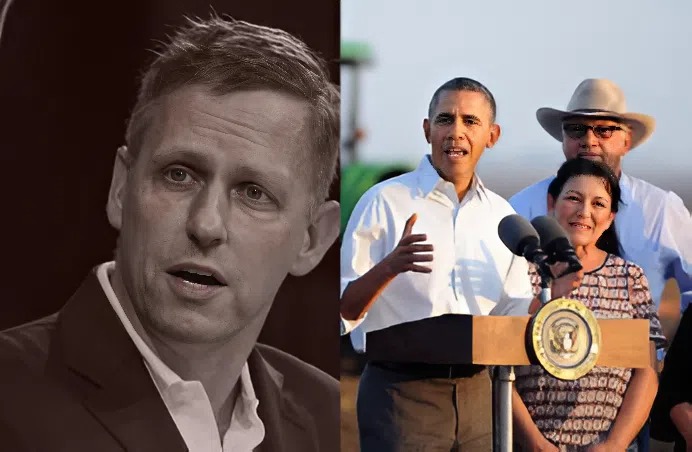
—Michael Lyles, B1Daily
The narrative of Silicon Valley as a meritocratic utopia obscures the role of government intervention in shaping fortunes like Peter Thiel’s. A closer examination reveals that Thiel’s rise and the broader tech oligarchy, was enabled by Obama-era tax breaks, corporate bailouts, and regulatory loopholes, all subsidized by working-class taxpayers. This article dissects the mechanisms behind this wealth transfer, grounded in economic data, policy analysis, and corporate financial disclosures.
1. The Tax Break Bonanza: Carried Interest Loophole & QSBS
Thiel’s wealth derives disproportionately from preferential tax treatment. Two policies were pivotal:
– Carried Interest Loophole: Private equity and venture capitalists (including Thiel’s Founders Fund) pay a 20% capital gains rate on profits instead of ordinary income rates (up to 37%). Obama’s 2010 tax deal extended this loophole, saving Thiel hundreds of millions.
– Qualified Small Business Stock (QSBS) Exemption Under Section 1202 of the tax code, investors in startups (like Thiel’s early Facebook stake) can exclude 100% of capital gains up to $10 million. Obama expanded this in 2010, allowing Thiel to shield billions from taxation.
Impact: Thiel’s estimated $5.2B Facebook windfall was largely tax-free, while median households paid higher effective rates than him and many other billionaires.
- Corporate Bailouts & Cheap Debt
The 2008 financial crisis saw Obama’s Treasury Department funnel trillions in bailouts and quantitative easing (QE) to Wall Street. Thiel capitalized on this:
– Zero-Interest Debt: Post-recession, the Fed suppressed rates to near-zero until 2015. Thiel’s Palantir and other ventures borrowed cheaply, inflating asset values while wages stagnated.
– TARP & Bank Subsidies: Banks bailed out by taxpayers (e.g., Goldman Sachs) became Thiel’s biggest investors. Goldman’s 2015 injection into Palantir ($880M) was indirectly subsidized by public liquidity.
Data Point: From 2009–2016, S&P 500 firms (including Thiel’s portfolio) spent $3.5 trillion on stock buybacks, a direct result of cheap debt, while worker wages grew just 2.1% annually.
3. Privatized Gains, Socialized Losses
Thiel’s companies relied on public infrastructure while avoiding taxes:
– Palantir’s Government Contracts: 75% of Palantir’s 2020 revenue came from taxpayers via defense/intel contracts ($2.6B total). Yet Palantir used offshore tax havens (Cayman Islands) to avoid U.S. taxes.
– Facebook’s Data Monopoly: Thiel’s early Facebook stake benefited from unregulated data extraction, a de facto public subsidy, as users (taxpayers) generated value without compensation.
The Rigged System
Thiel’s fortune wasn’t built on innovation alone but on policy choices that socialized risk and privatized rewards. Obama’s reforms—framed as “recovery” which accelerated wealth concentration. The working class, meanwhile, bore the cost through austerity, wage stagnation, and eroded public services.
Sources used in this article include IRS tax code analyses (Section 1202), Fed balance sheet data, Palantir SEC filings, Congressional Budget Office reports.
—Michael Lyles, B1Daily



 B1Daily
Leave a comment