—Michael Lyles, B1Daily
When global music star Akon announced plans for a futuristic metropolis in West Africa, the proposal captured imaginations across the continent and beyond. The project, known as Akon City, was marketed as a revolutionary smart city that would transform economic opportunity in Senegal and serve as a symbol of African innovation and self-determination.
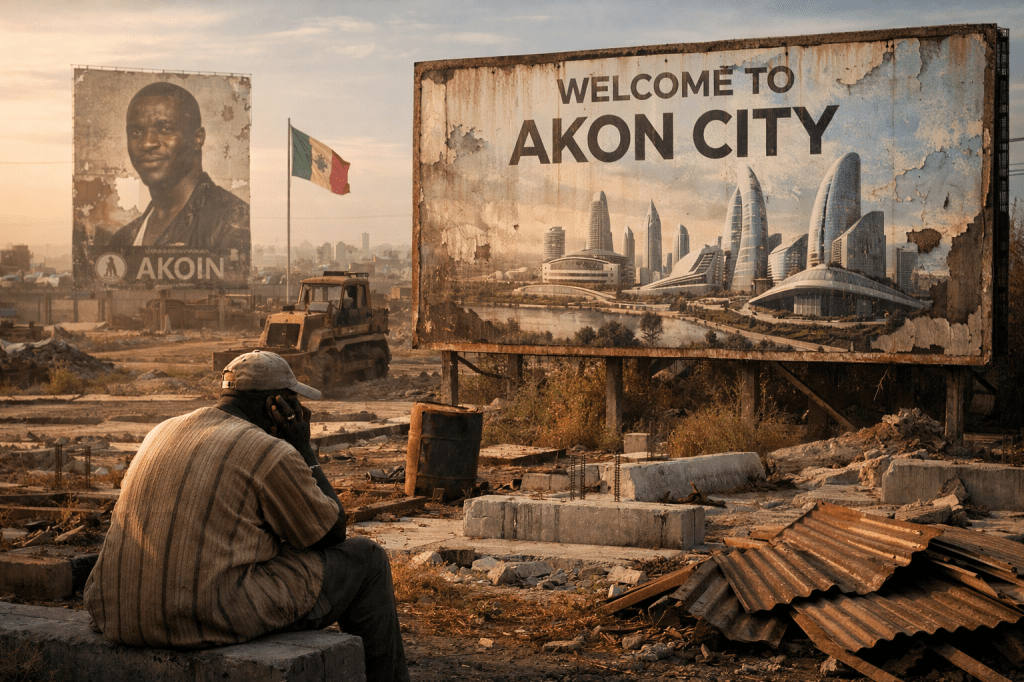
Years later, however, the grand vision has largely failed to materialize. What was once promoted as a multi-billion-dollar development complete with advanced infrastructure, luxury housing, hospitals, universities, and its own digital currency has stalled, leaving little more than undeveloped land and growing skepticism.
For many observers, the story of Akon City is no longer simply about an ambitious real estate project. It has become a cautionary tale about trust, accountability, and the consequences of high-profile figures making promises that never come to fruition.
A Vision That Captured the Continent
When Akon first introduced the concept of Akon City in 2018, it was presented as a bold step toward a new African future. Inspired by futuristic urban design and powered by renewable energy, the city was supposed to attract global investors and create jobs while offering Africans a technological hub that rivaled modern smart cities around the world.
Central to the project was the idea of Akoin, a cryptocurrency that would serve as the primary currency of the city’s economy. The proposal attracted attention from investors, governments, and diaspora communities eager to see a large-scale development initiative led by an African-born global figure.
For many across Africa and the diaspora, Akon’s involvement carried symbolic importance. Born in the United States but raised partly in Senegal, he was seen as someone who could bridge international capital and African development.
The Reality on the Ground
Despite the excitement surrounding the announcement, progress on Akon City has been minimal. Years after the initial unveiling, construction has struggled to move forward in any meaningful way. Reports from the site indicate that much of the land allocated for the project remains largely untouched.
While ambitious timelines once projected a bustling metropolis by the mid-2020s, critics now question whether the project will ever be completed at all.
Some observers argue that the project was always overly ambitious and underestimated the enormous logistical, financial, and political challenges involved in building a new city from scratch. Others have gone further, accusing the project of misleading investors and communities who believed the promises of rapid development and economic opportunity.
The Bigger Problem: Trust and Accountability
The deeper issue raised by the Akon City saga goes beyond one celebrity entrepreneur. It touches on a broader challenge facing parts of Africa: a fractured system of trust where grand announcements and political spectacle sometimes replace concrete results.
Across the continent, communities have seen major development projects announced with great fanfare only to stall, disappear, or fail to deliver on their promises. When influential figures promote ambitious visions without the capacity to follow through, public confidence in leadership and investment initiatives erodes.
In societies where loyalty networks—between leaders, investors, and communities—play an important role in social and economic stability, broken promises can have long-lasting consequences.
The Diaspora Factor
Projects like Akon City also highlight the complicated relationship between Africa and its global diaspora. Many diaspora entrepreneurs genuinely want to invest in and uplift African economies, but when highly publicized projects collapse, they can damage the credibility of future initiatives.
Potential investors become more cautious, governments become more skeptical, and local communities grow wary of outsiders promising rapid transformation.
Lessons for Africa’s Future
Africa’s future development will likely depend on a combination of domestic leadership, international partnerships, and responsible diaspora investment. But for that system to work, credibility is essential.
Projects must be grounded in realistic timelines, transparent financing, and accountability to the communities they claim to serve. Without those foundations, even the most inspiring visions risk becoming symbols of disappointment rather than progress.
The story of Akon City is therefore not just about one stalled development project. It reflects a broader lesson about leadership, trust, and responsibility.
For many Africans watching the project’s uncertain fate, the real question is not simply what happened to Akon City—but how future development efforts can avoid repeating the same mistakes.
—Michael Lyles, B1Daily



 B1Daily
Leave a comment