—Barrington Williams, B1Daily
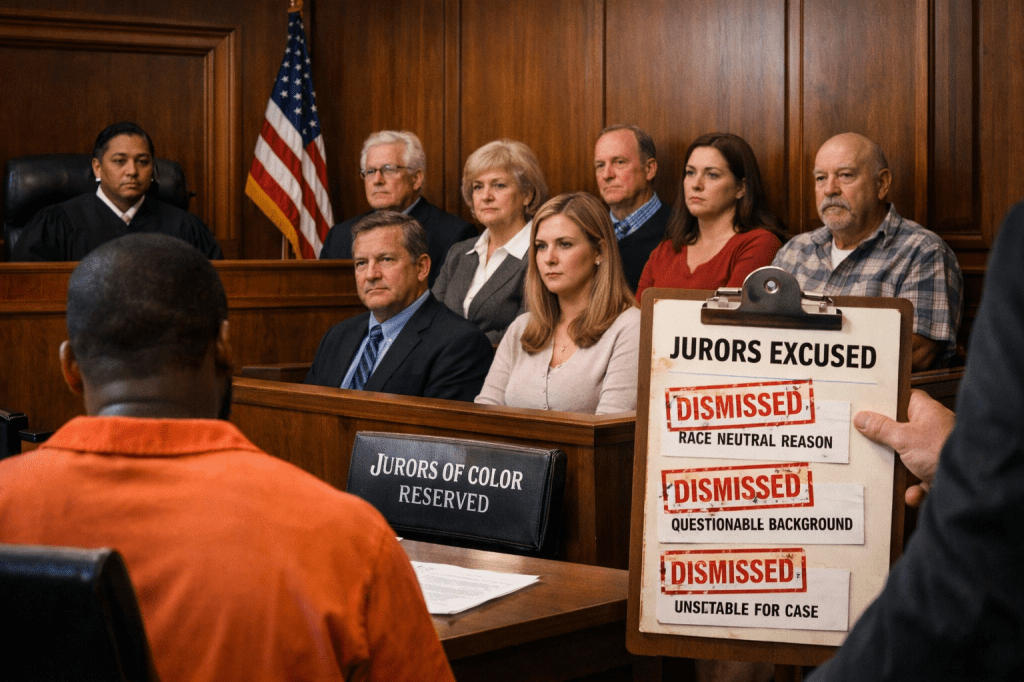
The American legal system proudly proclaims that every defendant has the right to a trial by a jury of their peers. It is one of the most celebrated principles in the justice system. But for many Black Americans, that promise has never fully been honored.
Across the country, Black defendants routinely walk into courtrooms where the juries deciding their fate do not reflect their communities. At the same time, Black citizens are often removed from jury pools or struck during jury selection, limiting their ability to participate in one of the most important civic duties in a democracy.
This is not accidental. It is the result of longstanding patterns of racial bias in jury selection.
In theory, discrimination against Black jurors is illegal. The U.S. Supreme Court ruled in Batson v. Kentucky that attorneys cannot exclude jurors solely because of race. The decision was supposed to end the practice of prosecutors removing Black jurors in cases involving Black defendants.
In reality, the ruling has often been easy to circumvent. Lawyers can still remove potential jurors through what are known as peremptory challenges, offering vague “race-neutral” explanations for their decisions. A juror might be dismissed because they allegedly looked uninterested, seemed distrustful of law enforcement, or simply did not appear to be the right “fit” for the case.
Those explanations are difficult to challenge, and the result is predictable: Black jurors continue to disappear from jury boxes across America.
The consequences are profound. When Black defendants face juries that lack racial diversity, the justice system risks reinforcing the very biases it claims to reject. Diverse juries are more likely to carefully evaluate evidence, challenge stereotypes during deliberations, and prevent groupthink from shaping verdicts.
When Black jurors are excluded, the courtroom loses perspectives shaped by lived experience. That absence can influence how testimony is interpreted, how credibility is judged, and ultimately how justice is delivered.
The problem is also structural. Jury pools are often built using voter registration lists or driver’s license records. Communities with lower registration rates or economic barriers to participation can end up underrepresented before jury selection even begins.
Then come the practical obstacles. Jury service can be financially burdensome for people who cannot easily miss work. Individuals with prior contact with the criminal justice system are frequently disqualified. These factors disproportionately affect Black communities, shrinking the pool of eligible jurors even further.
Taken together, these barriers create a troubling dynamic: Black Americans are overrepresented as defendants in the courtroom but underrepresented in the jury box.
That imbalance raises a deeper question about the meaning of justice. A jury system that consistently excludes certain communities cannot claim to fully represent the public it serves.
Jury service is not merely a procedural formality. It is a cornerstone of democracy. It gives ordinary citizens the power to shape legal outcomes and hold the state accountable.
When Black citizens are pushed out of jury service, the justice system loses legitimacy in the eyes of the communities most affected by it. And when Black defendants are denied juries that reflect their peers, the constitutional promise of fairness becomes harder to believe.
The solution requires more than simply repeating legal standards. Courts must enforce stronger protections against discriminatory jury strikes and ensure that jury pools truly reflect the diversity of the communities they represent.
Justice cannot be blind if the jury box is not inclusive.
—Barrington Williams, B1Daily


 B1Daily
Leave a comment