—Barrington Williams, B1Daily
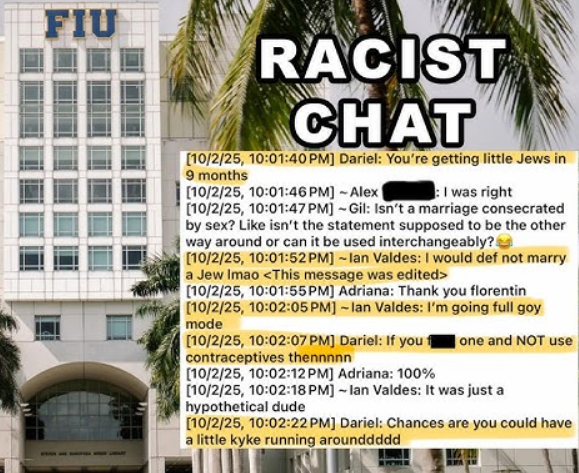
A political scandal erupted at Florida International University after leaked messages revealed that a group chat tied to conservative activists contained explicit anti-Black racism, antisemitism, and violent rhetoric. The chat reportedly involved individuals connected to Turning Point USA (TPUSA) and local members of the Republican Party of Miami-Dade County, raising serious questions about the political culture being fostered among some conservative student groups.
The WhatsApp chat was initially created by a local Republican official to coordinate conservative activism on campus. Instead, screenshots showed the group quickly devolving into a space filled with racist slurs, including repeated uses of the N-word, misogynistic comments, and antisemitic jokes. Some participants reportedly even joked about violence against Black people, triggering outrage once the messages became public.
The fallout was immediate. The president of the Turning Point USA chapter at Florida International University stepped down after revelations that he had participated in or affirmed racist remarks within the chat. The scandal sparked condemnation from students, civil rights advocates, and political leaders who said the messages exposed an ugly undercurrent of racism behind the scenes of student political organizing.
University officials made clear that such rhetoric contradicts campus values. Administrators at Florida International University emphasized that the institution does not tolerate hate speech, discrimination, or threats of violence, and the situation prompted calls for investigations and disciplinary action.
A Pattern of Anti-Black Hostility
For many observers, the scandal was not simply about a handful of reckless messages but about a broader culture where anti-Black rhetoric can be normalized in private spaces. The leaked chat reportedly contained hundreds of racist comments, along with references to extremist ideologies and offensive jokes targeting multiple minority groups.
Black students on campus expressed anger and frustration, saying the revelations confirmed long-standing concerns about racism lurking beneath the surface in some campus political organizations.
Anti-Blackness Within Parts of the Latino Community
The incident also sparked a broader conversation about anti-Black attitudes that have historically existed in parts of the Latino community, particularly in regions like South Florida where many political activists and students come from Latino backgrounds.
Historians and sociologists often trace these attitudes to colonial racial hierarchies in Latin America, where lighter skin and European ancestry were historically privileged while people of African descent were marginalized. Those social hierarchies did not disappear with migration to the United States and can sometimes manifest in tensions between Latino and Black communities.
South Florida’s political environment reflects those complexities. The region’s Latino-majority political culture—especially among Cuban-American conservative networks—has occasionally produced rhetoric that is hostile toward Black political movements and civil rights activism. Critics argue that the FIU group chat is another example of how those attitudes can surface in modern political spaces.
Political and Cultural Fallout
The scandal has forced conservative organizations to confront uncomfortable questions about accountability and internal culture. Critics say incidents like this reveal how racism can thrive in private conversations even when organizations publicly promote diversity and outreach.
For many Black students and community members, the episode reinforced a troubling reality: racism in American politics has not disappeared. Instead, it often hides in closed-door spaces such as private group chats—until someone exposes it.
The controversy at Florida International University has become a stark reminder that combating anti-Black racism requires more than public statements. It requires confronting the cultural attitudes that allow such behavior to persist in the first place.
—Barrington Williams, B1Daily



 B1Daily
Leave a comment