—Matt Gwinta, B1Daily
Coalition politics has become the new reality in South Africa, but Economic Freedom Fighters (EFF) leader Julius Malema says there is one compromise his party will never make.
Speaking at the Botswana National Front (BNF) National Conference in Jwaneng, Botswana, Malema declared that the EFF would never enter into a political alliance with the Democratic Alliance (DA) or the Freedom Front Plus (FF+), arguing that such a coalition would betray the liberation struggle and the party’s ideological principles.
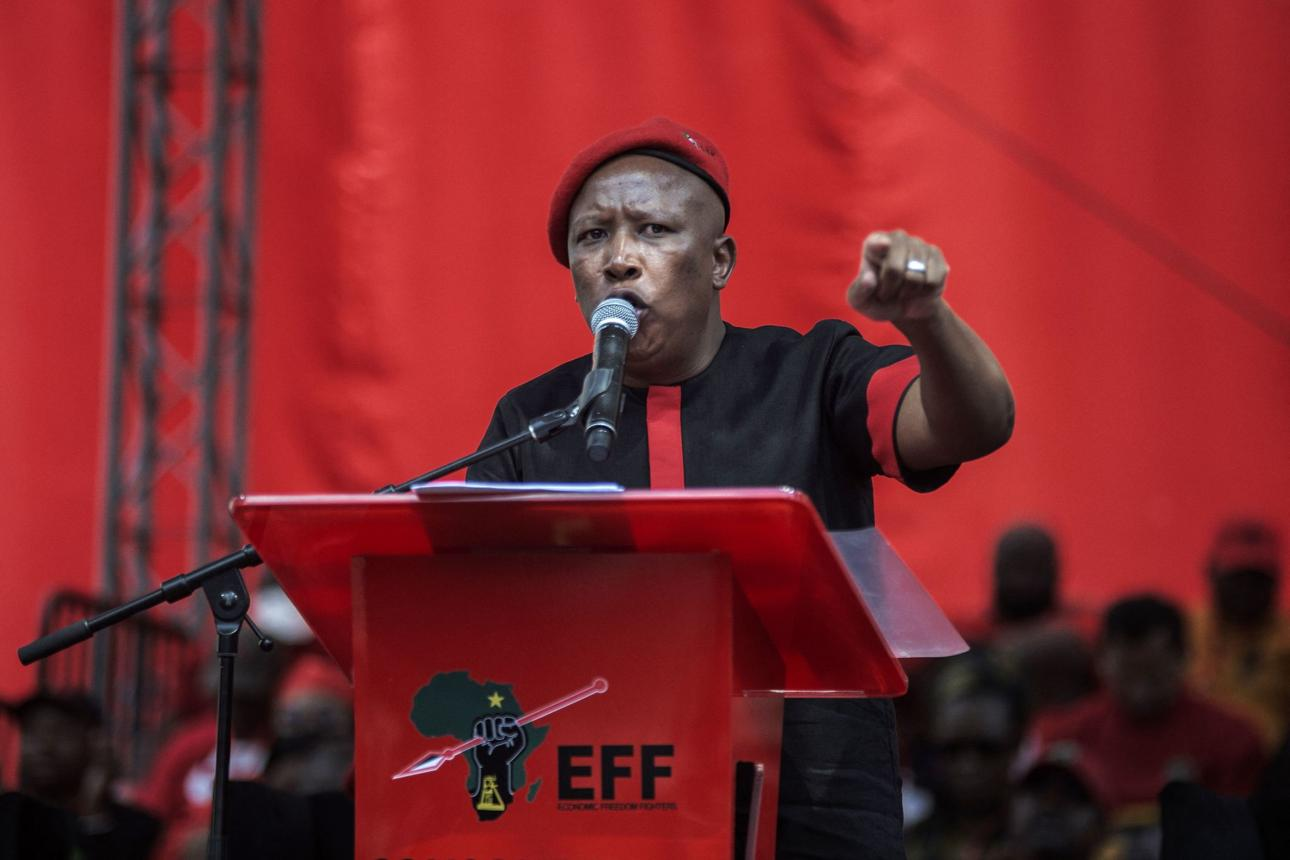
His remarks come at a pivotal moment in South African politics. Since the 2024 national elections, no single party has commanded a parliamentary majority, ushering in an era of coalition governments and political bargaining. The African National Congress (ANC), after losing its outright majority, formed a Government of National Unity (GNU) that includes the DA and several other parties. The EFF has consistently rejected participating in that arrangement.
“We Will Never Align”
Malema’s message left little room for interpretation.
Addressing delegates, he argued that partnering with either the DA or the Freedom Front Plus would amount to abandoning the very principles upon which the EFF was founded.
He stated that any alliance with those parties would undermine the progressive agenda that previous generations fought and died to achieve, adding that he would rather remain outside government than compromise the party’s ideological position.
The comments reaffirm one of the EFF’s longest-standing political positions: that it views the DA and FF+ as representing political interests fundamentally incompatible with its vision of economic transformation.
Ideology Over Political Convenience
South Africa’s coalition era has forced parties across the political spectrum to make uncomfortable compromises.
Municipal governments have changed hands through shifting alliances, and analysts increasingly expect coalition-building to remain a defining feature of South African politics.
Malema, however, insists that not every coalition is worth pursuing.
The EFF has built its political identity around policies such as land expropriation without compensation, expanded state ownership of strategic industries, and economic redistribution. The party describes itself as rooted in Marxist-Leninist and Pan-Africanist principles and has consistently argued that South Africa’s economic structure continues to benefit white wealth disproportionately.
From the EFF’s perspective, aligning with parties that oppose many of those policies would blur the ideological distinctions that define its movement.
A Rebuke of the Government of National Unity
Malema’s remarks also amounted to another criticism of the ANC’s decision to govern alongside the DA after the 2024 election.
The Government of National Unity was created to provide stability after the ANC failed to secure a parliamentary majority for the first time since the end of apartheid.
Supporters argue that the GNU has helped prevent political paralysis and encouraged cooperation across party lines.
The EFF has taken the opposite view, maintaining that the arrangement weakens transformative economic policies and distances the ANC from its liberation-era commitments.
Botswana as the Backdrop
Malema delivered his remarks while congratulating Botswana’s governing Botswana National Front and President Duma Boko.
During the speech, he praised Botswana’s political transition and argued that African governments should ensure their natural resources, including diamonds, are managed in ways that benefit ordinary citizens rather than primarily private capital.
Those comments reflected themes the EFF has long championed inside South Africa, particularly state involvement in strategic sectors of the economy and greater public control over natural resources.
Coalition Politics Faces Another Test
With municipal elections approaching, coalition negotiations are expected to intensify across South Africa.
Political analysts note that coalition governments often require ideological flexibility simply because no single party can govern alone.
Malema’s declaration narrows the EFF’s options while simultaneously reinforcing the party’s identity among supporters who value ideological consistency over political expediency.
Whether that strategy ultimately strengthens or limits the EFF’s influence remains an open question.
Supporters argue that refusing to compromise preserves the party’s credibility.
Critics contend that governing requires negotiation and that refusing to work with major political rivals could reduce the EFF’s ability to shape public policy from within government.
A Defining Political Message
Malema’s speech was about more than rejecting two rival parties.
It was a declaration that, despite South Africa’s increasingly fragmented political landscape, the EFF intends to define itself by ideological boundaries rather than coalition arithmetic.
As coalition politics becomes increasingly common, voters will ultimately decide whether they prefer parties willing to compromise for governing power or parties determined to preserve their principles regardless of the political cost.
For now, Julius Malema has made one thing unmistakably clear: when it comes to the Democratic Alliance and the Freedom Front Plus, the EFF believes some political lines should never be crossed.
—Matt Gwinta, B1Daily





Leave a comment