—Travis Luyindama, B1Daily
In a twist that sounds like it was drafted by a sci-fi writer with a chemistry degree, researchers have uncovered that melanin, the same pigment responsible for human skin, hair, and eye color, might double as a surprisingly powerful ingredient for future batteries.
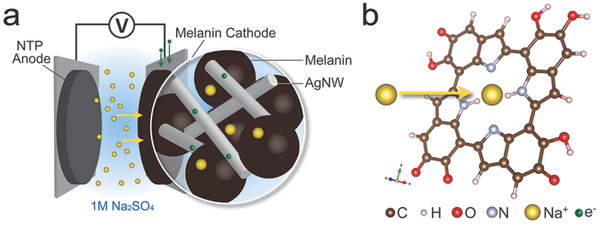
A team at Carnegie Mellon University found that melanin’s complex chemical structure can be arranged in ways that behave like traditional battery materials. At the microscopic level, melanin forms polymer structures that can act as a cathode, one of the key components needed to store and release energy.
The real intrigue lies in how this natural substance handles electricity. When configured in a specific “tetramer” structure, melanin showed the ability to bind with sodium ions and generate voltage levels comparable to some of the best sodium-based battery materials currently in use. That’s not just respectable, it’s a quiet flex from a pigment most people associate with biology, not power grids.
Even more fascinating, melanin-based systems display a two-voltage plateau behavior, a hallmark of conventional battery chemistry. In plain terms, it doesn’t just store energy, it behaves like it belongs in the same league as engineered materials designed for energy storage.
This discovery builds on earlier research showing melanin can function as part of biodegradable battery components, including electrodes that store charge using sodium ions. That opens the door to batteries that are not only effective but potentially safer and more environmentally friendly than current lithium-heavy designs.
The bigger picture feels almost poetic. A substance embedded in living organisms for millions of years could help power the next generation of electronics, medical implants, and maybe even wearable tech that literally runs on biology-inspired materials. Scientists are still decoding melanin’s full structure, it’s a molecular labyrinth, but each new breakthrough hints at a future where batteries aren’t just manufactured… they’re grown in concept.
There are still hurdles. Melanin’s structure is notoriously complex, and scaling it into commercial battery systems won’t be easy. But the idea is already sparking a new category of research: organic, bio-inspired energy storage that trades toxic metals for something closer to nature’s own blueprint.
In a world chasing cleaner energy, melanin might quietly step out of the shadows, less as pigment, more as power.
—Travis Luyindama, B1Daily






Leave a comment