—Pān Hě, B1Daily
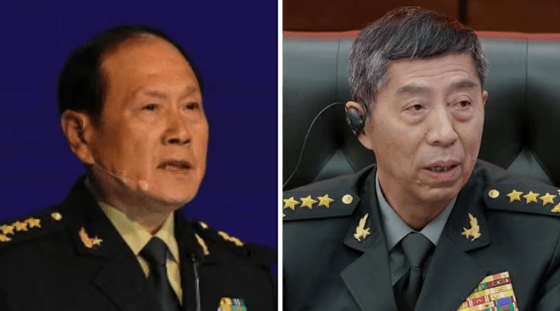
In the eyes of many Chinese observers, the suspended death sentences handed down to former defence ministers Wei Fenghe and Li Shangfu are not simply criminal punishments. They are political thunderbolts. A warning shot fired directly into the spine of the People’s Liberation Army.
Chinese state media announced that both men received death sentences with a two-year reprieve over massive graft charges tied to bribery, abuse of power, and corruption inside China’s military leadership structure. Under Chinese law, such sentences are typically commuted to life imprisonment after two years, often without parole.
From a Western perspective, the headlines immediately focus on authoritarian power and political purges. But from a Chinese nationalist or pro-government perspective, the story looks very different.
To many inside China, corruption inside the military is viewed as existential poison.
The Chinese Communist Party has spent years trying to modernise the PLA into a technologically advanced fighting force capable of competing with the United States in the Pacific. Missiles, hypersonic weapons, AI systems, aircraft carriers, satellite warfare, cyber capabilities, all of it requires discipline, loyalty, and internal trust. Corruption undermines every layer of that machine.
And according to Chinese authorities, that corruption had spread alarmingly high.
Li Shangfu was once considered one of Xi Jinping’s trusted military figures, heavily involved in weapons procurement and China’s ambitious military modernisation projects. Wei Fenghe previously commanded the powerful Rocket Force, the branch overseeing much of China’s missile and nuclear arsenal.
That makes the punishment especially symbolic.
In Chinese political culture, severe punishment of senior officials is often framed not as instability, but as proof that “no one is above the Party.” The government’s narrative is simple: if even top generals can fall, then the anti-corruption campaign is serious.
State-linked commentary and nationalist sentiment online frequently portray these purges as necessary surgery. Painful, but essential. The idea is that China cannot rise as a global superpower while military elites enrich themselves through bribery networks, procurement fraud, and political favoritism.
And there is historical precedent for this approach.
Since coming to power in 2012, Xi Jinping has overseen one of the largest anti-corruption campaigns in modern Chinese history. High-ranking officials, military officers, banking regulators, and Communist Party elites have all fallen under investigation.
Supporters inside China often argue Western media misunderstands this campaign because it views corruption purely through a liberal democratic lens. In China’s political philosophy, corruption is not merely financial misconduct. It is viewed as ideological betrayal, national weakness, and a threat to state stability itself.
That explains why punishments can appear extraordinarily harsh by Western standards.
But there is another layer beneath the surface.
Critics, particularly outside China, argue these anti-corruption drives also conveniently consolidate political loyalty around Xi Jinping while removing rival power networks inside the military and Communist Party.
From Beijing’s viewpoint, however, loyalty and anti-corruption are intertwined. A military officer accepting bribes while handling weapons procurement is not simply stealing money. Chinese officials increasingly frame such behaviour as jeopardising national security during a period of rising geopolitical tension with the United States and Taiwan.
In other words: corruption becomes treason-adjacent.
And timing matters.
China’s military has faced enormous scrutiny recently following repeated disappearances, investigations, and removals of senior officers connected to the Rocket Force and Central Military Commission. Some analysts believe Beijing became alarmed by how deeply corruption may have infected strategic military branches.
From a Chinese nationalist perspective, harsh punishment is therefore meant to restore fear, obedience, and discipline before future crises emerge.
There is also a cultural divide in how punishment itself is perceived.
In much of the West, state power is often viewed suspiciously, especially when it involves life sentences or death penalties tied to political figures. In China, many citizens tend to view harsh anti-corruption punishment as morally satisfying, particularly when officials are seen as enriching themselves while ordinary people struggle economically.
To many Chinese citizens, corrupt elites are not victims of state overreach. They are viewed as parasites feeding on national progress.
Whether one agrees with Beijing’s methods or not, the message coming from China is unmistakable: the Communist Party wants absolute control over the military, absolute loyalty from its leadership, and absolute fear among officials tempted by corruption.
And in modern China, even generals can vanish like smoke if the Party decides the rot has gone too deep.
—Pān Hě, B1Daily





Leave a comment