—Barrington Williams, B1Daily
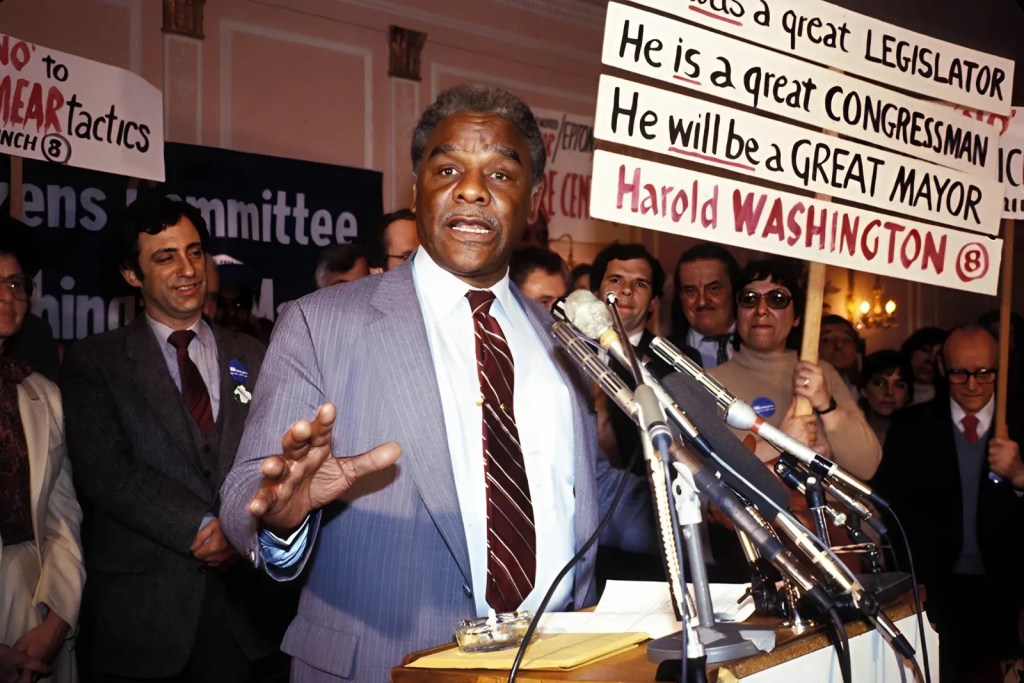
When Harold Washington took the helm of Chicago in 1983, his victory was more than electoral arithmetic. It was a political rupture. Washington’s administration became a symbol of coalition-building across racial and class lines, but for many Black Chicagoans it also represented something more intimate: the first time City Hall felt, even briefly, like it was structurally reachable rather than permanently sealed off.
Washington’s tenure was short, ending with his death in 1987, but his legacy has remained a kind of measuring stick—sometimes idealized, sometimes weaponized—for every Black mayor who followed in Chicago’s complex political ecosystem.
In the decades since, Black leadership in Chicago politics has continued, most notably through figures like Mayor Lori Lightfoot and Mayor Brandon Johnson, each navigating the city’s entrenched political machinery, competing ward-based power brokers, and the long shadow of the Democratic Party’s organizational influence. Yet a persistent critique has followed many of these administrations: that symbolic representation at the top has not consistently translated into structural economic empowerment at the neighborhood level.
Some activists and local business advocates argue that post-Washington administrations have drifted away from the grassroots economic priorities that defined his coalition era. They point in particular to disparities in city contracting, where Black-owned businesses continue to report underrepresentation in major municipal procurement pipelines. The frustration is not merely statistical; it is cultural, rooted in expectations formed during Washington’s tenure that political access would eventually open economic doors at scale.
A recurring theme in this critique is the idea that modern Black Democratic mayors operate within a political framework where loyalty flows upward into party infrastructure rather than outward into constituency demands. In this view, City Hall becomes less an engine of localized empowerment and more a node in a broader Democratic Party system, where policy decisions are filtered through institutional consensus, budget constraints, and statewide or national party priorities.
Supporters of recent administrations reject this framing, arguing that governing Chicago today is structurally more constrained than in the Washington era. They point to fiscal pressures, pension obligations, and procurement rules designed to prevent favoritism as real-world limits on how aggressively any mayor can reshape contracting ecosystems overnight. Still, the perception gap remains wide, especially in communities that feel left behind by the city’s ongoing development booms.
What complicates the narrative further is that Washington himself governed during a unique political moment. His administration emerged from a rare coalition that briefly disrupted Chicago’s traditional machine politics. The post-Washington era, by contrast, has been defined less by rupture and more by integration into established systems of governance, where mayors—regardless of identity—must navigate inherited structures rather than dismantle them outright.
For critics, that transition is precisely the problem. They argue that integration without transformation produces leadership that can occupy office but struggle to redirect institutional flows of money, contracts, and development toward historically excluded communities. In that sense, the debate over Chicago’s Black mayoral leadership is not just about personalities, but about whether access to power has translated into durable economic redistribution.
As the city continues to evolve, the question remains unresolved: whether Harold Washington’s legacy is a blueprint still waiting to be completed, or a historical moment that cannot be replicated under today’s political architecture.
—Barrington Williams, B1Daily





Leave a comment