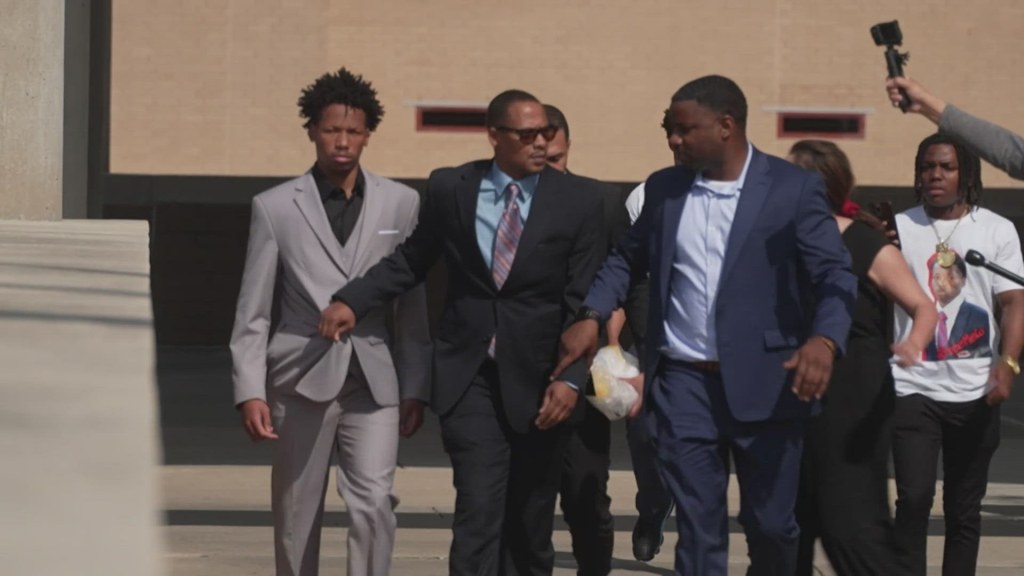
—Barrington Williams, B1Daily
The Karmelo Anthony case has already been tried in the court of public opinion. Social media turned a deadly confrontation between two Texas teenagers into a national culture-war battlefield almost immediately, with outrage, racial tension, misinformation, and political narratives spreading faster than verified facts.
But courtrooms are not supposed to operate on internet emotion.
They operate on law.
And under Texas law, there is a serious legal argument that Karmelo Anthony could potentially be found not guilty if a jury concludes he acted in lawful self-defense during the fatal altercation that killed 17-year-old Austin Metcalf at a Frisco track meet in April 2025.
That possibility has enraged many people online. But legal reality is often colder and more complicated than viral headlines.
The core issue in this case is not whether a death occurred. Karmelo Anthony admitted he stabbed Metcalf. According to police documents, Anthony reportedly told officers, “I’m not alleged, I did it,” while also asking whether the incident could be considered self-defense.
The real legal question is whether Texas law justified the use of force under the circumstances.
That distinction matters enormously.
Texas has some of the broadest self-defense protections in America. Under Texas Penal Code Section 9.31 and Section 9.32, a person may legally use force, including deadly force, if they reasonably believe it is immediately necessary to protect themselves against another person’s unlawful force or threat of serious bodily harm.
Texas is also a “stand your ground” state. There is generally no duty to retreat if the person is lawfully present and not engaged in criminal activity.
That legal framework is why Anthony’s defense team continues insisting the case is more legally complicated than many public reactions suggest.
According to witness statements summarized in police reports, the confrontation began after Metcalf allegedly told Anthony to leave an area under a school tent. Witnesses stated Anthony warned, “Touch me and see what happens.” Reports then diverge somewhat, but witnesses indicated Metcalf either touched or grabbed Anthony before Anthony pulled a knife and stabbed him once in the chest.
To many people, that alone settles the case morally.
But criminal law does not always work through morality alone. It works through burden of proof.
And that burden sits on the prosecution.
Once self-defense is raised in Texas, prosecutors must prove beyond a reasonable doubt that the defendant did not act lawfully in self-defense. That is an extremely important legal threshold that many public discussions ignore entirely.
Anthony’s defense could potentially argue several points:
First, they may argue Anthony was not the initial physical aggressor. Witness accounts reportedly suggest Metcalf initiated physical contact after a verbal confrontation.
Second, they may argue Anthony verbally warned Metcalf before any physical escalation occurred. Prosecutors may frame that warning as threatening. The defense may frame it as an attempt at deterrence.
Third, Texas law does not require a person to absorb physical contact before defending themselves if they reasonably fear escalation or serious bodily harm.
And fourth, perception matters in self-defense law. The jury does not necessarily have to believe Anthony was objectively correct in fearing harm. The question is whether his belief could be viewed as legally reasonable under the circumstances facing him in that moment.
That is where the case becomes legally volatile.
Critics of the self-defense argument point to several potentially damaging factors for Anthony. Prosecutors will almost certainly argue that bringing a knife to a school event escalated the danger dramatically. They may also argue Anthony’s statement, “Touch me and see what happens,” showed anticipation of violence rather than fear of it. Online discussions about the case frequently focus on whether Anthony’s own words and conduct constituted provocation that undermines a self-defense claim.
Texas law does limit self-defense protections for individuals who provoke confrontations.
But even that issue is not always straightforward legally.
The defense may argue that verbal confrontation alone does not automatically eliminate self-defense rights if the physical escalation comes from the other party. Jurors would likely need to evaluate the full sequence carefully, including body language, size differences, crowd pressure, perceived threats, and the speed of the confrontation.
Another major factor is reasonable doubt.
The prosecution does not merely need to prove Anthony stabbed Metcalf. That part is undisputed. Prosecutors must prove beyond a reasonable doubt that Anthony’s actions were not legally justified under Texas self-defense statutes.
That is a much more difficult challenge than many social-media commentators realize.
The political atmosphere surrounding the case also complicates matters further. The incident exploded online partly because Anthony is Black and Metcalf was white, triggering intense racial polarization and massive misinformation campaigns. Both families reportedly received threats, while authorities and the FBI warned about fake evidence, impersonations, and manipulated narratives circulating online.
That matters because pretrial publicity can contaminate public understanding long before jurors ever enter a courtroom.
Legally, Anthony remains presumed innocent unless convicted.
That principle becomes especially important in emotionally charged cases where public grief risks transforming into automatic assumptions about guilt before all evidence is fully tested in court.
None of this diminishes the tragedy of Austin Metcalf’s death. A teenager lost his life over what began as a seemingly minor confrontation. Two families were shattered. A community was traumatized.
But criminal courts are not designed to determine whose death feels most heartbreaking.
They are designed to determine whether the state can legally prove criminal guilt beyond a reasonable doubt.
And under Texas self-defense law, that may ultimately be far harder than many people currently assume.
—Barrington Williams, B1Daily



Leave a comment