—Kerry Hill, B1Daily
For more than three decades, Florida’s Congressional District 20 existed for a specific reason: to ensure Black voters in South Florida had the ability to elect a representative from their own communities after decades of racial exclusion from political power. Now, after a fresh round of Republican-backed redistricting scrambled South Florida’s political map like a casino dealer shuffling marked cards, that district has become the center of an explosive fight inside the Democratic Party itself. And at the center of the controversy stands Debbie Wasserman Schultz.
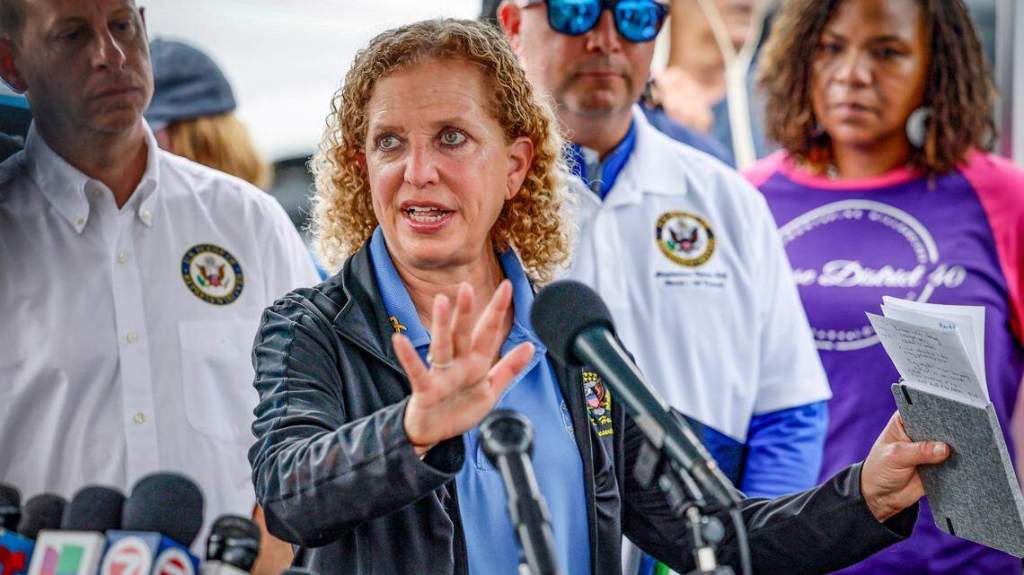
The longtime Democratic congresswoman announced this week that she will run in Florida’s newly reshaped 20th Congressional District following Governor Ron DeSantis’s aggressive redistricting overhaul. The move immediately triggered backlash from Black lawmakers, Black political organizations, and candidates already running in the district, many of whom argue Wasserman Schultz is attempting to occupy a seat historically designed to preserve Black representation.
The Democratic Black Caucus of Broward County publicly urged Wasserman Schultz not to run there at all.
“Black voters have always been the soul of the Democratic Party,” the caucus stated, warning that District 20 has long served as an “anchor of Black political representation.”
That phrase, anchor of Black political representation, is the heart of the entire dispute.
District 20 was historically structured as a majority-Black district under Voting Rights Act principles intended to counter racial disenfranchisement and political dilution. Critics say Wasserman Schultz’s candidacy transforms the district from a protective mechanism for Black political power into a political life raft for a powerful establishment Democrat displaced by Republican gerrymandering elsewhere.
Black lawmakers did not mince words.
The Florida Legislative Black Caucus accused Wasserman Schultz of ignoring direct appeals from Black community leaders to seek office elsewhere, arguing the district “was established to remedy decades of racial exclusion.” The caucus warned that her candidacy risks reducing representation to “performative allyship rather than meaningful connection.”
The tension exposes a contradiction Democrats increasingly struggle to explain to their own base: how can the party condemn Republican attacks on minority representation while some establishment Democrats simultaneously move into historically Black districts once their own seats become politically unstable?
That contradiction has become impossible to ignore in Florida.
Governor DeSantis’s new congressional maps have already drawn lawsuits and accusations of racial and partisan gerrymandering. Critics argue the maps weaken minority voting power statewide while tightening Republican control over Congress.
But instead of producing solidarity among Democrats, the redistricting fallout has opened an internal war over who gets protected politically when districts collapse.
Civil rights activist and District 20 candidate Elijah Manley blasted Wasserman Schultz’s decision, accusing her of helping perpetuate the same erosion of Black representation Democrats publicly claim to oppose.
Online reaction has been even harsher.
Across Florida political forums and local organizing circles, critics accused Wasserman Schultz of “carpetbagging” into a Black-majority district after her original political footing weakened. Others framed the move as another example of entrenched Democratic leadership protecting institutional power over community representation.
Supporters of Wasserman Schultz argue the criticism oversimplifies the issue. They point to her decades representing parts of Broward County and argue experience and congressional seniority matter in an era where Republicans dominate Florida politics. Wasserman Schultz herself emphasized affordability, federal influence, and legislative experience in announcing her campaign.
But the symbolism surrounding District 20 remains radioactive.
For many Black voters and organizers, this is not merely about residency lines or political qualifications. It is about whether historically Black districts remain spaces where Black political leadership can still be cultivated in an era where the Voting Rights Act itself faces increasing legal erosion.
The fear running underneath this controversy is larger than one race.
If historically Black districts become fallback options for displaced incumbents with stronger fundraising networks, deeper donor relationships, and national party backing, then Black political representation risks becoming negotiable the moment political pressure intensifies elsewhere.
That is why this race has suddenly become national.
Because Florida’s District 20 is no longer just a congressional seat. It is becoming a test case for what minority representation actually means inside a Democratic Party increasingly pulled between establishment survival and grassroots demands for authentic community power.
And right now, that argument is unfolding in public with the volume turned all the way up.
—Kerry Hill, B1Daily




Leave a comment