—Gerald Greene, B1Daily
One of the most consequential breakthroughs in North Carolina’s agricultural history did not begin in a laboratory, university, corporate office or wealthy planter’s study.
It began inside a tobacco-curing barn with an enslaved Black blacksmith named Stephen Slade.
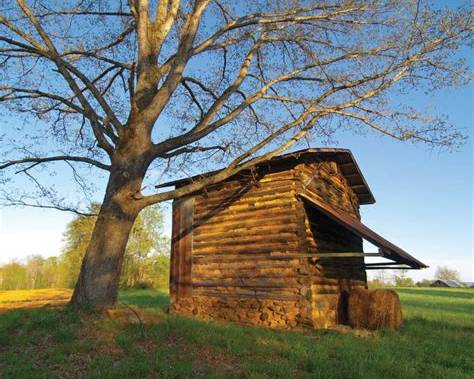
In 1839, on the Caswell County farm of planter Abisha Slade near the Virginia border, Stephen made the discovery that would help revolutionize tobacco production, enrich generations of growers and contribute to North Carolina becoming one of the most powerful tobacco-producing states in America. Yet for much of American history, the economic empire that grew from bright leaf tobacco became far more famous than the enslaved man whose actions helped make it possible.
Stephen’s story is not merely an obscure agricultural footnote.
It is another example of a recurring pattern in American history: Black knowledge, Black labor and Black ingenuity helping create immense economic value while ownership, recognition and wealth flowed elsewhere.
An Enslaved Blacksmith in Caswell County
Stephen was enslaved by Abisha Slade, a prominent tobacco farmer in Caswell County, North Carolina. Historical accounts identify Stephen as a blacksmith who also had responsibility for watching tobacco during the curing process.
That detail matters because blacksmithing required considerably more technical knowledge than the word “laborer” sometimes suggests.
A blacksmith had to understand fire.
He had to understand heat.
He had to know how different fuels behaved, how quickly temperatures changed and what intense heat could do to different materials.
Those skills became unexpectedly important one night in 1839.
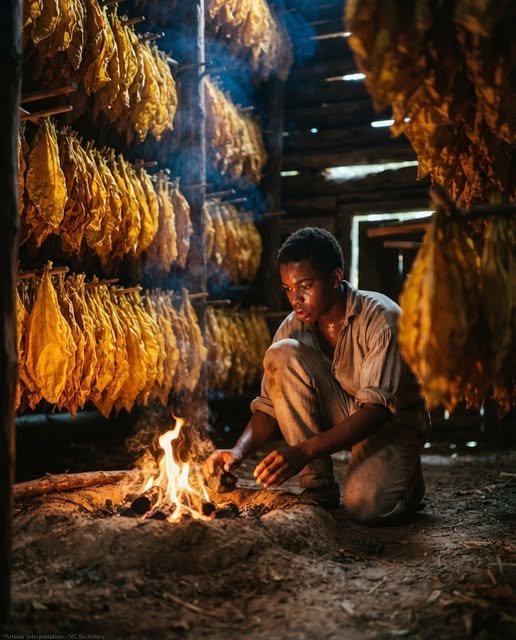
According to the account preserved by North Carolina historical authorities, Stephen was overseeing a barn where tobacco was being cured. He fell asleep near the warmth of the curing fires. When he awoke several hours later, the fires had nearly gone out.
Stephen had a problem.
The crop was in danger.
He reacted quickly.
Using charcoal from his blacksmithing operation, he placed hot coals onto the dying fires.
The temperature surged.
And something remarkable happened.
The Leaves Turned Gold
The sudden blast of dry heat rapidly removed moisture from the tobacco.
Instead of curing into the darker tobacco normally associated with the era, the leaves emerged with a striking yellow appearance.
Bright.
Golden.
Different.
North Carolina’s ANCHOR history project describes the result as tobacco possessing a vivid yellow color after Stephen’s emergency use of charcoal dramatically increased the heat.
What may have begun as an effort to rescue a crop had stumbled onto a method capable of producing an entirely different commercial product.
The discovery eventually became associated with bright leaf tobacco.
And consumers liked it.
The lighter-colored tobacco commanded impressive prices and eventually became enormously important to the tobacco industry of North Carolina and Virginia.
But this is where the story becomes uncomfortable.
Stephen made the critical discovery.
Abisha Slade owned the farm.
And in an economy built upon slavery, ownership determined who could transform an idea into wealth.
Slade Turned Stephen’s Discovery Into a System
Abisha Slade did not simply ignore what had happened.
He studied it.
Experimented with it.
Repeated it.
And eventually refined the process into a reliable formula for producing yellow tobacco.
NCpedia credits Abisha Slade with developing a dependable method for producing bright leaf tobacco after Stephen’s accidental discovery. By 1856, Slade was successfully demonstrating the process to other tobacco growers throughout the Virginia-Carolina tobacco belt.
That distinction is important.
Stephen’s discovery and Abisha Slade’s later refinement of the technique are both part of the historical record.
It would therefore be inaccurate to claim that Stephen single-handedly invented every aspect of modern flue curing.
But it would be equally misleading to tell the story as though Abisha Slade simply invented bright leaf tobacco independently.
The chain begins with Stephen.
Without that extraordinary curing event in 1839, the history may have unfolded very differently.
The Discovery Became an Economic Earthquake
Bright leaf tobacco was not merely another agricultural curiosity.
It helped transform North Carolina.
ANCHOR reports that farmers throughout the region learned the new curing process, and tobacco barns designed for the technique spread across the countryside. By 1857, Abisha Slade was producing approximately 20,000 pounds of tobacco annually and earning exceptionally high profits.
Caswell County’s own historical tourism organization describes Stephen’s discovery as helping trigger an explosion in demand and assisting North Carolina in becoming dominant within the American tobacco industry.
This was no small market.
North Carolina tobacco eventually became synonymous with enormous corporate fortunes and brands known throughout the world.
NCpedia specifically notes that the bright leaf process helped lay the foundation for fortunes associated with names including Richard J. Reynolds, Julian Carr and the Duke family.
Think about the scale of that historical irony.
A Black man held as property made the discovery.
White planters commercialized it.
Industrialists eventually built fortunes around the tobacco economy it helped expand.
Factories rose.
Brands spread.
Corporate empires formed.
Money cascaded through generations.
Stephen’s descendants did not receive royalties every time bright leaf tobacco was sold.
There was no patent check.
No equity stake.
No licensing agreement.
No venture-capital round.
He was enslaved.
The legal structure of the United States made the imbalance brutally simple.
The person could be property.
Therefore, what the person produced could become somebody else’s wealth.
Black Innovation Under Slavery Is Often Hidden Behind the Owner’s Name
Stephen’s story fits into a much larger historical problem.
Enslaved African Americans were farmers, carpenters, metalworkers, cooks, engineers, craftsmen, horse handlers and agricultural specialists.
Their knowledge did not disappear merely because the law refused to recognize them as independent economic actors.
The Library of Congress notes that enslaved African Americans performed not only agricultural labor but also skilled trades throughout the South.
That creates a fundamental historical challenge.
When an enslaved worker discovered a better agricultural process, improved a tool or developed specialized expertise, who received the public credit?
Often, the person who owned the farm, workshop or plantation.
The archive follows ownership.
The money follows ownership.
The newspaper follows ownership.
And eventually, history books can follow ownership too.
That is how innovation can be separated from the innovator.
Even Stephen’s Name Reveals the Historical Problem
There is some uncertainty surrounding Stephen’s surname.
Modern North Carolina sources frequently refer to him as Stephen Slade, taking the surname of the enslaving family. Other historical treatments simply call him Stephen, noting that his original surname is not known.
That uncertainty itself says something about slavery.
Abisha Slade left behind a documented biography.
His birth date is recorded.
His family history is recorded.
His political career is recorded.
His property is recorded.
His marriages are recorded.
Stephen changed an industry, yet historians struggle even to reconstruct the basic facts of his independent identity.
That is not because Stephen’s life lacked importance.
It is because the record-keeping systems of slavery were primarily designed to document the people who owned property, not the people who were property.
There Is an Important Historical Nuance
The bright leaf story should also be told carefully because tobacco curing technology did not begin and end with Stephen.
Historical evidence indicates that various people experimented with flue-curing methods before and after 1839. A Library of Congress-hosted historical study notes that experiments with flue curing occurred as early as the 1820s and that multiple individuals independently reported improved curing methods.
What distinguishes the Caswell County episode is the development of the bright yellow tobacco that became commercially transformative.
Stephen’s charcoal-fueled curing accident is the traditional and officially recognized North Carolina account of that breakthrough, while Abisha Slade subsequently refined the method into a repeatable commercial process.
History is often messier than a single “inventor” standing beside a machine.
Innovation can emerge through accident, observation, refinement and diffusion.
But none of that diminishes Stephen.
If anything, it makes his contribution more interesting.
He recognized a crisis, applied knowledge from another skilled trade and inadvertently revealed a commercially valuable principle of heat and tobacco curing.
Tobacco Wealth Was Built on Black Labor Long After Stephen
Stephen’s role also belongs within the broader history of Black labor in North Carolina tobacco.
Tobacco production depended heavily upon enslaved African American labor before emancipation. After slavery ended, Black workers remained deeply involved in tobacco agriculture and manufacturing, often under discriminatory labor arrangements.
NCpedia notes that Black workers performed much of the difficult work in North Carolina’s tobacco economy while frequently receiving unequal wages and enduring segregation and unsafe working conditions.
Black women in tobacco factories performed tedious processing jobs.
Black agricultural workers planted and harvested crops.
Black families participated in sharecropping systems after emancipation.
And decades later, Black tobacco workers would become central actors in labor struggles such as the Piedmont Leaf Tobacco Company strike of 1946.
The industry’s relationship with Black America therefore did not begin and end with slavery.
Black labor remained woven through the machinery long after emancipation.
The Fortunes Went Somewhere Else
Bright leaf tobacco helped create enormous value.
And value, once created, tends to leave footprints.
There were prosperous farms.
Tobacco warehouses.
Railroads.
Auction houses.
Factories.
Banks.
Universities supported by tobacco fortunes.
Corporate dynasties.
Philanthropic foundations.
Entire cities whose growth was intertwined with tobacco money.
Yet Stephen stood near the beginning of that chain without having the legal freedom to claim the economic rewards created by his contribution.
Caswell County historical accounts explicitly connect his breakthrough with the bright leaf tobacco on which major later tobacco fortunes were built.
That is why Stephen deserves to be discussed not merely as a curiosity of tobacco history but as part of the history of American wealth.
Economic history frequently begins its accounting ledger too late.
It records who founded the corporation.
Who incorporated the company.
Who sold the stock.
Who built the factory.
But not always who created the knowledge that made those enterprises possible.
Stephen forces us to move the starting line backward.
Innovation Without Ownership
Stephen’s story captures one of slavery’s least discussed economic crimes.
Slavery did not only steal wages.
It stole ownership of ideas, expertise and economic opportunity.
An enslaved person could become extremely skilled.
He could discover something.
She could invent something.
They could improve production.
But the surrounding legal system denied them control over the resulting capital.
That distinction matters when Americans discuss historical wealth disparities.
Wealth is cumulative.
A profitable discovery can finance another farm.
That farm can finance another enterprise.
That enterprise can finance education.
Education can produce another generation of wealth.
Capital reproduces itself.
Stephen participated at the beginning of a valuable innovation but stood outside the wealth-building chain that followed.
That is the economic shadow slavery cast long after emancipation.
North Carolina Has Recognized His Contribution, but More People Should Know His Name
Today, North Carolina officially acknowledges Stephen’s role.
The state’s historical marker for bright leaf tobacco explicitly states that Abisha Slade perfected the curing process in the 1850s after his enslaved worker Stephen discovered it in 1839.
That recognition matters.
But Stephen remains far less recognizable nationally than the tobacco magnates whose fortunes emerged from the industry bright leaf helped create.
Most Americans have heard the name Duke.
Many know R.J. Reynolds.
Far fewer know Stephen.
That imbalance deserves correction.
Not by pretending he single-handedly created the entire cigarette industry.
Not by erasing the subsequent experimentation that turned his discovery into a standardized process.
But by placing him where the evidence says he belongs:
at a crucial turning point in the history of American tobacco.
Stephen Slade Belongs in the Story of Black American Innovation
There is a tendency to tell Black history primarily through oppression.
Slavery.
Segregation.
Lynching.
Discrimination.
Those histories must be taught.
But Black American history is also a history of creation.
Agriculture.
Engineering.
Music.
Medicine.
Manufacturing.
Military innovation.
Entrepreneurship.
Technology.
Stephen’s story sits at the intersection of both realities.
He was enslaved.
And he was knowledgeable.
He was denied economic independence.
And his actions changed an industry.
His contribution emerged inside a system designed to extract value from him without granting him ownership over that value.
That makes the bright leaf story more than tobacco history.
It is American economic history.
It is Black American history.
And it is another reminder that when we trace the origins of American wealth carefully enough, we sometimes find a Black worker standing much closer to the beginning than the traditional story ever bothered to mention.
—Gerald Greene, B1Daily





Leave a comment