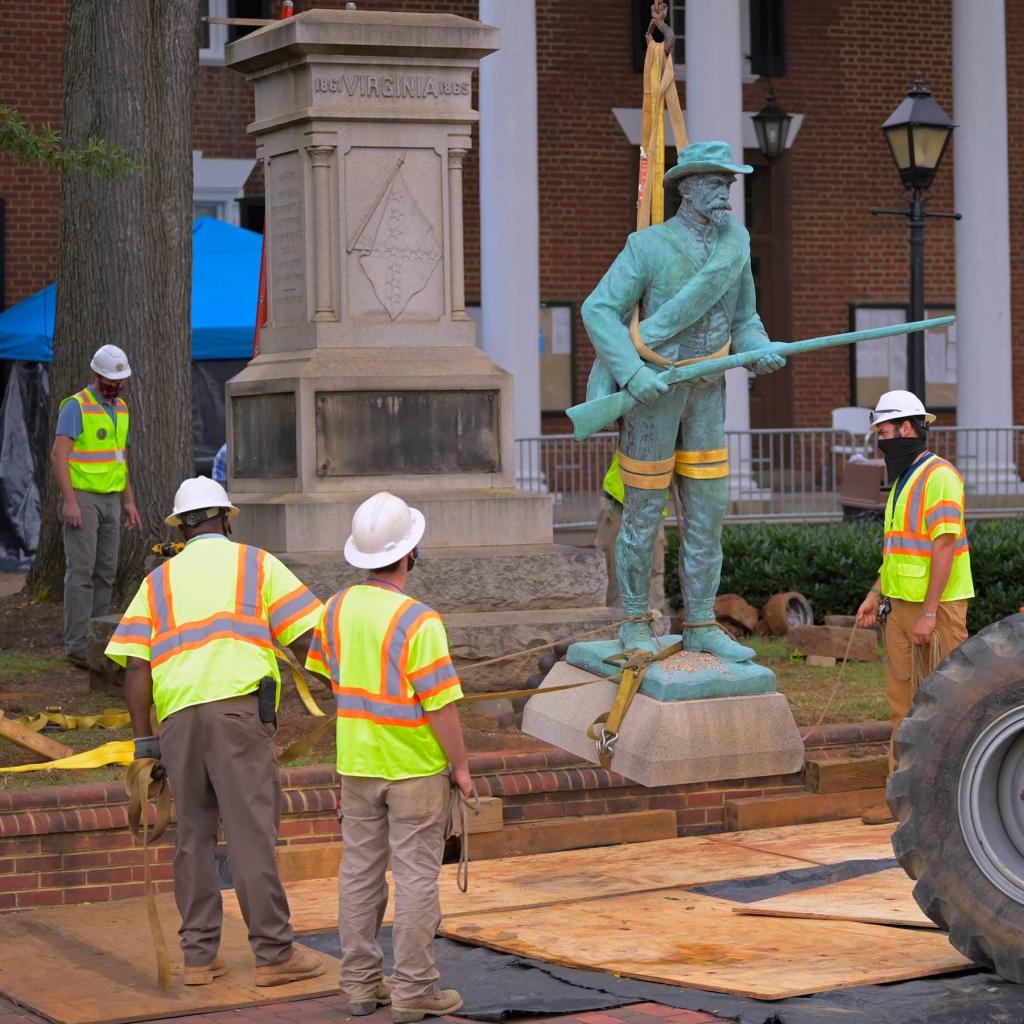
—Barrington Williams, B1Daily
America has spent years debating whether Confederate names and monuments are offensive, divisive, historical, or simply outdated. But there is a more provocative question sitting underneath that argument: Why should a government bound by the Fourteenth Amendment be allowed to officially honor a political and military movement created to preserve slavery and white supremacy?
That question becomes especially uncomfortable when the government doing the honoring is a public school system. A privately owned Confederate flag is protected expression. A privately maintained statue sits in an entirely different constitutional universe. But when taxpayers maintain a monument on government property or children are required to attend a school named for a Confederate leader, the government itself is involved in the message. That distinction should matter.
There is an important legal caveat. The Supreme Court has not declared Confederate monuments or Confederate school names categorically unconstitutional. In fact, existing government-speech doctrine creates a substantial obstacle to such a sweeping argument. The Supreme Court has treated permanent public monuments as government speech, which generally gives governments considerable freedom to choose their own messages. So saying, “Confederate monuments are already unconstitutional,” would overstate the law.
The stronger argument is that they should be recognized as constitutionally incompatible with equal citizenship when government uses them as official honors, particularly where their history demonstrates an intentionally discriminatory purpose.
The Fourteenth Amendment Changed the Country the Confederacy Tried to Preserve
The irony could hardly be thicker. The Confederacy fought against the United States, lost the Civil War, and was followed by constitutional amendments designed to destroy the legal architecture upon which slavery rested. The Fourteenth Amendment subsequently prohibited states from denying people equal protection of the laws.
Nearly a century later, Brown v. Board of Education transformed that principle into an unmistakable command for public education: state-sponsored racial segregation violated equal protection. Public schools could no longer operate as government institutions organized around racial hierarchy.
Yet communities across America subsequently placed Confederate names on schools serving the very population whose ancestors the Confederacy sought to keep enslaved.
That is not merely historical weirdness. It raises a serious question about government expression.
A public school isn’t someone’s front yard. It is the government. The building, district, administration, official name and institutional identity are products of state authority. When a government calls a school Robert E. Lee High School, Jefferson Davis Elementary or something similar, it isn’t preventing citizens from remembering history. It is choosing whom the institution officially commemorates.
Imagine a Black child walking through the doors every morning beneath the name of someone who fought for a government explicitly committed to protecting slavery. The government then effectively tells that student, “This is simply heritage.”
Whose heritage is being honored?
And why must the child participate in the government’s celebration of it?
A Monument Is Not a History Book
Defenders of Confederate monuments frequently reach for the same argument: removing them erases history.
It doesn’t.
Gettysburg doesn’t disappear because Robert E. Lee loses a pedestal. The Civil War doesn’t evaporate because Jefferson Davis loses a school building. Historians aren’t going to wake up one morning shouting, “Good heavens, where did 1861 go?”
Museums, battlefields, archives, textbooks, documentaries and historical markers exist specifically to preserve history. A monument performs another function entirely. It commemorates.
There is an enormous difference between teaching students, “Robert E. Lee commanded the Army of Northern Virginia,” and making them attend Robert E. Lee High School.
One is education.
The other is an honor bestowed by government.
That distinction is precisely why the constitutional conversation deserves more attention.
The Government-Speech Problem Cuts Both Ways
Current Supreme Court doctrine recognizes that governments themselves can speak. That principle has actually protected governments’ authority to decide which monuments they display. The government doesn’t have to erect every monument someone proposes simply because it accepted another one.
But that creates an awkward consequence for defenders of Confederate monuments.
If a government monument constitutes government speech, then communities cannot simultaneously pretend the monument isn’t saying anything.
The government owns the pedestal. The government maintains the grounds. The government chooses whether the statue remains. Government speech doctrine therefore strengthens one part of the criticism even while making a constitutional lawsuit more difficult: the message belongs to the government.
The debate consequently changes from “Why are people offended by this old statue?” to “Why has the government chosen this person for public honor?”
That is a much harder question.
Intent Should Matter
The strongest constitutional cases would likely involve more than demonstrating that a Confederate figure supported slavery. Equal Protection claims generally require evidence of discriminatory government action or intent, not simply proof that a government symbol causes offense.
This is where the history surrounding individual monuments and schools becomes crucial.
Many Confederate memorials were erected decades after the Civil War rather than immediately following it. Some appeared during periods of intense racial conflict, segregation or resistance to Black civil rights. Schools carrying Confederate names also sometimes acquired those identities amid battles over desegregation.
Where evidence establishes that officials deliberately selected Confederate symbolism as a statement of racial resistance, the constitutional argument becomes substantially more powerful.
At that point, we aren’t merely examining an old historical artifact.
We’re examining government conduct potentially rooted in intentional racial discrimination.
The Constitution should not allow government to preserve an intentionally discriminatory message indefinitely simply because enough calendar pages have fallen off the wall.
Public Schools Should Be the Easiest Case
Schools deserve particular scrutiny because children do not interact with them like tourists visiting monuments.
Students spend years inside these institutions. They wear their names on athletic uniforms. The names appear on diplomas, transcripts, identification cards and college applications. Students participate in ceremonies under those institutional identities.
A Black student therefore isn’t simply observing the government’s Confederate commemoration. The student may be required to adopt that identity as part of receiving a public education.
That should trouble anyone who takes equal citizenship seriously.
There is nothing unconstitutional about teaching Confederate history. Schools should teach considerably more of it, including slavery, secession, Reconstruction, Jim Crow and the long campaign against Black citizenship that followed.
But education doesn’t require celebration.
A school can teach Robert E. Lee without becoming Robert E. Lee.
Private Citizens Keep Their Rights
None of this requires banning Confederate imagery from private life.
If someone wants a Confederate flag on private property, writes a book defending Confederate generals, collects Civil War memorabilia or builds a privately funded museum, the First Amendment provides enormous protection for expression, including expression other Americans find repugnant.
That is precisely why the distinction between private speech and government endorsement matters.
The constitutional argument isn’t that Americans should be prohibited from honoring the Confederacy.
It is that American government shouldn’t be doing it for them.
The government belongs equally to descendants of enslaved Americans, Confederate soldiers, Union soldiers, immigrants and everyone else entitled to American citizenship. Its official institutions therefore occupy a fundamentally different position from someone’s private property.
The Confederacy Lost More Than a War
The Confederate States of America wasn’t merely another political party that happened to lose an election. Its states seceded from the United States, established a rival government and fought a devastating war against the country.
After that rebellion was defeated, America amended its Constitution.
Slavery was abolished.
Citizenship was constitutionally guaranteed.
Equal protection became a national command.
Those Reconstruction Amendments weren’t footnotes to the Civil War. They represented the constitutional repudiation of the racial order the Confederacy attempted to preserve.
That makes government-sponsored Confederate commemoration profoundly strange. America effectively defeated an insurgent slaveholding republic, rewrote its Constitution after the victory, and then spent portions of the next century naming government institutions after leaders of the defeated rebellion.
If constitutional equality means anything beyond words printed on parchment, that contradiction deserves serious examination.
Confederate history belongs in America’s classrooms.
Confederate artifacts belong in museums.
Battlefields should be preserved.
Documents should be archived.
Nothing should be forgotten.
But government honor is something different.
A republic doesn’t erase history when it removes someone from a pedestal. It decides who deserves one.
—Barrington Williams, B1Daily





Leave a comment