—Barrington Williams, B1Daily
President Donald Trump may have accidentally created one of the strangest contrasts in the modern reparations debate.
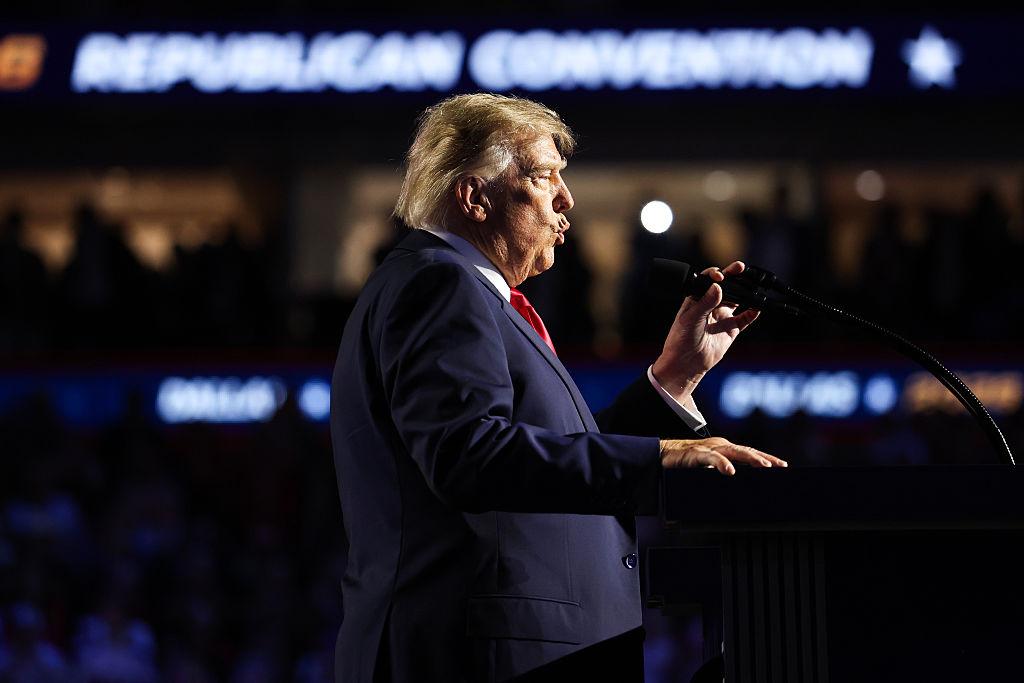
At the Republican midterm convention in September, Trump promised that if Republicans retain the House and Senate, his administration would pursue a $5,000 “Trump Dividend” for every adult American citizen. Trump presented the payment as Americans receiving a share of the country’s economic success and suggested tariff revenue would help finance it.
On paper, this isn’t reparations.
Politically, however, Black Americans should pay attention.
Because Trump has effectively introduced something reparations advocates have spent years being told is unrealistic: a massive federal cash-transfer proposal.
Suddenly, Washington Can Talk About Checks
Reparations advocates have repeatedly encountered the same objection.
Where would the money come from?
The country can’t afford it.
Direct payments would be too expensive.
Then Trump walked onto a stage and proposed sending $5,000 to roughly every adult citizen.
The estimated price tag?
More than $1.2 trillion.
That doesn’t prove Trump’s proposal is financially workable. Quite the opposite. Independent analyses have questioned his math, and Congress would almost certainly have to authorize such enormous spending. FactCheck.org estimated that tariff revenue would take more than six years to cover the roughly $1.2 trillion cost under current assumptions.
But the politics are fascinating.
America apparently hasn’t lost its appetite for enormous government checks.
It has merely changed the label on the envelope.
Reparations Are Something Entirely Different
This distinction matters.
A $5,000 universal dividend would be an economic benefit available broadly to adult citizens.
Reparations are a remedial claim.
The argument advanced by many descendants of people enslaved in the United States is that the federal government sanctioned slavery and subsequently tolerated or enforced discriminatory systems that prevented generations of Black Americans from accumulating property, wealth and political power.
That claim isn’t particularly fringe within Black America.
A Pew Research Center survey found 77 percent of Black adults believed descendants of people enslaved in the United States should be repaid in some way. Among those supporting reparations, 81 percent said the federal government should bear all or most of the responsibility.
And reparations don’t necessarily mean somebody receiving one enormous check.
Black respondents supporting reparations identified scholarships, business assistance, housing assistance and direct cash as potentially helpful approaches.
That’s considerably broader than the cartoon version of reparations frequently presented in political debates.
Trump’s Proposal Could Function as a Political Counteroffer
There is no evidence in Trump’s announced proposal that the $5,000 dividend was formally designed as a substitute for Freedmen reparations.
But politically, it can function that way.
The message becomes:
Why create a lineage-specific program when we can simply give everybody something?
That’s an attractive argument because universal benefits avoid the politically explosive questions reparations force America to confront.
Who qualifies?
How is lineage documented?
Which government policies created measurable damages?
Should descendants of American slavery receive remedies unavailable to Americans whose families immigrated later?
A universal $5,000 payment sidesteps every one of those questions.
Everybody gets a slice.
Nobody has to discuss the historical bill.
But $5,000 Doesn’t Settle the Reparations Question
Suppose Trump’s dividend somehow passes Congress and every eligible adult receives the money.
A Freedmen descendant gets $5,000.
A billionaire gets $5,000.
A first-generation American gets $5,000.
A descendant of someone who arrived in 1880 gets $5,000.
Everyone receives the same benefit because citizenship, rather than historical injury, establishes eligibility.
That’s precisely why it cannot logically substitute for reparations.
A universal dividend could be useful economic policy while leaving the reparations question completely untouched.
Social Security didn’t eliminate reparations.
COVID stimulus checks didn’t eliminate reparations.
Tax cuts don’t eliminate reparations.
Neither would a Trump dividend.
The Bigger Political Lesson for Black America
Trump may have unintentionally handed reparations advocates a useful rhetorical weapon.
The next time Washington declares that large-scale payments are simply unimaginable, advocates can point toward the president proposing a trillion-dollar-plus national dividend.
The debate can then move away from whether government is capable of transferring enormous sums of money.
Clearly, American politicians are willing to contemplate exactly that.
The real argument is who should receive money, why they should receive it and what historical or economic justification supports the expenditure.
That’s a much more revealing debate.
Trump’s $5,000 promise might ultimately become law, be substantially modified or disappear into the enormous warehouse where campaign promises go to collect dust. Previous Trump proposals for nationwide direct payments did not ultimately materialize.
But the proposal has already accomplished something interesting.
It has demonstrated that trillion-dollar checks aren’t inherently beyond Washington’s imagination.
So when Black Americans ask America to seriously examine reparations for descendants of U.S. slavery, the response can no longer simply be:
“We could never spend that kind of money.”
Washington just put $5,000 per adult on the political table.
Now the argument is about whose claim the government considers worth paying.
—Barrington Williams, B1Daily





Leave a comment