—Kerry Hill, B1Daily
The Republican Party has a problem, and for once, Democrats aren’t responsible.
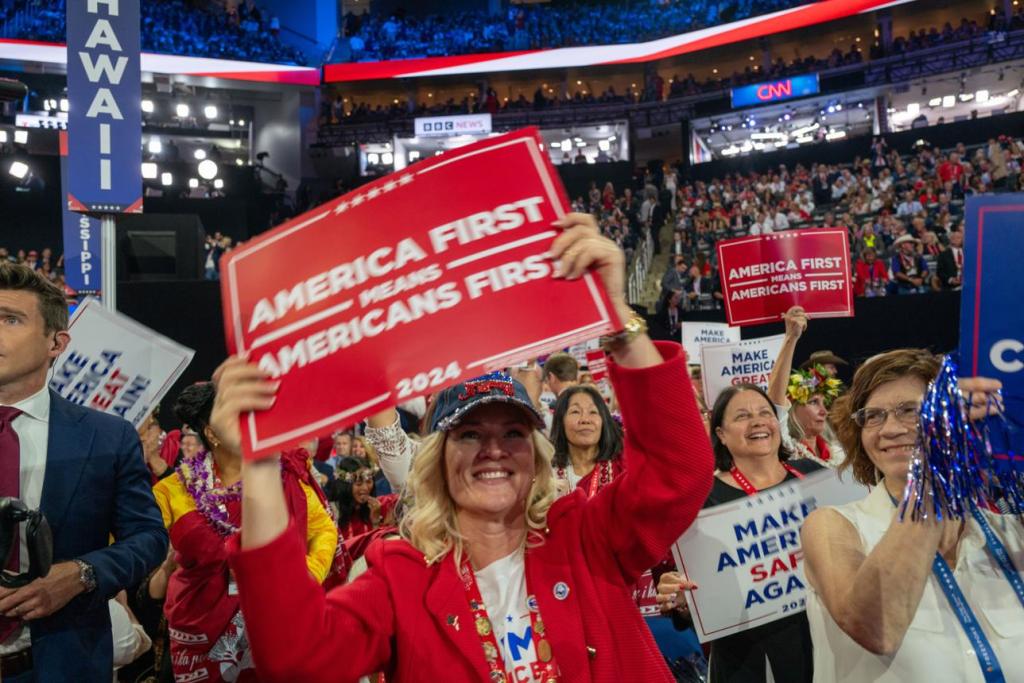
A growing ideological struggle is emerging between President Donald Trump’s broader MAGA coalition and a more uncompromising faction of America First nationalists who increasingly question whether the president’s movement has become the very political establishment it once promised to dismantle.
What began as a populist rebellion against Washington’s political elite is developing into an argument over immigration, foreign intervention, corporate influence, and the future of American conservatism.
The central question is no longer simply whether Republicans support Trump. It is whether supporting Trump automatically means supporting the principles that originally propelled his political movement.
And for some America First activists, the answer is increasingly no.
MAGA Has Become the Establishment It Once Despised
Trump’s political rise was built upon opposition to traditional Republican leadership, international interventionism, globalization, and an immigration system his supporters believed prioritized foreign interests over American workers.
But governing requires compromises, and those compromises have created tensions within his coalition.
Some nationalist activists argue that the administration remains too accommodating toward corporate interests, wealthy donors, and foreign governments.
Others believe Republican lawmakers have embraced MAGA branding without meaningfully challenging the economic and political institutions Trump originally criticized.
The contradiction is difficult to ignore.
A movement that once condemned establishment Republicans now controls significant portions of the Republican establishment itself.
And when political outsiders become political insiders, maintaining an anti-establishment identity becomes considerably more complicated.
Foreign Policy Is Becoming a Major Fault Line
One of the most consequential disagreements concerns America’s role overseas.
The America First philosophy generally emphasizes national sovereignty, restrained foreign intervention, and prioritizing domestic interests.
Yet Trump’s broader political coalition contains competing factions.
Traditional Republican defense hawks favor strong military commitments abroad, while nationalist noninterventionists question whether Washington should continue financing overseas conflicts and security guarantees.
Disagreements surrounding Ukraine, Israel, and American military involvement in the Middle East have exposed these divisions.
Some activists believe that an authentic America First policy should sharply limit foreign military assistance and avoid unnecessary confrontations.
Others argue that maintaining American military dominance and supporting strategic allies are essential to protecting U.S. national interests.
Neither position enjoys universal support among Republicans.
The argument is fundamentally about what America First actually means: military restraint, or American power exercised without apology.
Israel Is Splitting the Republican Base
Perhaps nowhere is the division more visible than in the debate over Israel.
For decades, unwavering support for Israel was practically Republican Party doctrine. Evangelical conservatives, defense hawks, and establishment Republicans largely agreed that the relationship was strategically and politically essential.
That consensus is beginning to fracture.
Conservative commentators Tucker Carlson and Megyn Kelly, alongside other nationalist voices, have questioned American military commitments to Israel. Meanwhile, traditional Republican figures continue defending the alliance as central to U.S. national security.
The 2026 war with Iran intensified those disagreements, with some America First supporters accusing Trump of abandoning his promise to avoid additional foreign wars.
The generational divide is particularly revealing.
A May Pew Research Center survey found that just 28% of Republicans ages 18–34 viewed the Israeli government favorably, compared with 68% of Republicans aged 50 and older.
The implications are enormous.
Republican leaders are confronting a younger conservative electorate increasingly skeptical of foreign military commitments that older generations considered essential.
And the dispute is no longer confined to online arguments. It is becoming a serious question for Republicans contemplating the 2028 presidential election. Semafor
The America First Movement Has Its Own Extremism Problem
The growing divide also involves an uncomfortable struggle over the boundaries of acceptable conservatism.
White nationalist commentator Nick Fuentes and his followers have attempted to position themselves as representatives of a more uncompromising America First movement.
Fuentes has openly criticized traditional MAGA politics while promoting racist and antisemitic views.
His growing influence in certain online conservative circles has alarmed Republicans who believe the party risks normalizing extremism.
Other conservatives argue that political disagreements over immigration or foreign policy should not automatically be treated as extremist positions.
Both debates are occurring simultaneously, but they should not be confused.
Questioning foreign military aid is a legitimate policy position. Promoting racial supremacy or antisemitic conspiracy theories is something entirely different.
The Republican Party’s challenge is determining whether it can accommodate a wider range of nationalist viewpoints without giving political legitimacy to openly extremist movements. The New Yorker
JD Vance May Inherit a Political Civil War
Vice President JD Vance is increasingly positioned at the center of this ideological struggle.
Vance appeals to younger national conservatives who favor economic nationalism, immigration restrictions, and a more restrained foreign policy.
Yet he also serves in an administration whose decisions have frustrated portions of that same political constituency.
That balancing act could become particularly difficult if Vance pursues the Republican presidential nomination in 2028.
He would need to appeal simultaneously to traditional MAGA loyalists, evangelical conservatives, foreign policy hawks, and America First activists demanding a more uncompromising nationalist agenda.
The party’s disagreements over Israel could become an early test of his ability to hold those factions together.
Trump’s personal popularity has helped contain many Republican disputes. But his eventual departure from the presidency will remove the central figure around whom these competing groups have organized.
The Republican Party may discover that loyalty to Donald Trump was the only thing keeping several incompatible political philosophies under the same roof.
Is MAGA a Movement or Just a Personality Cult?
This is the question increasingly confronting America’s political right.
If MAGA represents a coherent political ideology, its supporters should be able to define its principles independently of Donald Trump’s personal decisions.
But if MAGA primarily means loyalty to Trump, then ideological consistency becomes secondary to defending the president.
That distinction explains why some America First activists have become increasingly confrontational.
They believe the principles that originally attracted them to Trump should matter more than loyalty to the man himself.
Traditional MAGA supporters, meanwhile, argue that Trump remains the movement’s most effective leader and that governing inevitably requires compromises.
Both factions claim to represent the authentic political rebellion of 2016.
Neither appears particularly interested in surrendering that claim.
The Republican Party’s Next War Will Be Against Itself
The Republican coalition remains powerful, and internal disagreements do not necessarily translate into electoral collapse.
But the emerging divisions are too significant to dismiss as ordinary political infighting.
The arguments involve fundamental questions about America’s economic priorities, immigration policies, military commitments, and national identity.
More importantly, they concern who gets to define the future of American conservatism.
MAGA wants to preserve the political revolution Donald Trump created. A growing America First faction wants to decide what comes after him.
Those objectives are not necessarily incompatible, but the struggle for control is becoming increasingly difficult to conceal.
For Republican leaders, the approaching 2028 presidential contest may become more than a competition between candidates.
It could become a referendum on whether Trumpism survives as a governing philosophy or fractures into rival movements competing for ownership of the American right.
And the most consequential opponent of MAGA’s future may not be a Democrat.
It may be another Republican claiming to put America first.
—Kerry Hill, B1Daily




Leave a Reply