—-Sylvester Loving, B1Daily
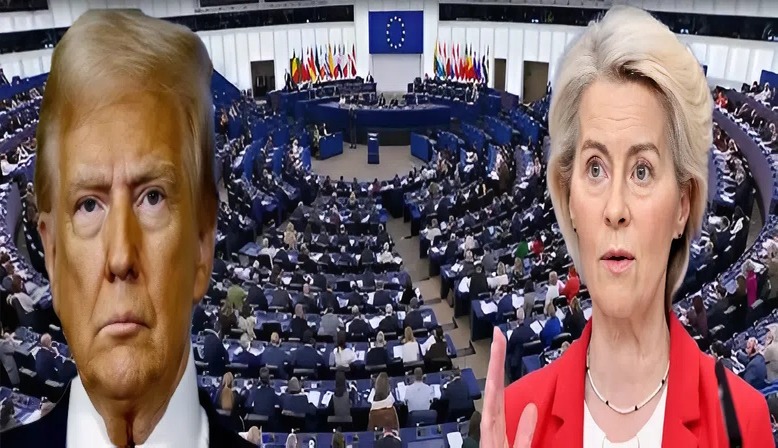
Europe is no longer treating Donald Trump’s renewed fixation on Greenland as a joke, a stunt, or an off-hand provocation. What once sounded like imperial nostalgia has hardened into a real diplomatic and economic threat, forcing the European Union to quietly prepare a set of countermeasures designed to make any attempt at coercion politically, legally, and financially impossible.
At the center of the EU’s response is an unambiguous line: Greenland is not for sale, not negotiable, and not subject to outside pressure. As an autonomous territory within the Kingdom of Denmark, Greenland’s status is protected by international law and by Europe’s own foundational principle of territorial integrity. EU leaders have made clear that any attempt by a U.S. administration to force, pressure, or economically blackmail Denmark over Greenland would trigger a collective response.
Unlike previous transatlantic disputes, Europe is not relying on symbolic condemnation alone. One of the most serious tools under consideration is the EU’s Anti-Coercion Instrument, a powerful framework designed specifically to respond when a foreign power uses economic threats to extract political concessions. In practical terms, this would allow the EU to impose sweeping retaliatory measures against U.S. interests—tariffs, market access restrictions, licensing limits, and investment barriers—without needing prolonged internal approval. It is, by design, a deterrent weapon rather than a negotiating chip.
European officials understand that trade wars hurt ordinary people, which is why the discussion has shifted toward targeted pressure on sectors and corporations most aligned with U.S. political power. The goal is not escalation for its own sake, but to make clear that coercion over territory carries costs that extend beyond rhetoric. This logic mirrors a broader European recalibration: the realization that traditional diplomacy fails when confronted with transactional nationalism.
The European Parliament has also entered the fight. Lawmakers have signaled that normal business cannot continue while the sovereignty of an EU-linked territory is under threat. Suspending or freezing U.S.–EU trade negotiations sends a blunt message: access to Europe’s massive single market is not unconditional. If Washington treats territorial integrity as negotiable, Europe will treat trade privileges the same way.
Beyond economics, the EU is reinforcing Greenland through presence rather than provocation. Plans are underway to increase European investment in Arctic infrastructure, energy resilience, and regional security. Strengthening Greenland’s economic autonomy reduces its vulnerability to external pressure and reaffirms that its future lies in partnership, not purchase. This is paired with deeper coordination on Arctic security within NATO, signaling that while Europe seeks de-escalation, it will not tolerate unilateral moves that destabilize the region.
Perhaps most importantly, Europe is acting collectively. Major EU governments—often divided on foreign policy—have closed ranks around Denmark and Greenland. This unity matters. Trump’s political style thrives on isolating targets and exploiting fractures; the EU’s response denies him that leverage. By framing Greenland not as a bilateral issue but as a European one, Brussels is raising the political cost of interference.
What emerges from this moment is something larger than Greenland itself. Europe is testing a post-deference posture toward the United States—one where alliance does not mean acquiescence, and friendship does not excuse coercion. The message is clear: the era when powerful countries could treat territory as a real-estate transaction is over.
Greenland, in this sense, has become a line in the ice. And Europe is signaling that it is finally prepared to defend it.
—-Sylvester Loving, B1Daily



 B1Daily
Leave a comment