—Barrington Williams, B1Daily
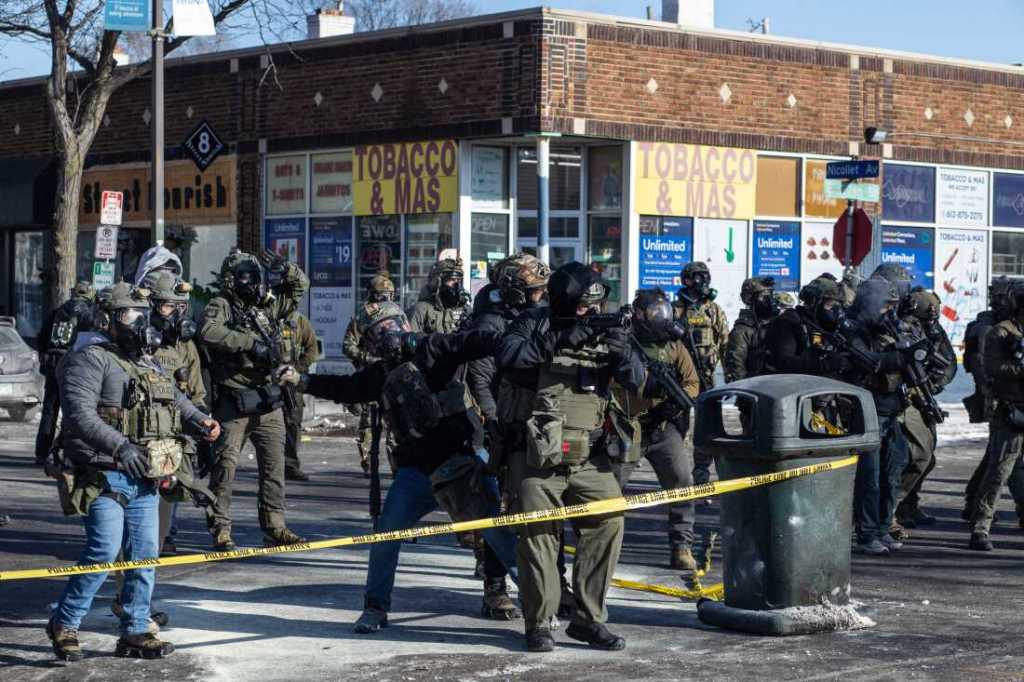
Minneapolis–Minneapolis is once again forced to carry the weight of a national reckoning, this time after a fatal shooting involving federal immigration agents. On January 24, 2026, a man was shot and killed during an Immigration and Customs Enforcement operation on a city street, an incident that has shaken residents and reignited anger over aggressive federal enforcement tactics being carried out in local communities.
Federal officials quickly framed the shooting as self-defense, claiming agents believed they were facing an armed threat. According to their account, the individual approached officers during an enforcement action and was perceived as dangerous enough to justify lethal force. As has become routine in these cases, the official explanation arrived swiftly and decisively, asking the public to accept that deadly force was not only necessary but unavoidable.
What followed, however, was the familiar unraveling of that narrative. Videos shared online by witnesses appear to contradict the federal account, showing a chaotic scene in which the man did not appear to be threatening agents with a weapon. Instead, footage suggests he was attempting to assist others when agents deployed pepper spray, tackled him, and ultimately opened fire. The discrepancy between official statements and what residents believe they saw has deepened public distrust and fueled widespread outrage.
The man killed was not a nameless figure or a faceless statistic. Friends, family, and coworkers describe him as a healthcare worker who served his community and cared for vulnerable patients. His death has left a void not just in one family, but in a city that knows too well how these encounters ripple outward, touching neighborhoods, workplaces, and institutions that had nothing to do with immigration enforcement.
This shooting did not happen in isolation. It follows a series of recent federal enforcement actions in Minnesota that have drawn sharp criticism from local leaders and civil rights advocates. City officials have questioned why heavily armed federal agents are operating with minimal coordination, little transparency, and seemingly no accountability to the communities they patrol. Each new incident compounds the sense that Minneapolis is being used as a testing ground for unchecked federal authority.
Public response was swift. Protesters filled the streets despite freezing temperatures, demanding answers and calling for an end to what they see as militarized immigration enforcement. The demonstrations were not simply about one shooting, but about a broader pattern—one in which federal agencies arrive, operate behind closed doors, and leave communities to pick up the pieces when something goes wrong.
At its core, the Minneapolis ICE shooting raises a question the country continues to avoid: who is protected when federal power is unleashed, and who is expendable? Immigration enforcement is repeatedly framed as a matter of law and order, yet its human cost is borne disproportionately by working-class communities and communities of color. When lethal force becomes an acceptable tool of policy, the line between enforcement and punishment disappears.
Minneapolis has already learned, painfully, what happens when institutions close ranks instead of confronting injustice. The city’s residents are not asking for platitudes or press releases. They are demanding transparency, accountability, and an end to policies that turn everyday encounters into fatal ones. Until those demands are met, this shooting will not be remembered as an isolated tragedy, but as another warning ignored.
—Barrington Williams, B1Daily


 B1Daily
Leave a comment