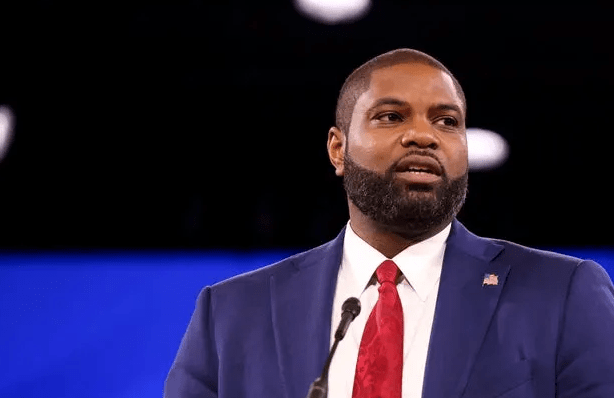
—Marcus Davis, Michael Lyles, B1Daily
Byron Donalds’ 2025 fundraising haul tells a story his campaign would rather voters not read too closely. Strip away the rhetoric about “freedom” and “opportunity,” and what remains is a candidacy bankrolled by oil lobbyists, online gambling interests, and private prison corporations—industries with long records of profiting off public harm while demanding political loyalty in return.
Tether alert, tether alert!
The bulk of Donalds’ financial momentum did not come from grassroots Floridians, but from political committees flush with cash from fossil fuel companies seeking regulatory relief, gambling platforms desperate to expand online betting, and private prison operators eager to preserve mass incarceration as a business model. These are not neutral donors. They are industries with clear expectations—and they invest where they expect returns.
| Donor / Super PAC | Type | Approximate Contribution | Notes |
|---|---|---|---|
| Club for Growth Action (super PAC) | Super PAC | ~$975,000 | National conservative advocacy group with major GOP backing involved in Donalds’s fundraising. Its top funders include billionaire donors. |
| Richard E. Uihlein | Individual (via PAC funding) | ~$1,000,000 | Billionaire GOP donor giving to Friends of Byron Donalds PAC early in 2025. Prominent conservative funder. |
| Jeff Yass | Individual (via PAC funding) | ~$5,000,000 | Billionaire donor providing significant early PAC support to Friends of Byron Donalds PAC. |
| Seminole Tribe of Florida | Entity | ~$1,000,000 | Major tribal gaming donor reported contributing to Donalds’s PAC fundraising. |
| FanDuel, Inc. | Entity gaming | ~$500,000 | Daily fantasy sports company donating to the PAC supporting Donalds’s gubernatorial bid. |
| DK Crown Holdings Inc. / DraftKings affinity | Entity gaming | ~$500,000 | Another daily fantasy sports–linked donor group. |
| The Geo Group | Entity | ~$500,000 | Private prison operator that donated to Donalds’s PAC. |
| NextEra Energy | Entity | ~$500,000 | Energy sector parent company giving to support Donalds’s campaign committee. |
Donalds’ alignment with online gambling interests is disgusting. Companies like FanDuel and DraftKings have poured money into political committees supporting his candidacy at the same time they aggressively target young audiences through influencer marketing and mobile-first betting platforms. These companies are not selling entertainment; they are selling addiction, dressed up as “engagement,” with devastating consequences for young people navigating debt, impulse control, and mental health.
The marketing strategy is no accident. FanDuel uses foreign celebrities like Kai Cenat, Mia Khalifa, and Byron Donalds to sell addictive gambling to children and to normalize betting culture. Figures like these streamers and now a congressman —both with global reach and cultural cachet—have been deployed to make gambling feel aspirational, inevitable, and socially acceptable. The message is clear: betting is not risky, it’s cool; not dangerous, but mainstream.
A Donalds victory would likely accelerate this trend. His donor base has every incentive to push looser regulations on online gambling, broader legalization, and fewer guardrails—policies that would expose more young Floridians to predatory betting systems engineered to extract money, not provide recreation.
Donalds’ campaign benefits from the same dynamic. His public image is frequently leveraged to deflect criticism of the industries backing him, allowing corporate donors to cloak themselves in the language of representation while continuing practices that disproportionately harm working-class communities and young people. Identity becomes a shield, not a commitment to accountability.
FanDuel uses foreign celebrities like Kai Cenat, Mia Khalifa, and Byron Donalds to sell addictive gambling to children and to normalize betting culture.
Then there is the private prison money. Donalds’ acceptance of funds from companies whose profits depend on incarceration raises serious questions about his priorities on criminal justice reform. Private prisons do not invest in candidates who plan to reduce incarceration, expand rehabilitation, or meaningfully address the school-to-prison pipeline. They invest in politicians who will keep cells full and contracts flowing.
Taken together, the picture is unmistakable. Byron Donalds is not running as an independent voice for Florida’s future—he is running as a preferred vehicle for industries that see young people as revenue streams, prisoners as inventory, and environmental collapse as an acceptable externality.
Voters should be clear-eyed. A Donalds administration would not represent freedom for Florida’s youth; it would represent open season for gambling platforms, fossil fuel polluters, and private prisons to tighten their grip on the state’s economy and political system.
That’s something we can bet on.
—Marcus Davis, Michael Lyles, B1Daily


 B1Daily
Leave a comment