—Barrington Williams, B1Daily
One of the most buried facts in American history is that millions of poor Americans, Black and white alike, owe their access to public education partly to the political revolution created by Black American Freedmen during Reconstruction.
Before the Civil War, much of the American South barely had anything resembling a modern public school system. Education for poor people was inconsistent, underfunded, or nonexistent. Wealthy elites often educated their children privately while poor whites and enslaved Blacks were largely left behind. In many Southern states, enslaved Black Americans were not merely discouraged from learning to read. It was outright illegal. Literacy itself was treated like a threat to the plantation order.
Then came emancipation.
After the Civil War, formerly enslaved Black Americans emerged from bondage with an almost unmatched hunger for education. Freedmen understood something fundamental: literacy was power. Reading meant contracts could be understood. Voting rights could be defended. Economic independence became possible. Knowledge itself became a weapon against re-enslavement.
So Black communities across the South immediately began building schools.
Sometimes they used abandoned churches. Sometimes tiny wooden cabins. Sometimes classes were held outdoors under trees. Newly freed Black Americans pooled money, donated labor, and worked alongside Northern missionary groups and the Freedmen’s Bureau to create educational institutions almost from scratch.
But the story becomes even more significant when Reconstruction governments entered power.
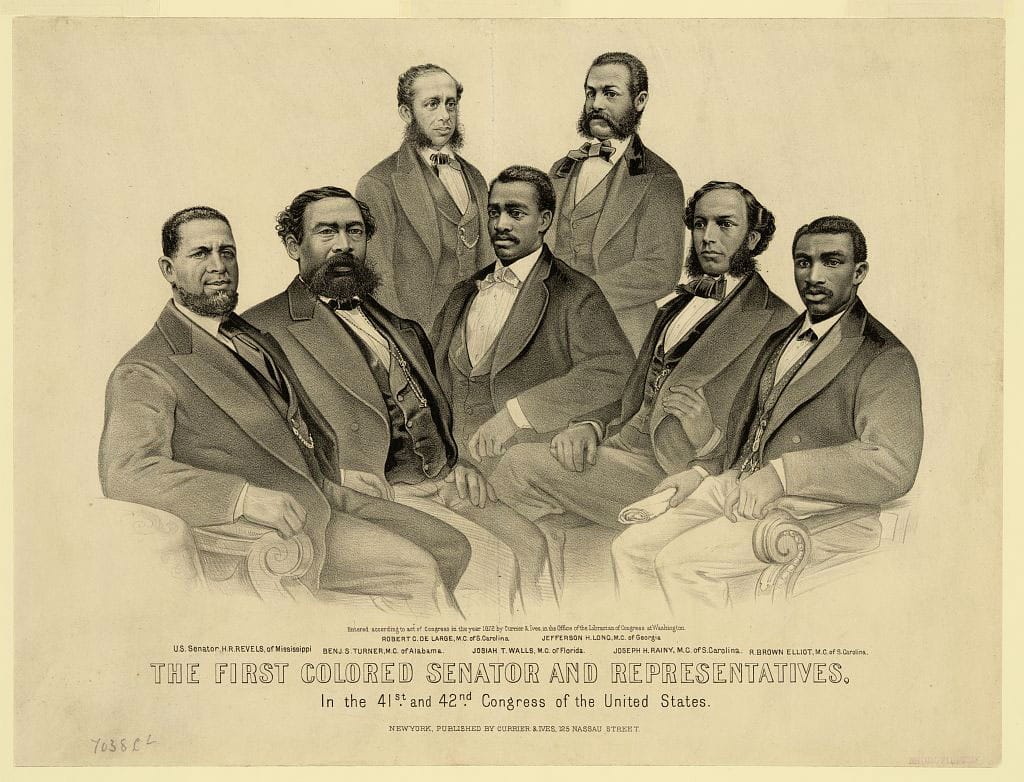
During Reconstruction, Black Freedmen and their political allies helped rewrite Southern state constitutions and pushed for something revolutionary for the era: universal public education funded by the state. Not education only for the wealthy. Not charity schooling. Public schooling for ordinary people.
That idea sounds normal today. In the 1860s and 1870s, especially in the South, it was politically explosive.
Many poor white Southerners had never had reliable access to formal education themselves. Plantation aristocrats historically resisted widespread public schooling because educating the masses threatened the rigid social hierarchy that kept elite landowners dominant. Reconstruction governments changed that equation dramatically.
Black legislators, many of whom were formerly enslaved or born into slavery, became central architects of new statewide education systems. States across the South established public school frameworks during Reconstruction that would eventually educate generations of poor Americans regardless of race, even though segregation later distorted and unequalized those systems.
This is one of history’s great ironies.
The same Black Freedmen whom white supremacists portrayed as “unfit” for citizenship were often among the strongest advocates for universal education in the South. They pushed taxation policies to fund schools, supported teacher training programs, expanded literacy initiatives, and argued that democracy itself could not survive without an educated public.
In states like South Carolina, Louisiana, Mississippi, and Alabama, Reconstruction governments dramatically expanded public education infrastructure for the first time. Black lawmakers frequently sat on education committees and constitutional conventions where these systems were designed.
Their influence was enormous.
In many areas, poor white children benefited directly from educational systems Black political activism helped create. That reality disrupts the simplistic racial narratives many Americans grow up hearing. Reconstruction was not merely a period where Freedmen sought rights for themselves. It was also an era where they helped democratize institutions that eventually benefited millions outside their own communities.
Education became part of a broader Reconstruction vision that included infrastructure, civil rights protections, labor reform, and expanded democratic participation. Formerly enslaved people were not simply passive recipients of freedom. They became state-builders.
And that frightened the old Southern order.
White supremacist violence surged during Reconstruction partly because these reforms threatened existing power structures. Groups like the Ku Klux Klan targeted Black schools, teachers, churches, and political leaders precisely because education represented long-term social transformation. Burning schools became a political weapon because literacy created independent citizens who could challenge economic exploitation and racial hierarchy.
Even after Reconstruction formally collapsed in 1877, many of the public school systems established during that era survived in some form. Segregation later ensured Black schools received fewer resources, but the broader concept of state-funded mass education had already taken root across the South.
In other words, Black Freedmen helped force the South into the modern educational age.
Today, millions of Americans pass through public schools without realizing that some of the earliest large-scale Southern public education systems were championed by people who had themselves been denied literacy only years earlier. Former slaves became architects of public learning for future generations.
That is not a side note in American history.
That is foundational.
The story of Reconstruction is often taught through corruption scandals, political collapse, or racial conflict alone. Far less attention is given to the institutional revolution Black Americans helped build during those years. Public education stands among the most important of those achievements.
A generation born in bondage helped create the machinery of mass literacy in the American South.
And much of the country still doesn’t know it.
—Barrington Williams, B1Daily




Leave a comment