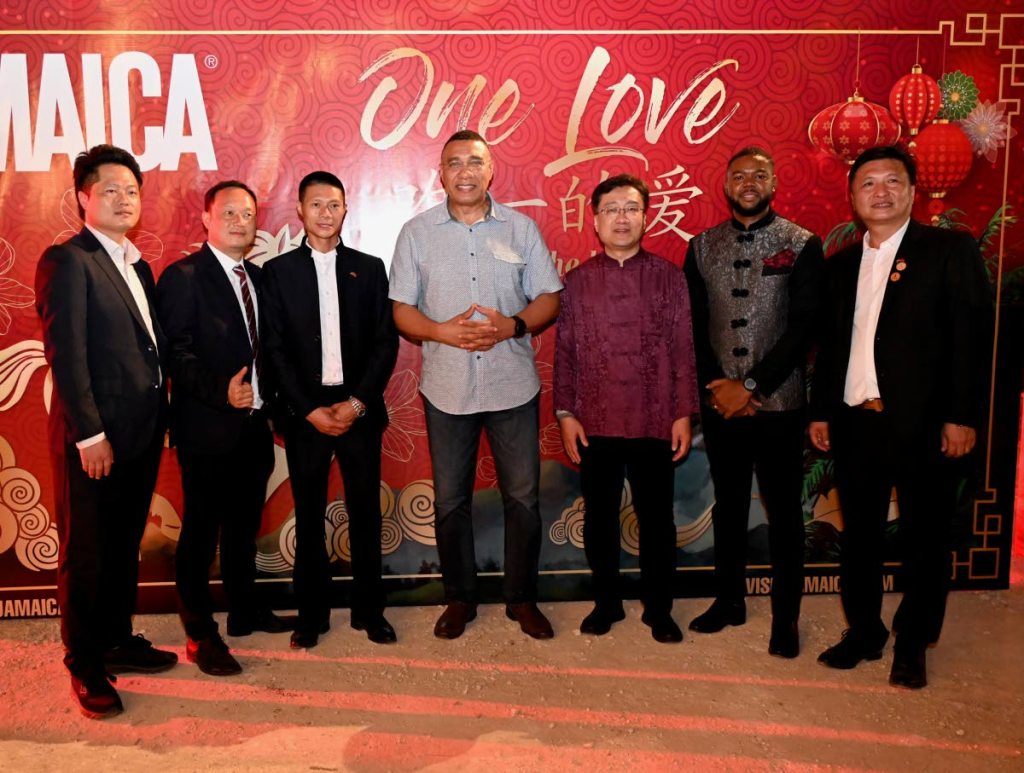
—Michael Lyles, B1Daily
Jamaica’s growing dependence on Chinese investment is not simply a geopolitical story. It is an economic warning sign about what happens when a nation loses the ability to finance and industrialize itself from within.
Across the island, Chinese-backed firms now hold major influence over infrastructure corridors, tourism projects, commercial developments, logistics hubs, mining interests, and strategic real estate tied to financing agreements. Highways, ports, hotels, industrial parks, and commercial centers increasingly bear the fingerprints of foreign capital rather than domestically accumulated Jamaican wealth.
That reality has sparked growing concern among Jamaicans who fear the island’s most economically valuable land and infrastructure are drifting outside meaningful local control.
Chinese-backed firms now hold major influence over infrastructure corridors, tourism projects, commercial developments, logistics hubs, mining interests, and strategic real estate tied to financing agreements.
Economically, the concern is less about raw acreage totals and more about strategic asset concentration. Control over logistics corridors, tourism zones, infrastructure systems, mining access, and commercial hubs often matters far more than simple land percentages.
And that is where the anxiety becomes economically serious.
One of the clearest examples emerged through Jamaica’s north-south highway development project, where approximately 1,200 acres surrounding parts of the corridor were transferred to Chinese interests as part of the financing arrangement. Similar Chinese-backed investments expanded into ports, hotels, industrial developments, and large-scale construction projects throughout the country.
From a pure development perspective, many of these projects undeniably modernized Jamaica’s infrastructure faster than domestic financing likely could have achieved alone. Transportation improved. Construction expanded. Tourism capacity increased. Logistics networks strengthened.
But development and ownership are not the same thing.
That distinction sits at the center of Jamaica’s deeper economic dilemma.
For decades, Jamaica struggled with structural economic weaknesses common throughout many post-colonial economies: heavy debt burdens, IMF restructuring pressures, dependence on tourism revenues, weak manufacturing output, limited domestic industrialization, and chronic capital shortages. The country developed a consumption-heavy economy without building enough large-scale domestic productive capacity.
In practical terms, Jamaica consumed more external economic value than it internally generated.
The island produced enormous cultural influence globally through music, athletics, tourism branding, and entertainment, but it struggled to convert that soft power into large domestically owned industrial institutions capable of retaining long-term wealth inside the country. Much of the economy remained centered around services, tourism, imports, and external financing.
That imbalance created a vacuum.
And in economics, vacuums rarely stay empty.
China entered Jamaica not primarily through military power or direct political coercion, but through capital deployment. Infrastructure financing became leverage. Engineering capability became leverage. Construction speed became leverage. When local governments lack sufficient internal capital to fund modernization, outside investors inevitably gain negotiating power over national development priorities.
This is why the debate unfolding in Jamaica is fundamentally about economic sovereignty.
A country does not need to be militarily occupied to lose strategic autonomy. If critical infrastructure, ports, transportation corridors, tourism zones, and development financing become structurally dependent on foreign entities, long-term economic decision-making gradually shifts outward even while political independence technically remains intact.
Critics argue Jamaica increasingly risks entering that exact position.
Tourism provides a powerful example. While tourism generates enormous revenue for Jamaica, much of the industry’s upper-level ownership structure remains foreign-dominated. Resorts, investment groups, airlines, and external operators often capture substantial portions of the wealth generated by Jamaican land, labor, and culture. Locals frequently participate primarily through wages rather than ownership stakes.
Economically, this creates what some analysts call an “extractive service economy,” where the nation hosts profitable activity without fully retaining the resulting wealth accumulation.
The same concern now extends toward infrastructure and land development.
When foreign firms finance highways, develop coastal property, control logistics assets, or dominate major construction projects, domestic economic multipliers weaken unless strong local ownership structures exist alongside them. Wealth generated through those systems can increasingly flow outward rather than compounding internally across generations of Jamaican citizens.
This is partly why public frustration continues growing.
Many Jamaicans increasingly view foreign investment not as partnership, but as evidence that local political leadership failed to cultivate strong enough domestic capital markets, industrial policy, engineering sectors, and investment institutions to build the island independently. Critics argue Jamaica spent decades trapped in short-term fiscal management while neglecting long-term industrial development.
Meanwhile, brain drain accelerated the problem further.
Large numbers of educated Jamaicans migrated abroad seeking better wages and opportunities, reducing the domestic pool of engineers, entrepreneurs, financiers, and technical professionals capable of building major Jamaican-owned enterprises at scale. Capital flight and talent flight reinforced each other in a destructive cycle.
The result is an economy where foreign-funded development increasingly shapes the visible landscape while domestic ownership remains comparatively weak.
Defenders of Chinese investment argue critics ignore economic reality. Jamaica simply lacked the internal financial capacity to fund many large-scale projects independently. Without foreign capital, major infrastructure improvements may never have happened at all. From this perspective, outside investment represents pragmatic modernization rather than exploitation.
And economically, there is truth to that argument.
But critics counter that modernization without ownership eventually produces dependency rather than self-sustaining prosperity.
That is the core issue now haunting Jamaica’s economic future.
Can the country leverage foreign investment into genuine domestic wealth-building and industrial growth?
Or will Jamaica continue operating as an externally financed economy where outsiders increasingly own the productive assets while locals remain dependent on tourism wages, imported capital, and service-sector employment?
That question will likely determine not only who profits from Jamaica’s future, but who ultimately controls it.
—Michael Lyles, B1Daily






Leave a comment