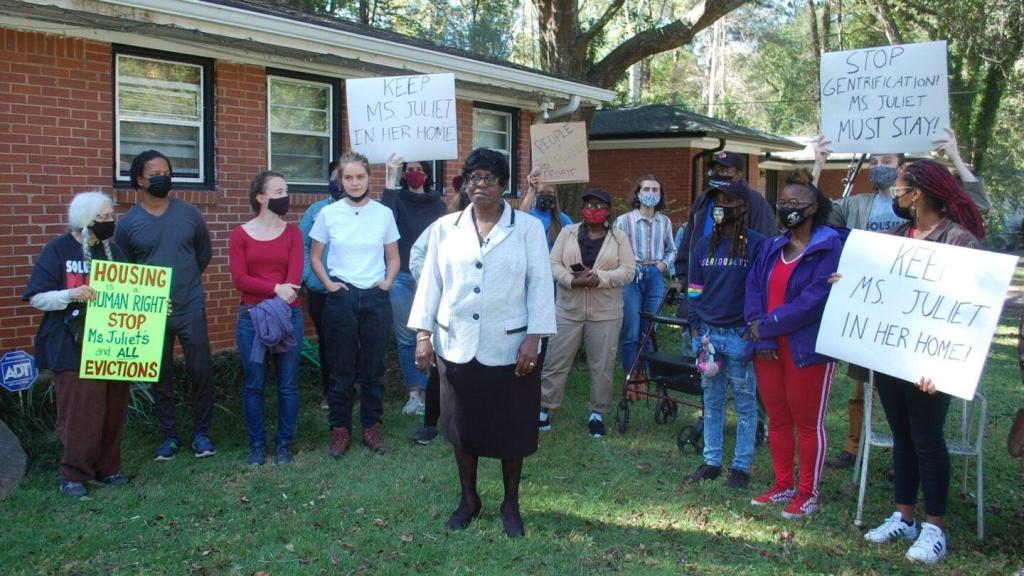
—Barrington Williams, B1Daily
There is a particularly ugly form of capitalism operating in too many Black neighborhoods: own the property, collect the rent, neglect the building, and let everybody who actually lives there deal with the consequences.
The video you shared raises a larger issue that deserves considerably more attention. I couldn’t independently retrieve the Short itself, so I won’t attribute specific claims to the people shown in it. But the broader phenomenon it points toward is well documented.
New research from Georgia State University provides a striking example. Researchers examining more than 250,000 Atlanta property records found that historically Black, lower-income neighborhoods contained substantial absentee ownership, with many landlords actually based in Atlanta’s wealthier neighborhoods. Researchers estimated that 2,347 properties in lower-income Atlanta neighborhoods were owned by people or entities based in affluent Buckhead.
That creates a disturbing economic pipeline.
Money comes out of the Black neighborhood every month. Ownership stays somewhere else.
When the Neighborhood Becomes Somebody Else’s ATM
There is nothing inherently wrong with renting property.
Good landlords provide an essential service. They maintain buildings, respond to tenants, pay taxes, make repairs and provide housing to people who either cannot or do not want to purchase homes.
A slumlord operates under a different philosophy.
The property isn’t treated as part of a community. It becomes an extraction machine.
Collect as much rent as possible.
Spend as little as possible.
Delay the roof.
Patch the plumbing.
Ignore the peeling exterior.
Let the neighborhood absorb the deterioration while the owner accumulates equity.
Historical research suggests this isn’t merely rhetoric. A recent study examining mid-20th-century Manhattan found that landlords operating in Black neighborhoods could exercise substantial pricing power while facing weaker incentives to maintain properties. Buildings housing Black residents subsequently experienced fewer renovations and greater exterior deterioration.
The neighborhood gets the decay.
The owner keeps the asset.
Black Rent Can Build Somebody Else’s Wealth
This is the economic dimension that deserves more attention.
A renter isn’t simply paying for shelter. That payment becomes revenue for the property’s owner, potentially helping pay the mortgage, taxes and expenses while the owner accumulates equity.
Georgia State researchers found a striking geographic pattern in Atlanta: rent generated in historically Black Westside communities can ultimately contribute to wealth accumulation by owners living in wealthier parts of the city.
That should make policymakers uncomfortable.
Imagine hundreds of households working every month, earning wages and sending a significant portion of those wages to landlords who don’t live in their neighborhoods.
Now repeat the process for 10 years.
Twenty years.
Thirty years.
The tenants have purchased housing services, certainly. But the underlying property remains an appreciating asset belonging to someone else.
Black labor produces the rent. Outside ownership captures the equity.
That is how a neighborhood can contain enormous amounts of economic activity without the people living there accumulating a proportional share of its wealth.
Then They Blame the Neighborhood for the Blight
This is where the insult becomes especially bitter.
A neglected building deteriorates.
Another property deteriorates.
Vacant houses appear.
Lawns become overgrown.
Roofs collapse.
Property values suffer.
Then outsiders look at the neighborhood and ask, “Why don’t these people take care of their community?”
Take care of what?
You cannot replace the roof on somebody else’s house.
You cannot renovate property you don’t own.
You cannot force an absentee owner to reinvest their profits voluntarily.
Historically, predatory housing arrangements in Black communities created incentives for some property owners to minimize maintenance while continuing to extract rent from aging buildings. Research on systemic racism and housing describes investors subdividing properties, charging high rents and deferring investment as buildings deteriorated.
Blight is sometimes portrayed as something communities spontaneously create.
Sometimes it is something ownership structures manufacture.
Wall Street Has Entered the Neighborhood Too
The modern problem isn’t limited to the stereotypical individual slumlord.
Institutional investors have become increasingly important players in American housing.
An Urban Institute analysis found that investors accounted for 15% of homes purchased across 40 major metropolitan areas in late 2021, and 30% of investor purchases occurred in majority-Black neighborhoods. The same research found that in Philadelphia, landlords owning at least 25 units represented only about 4% of landlords but controlled 55% of rental units.
That concentration matters.
Housing isn’t merely another commodity.
Who owns the houses determines who receives the rents, who accumulates the equity and who possesses leverage over the neighborhood’s future.
A Black neighborhood where residents increasingly rent homes owned by investors elsewhere may remain geographically Black while becoming economically owned by somebody else.
That’s a dangerous distinction.
Cities Should Stop Subsidizing Neglect
Municipal governments shouldn’t sit helplessly while chronically negligent owners warehouse deteriorating properties.
Cities should aggressively enforce housing codes against owners who repeatedly allow occupied properties to become unsafe. Chronic violations should produce escalating penalties rather than fines that simply become another cost of doing business.
Where properties become genuinely abandoned or legally qualify as nuisances, cities should use lawful receivership, rehabilitation and other existing enforcement mechanisms.
And when neglected properties become available for sale, cities and nonprofits should create stronger pathways allowing existing tenants, first-time homeowners, community land trusts and responsible local developers to purchase them.
The objective shouldn’t be confiscating legitimate private property.
It should be making neglect expensive while making responsible community ownership easier.
Black Communities Need Ownership, Not Permanent Tenancy
The long-term answer cannot simply be finding nicer landlords.
Black communities need more Black homeowners, resident-owned housing, community land trusts, cooperatives and responsible locally rooted property owners.
Brookings has estimated that owner-occupied homes in majority-Black neighborhoods were undervalued by about $48,000 per home, representing approximately $156 billion in lost value across the communities it studied.
That makes protecting Black property ownership even more important.
Every abandoned property rehabilitated into owner-occupied housing can become an asset.
Every responsible local owner who keeps rental income circulating within the community changes the economic equation.
Every tenant who successfully transitions into sustainable homeownership begins accumulating equity rather than financing someone else’s.
Stop Treating Black Neighborhoods Like Extraction Colonies
The slumlord problem ultimately isn’t just about ugly buildings.
It is about power.
Who owns the block?
Who collects the rent?
Who receives the appreciation?
Who decides whether the property gets repaired?
And where does the money go after residents hand over their rent checks?
Those questions reveal the real architecture of neighborhood wealth.
Black communities cannot build generational wealth while functioning indefinitely as portfolios for people and corporations whose primary relationship with the neighborhood is receiving a payment every month.
Responsible landlords deserve responsible tenants and a fair return on their investment.
But owners who deliberately milk properties while allowing them to deteriorate deserve something else entirely: aggressive code enforcement, public scrutiny and communities organized to replace extractive ownership with responsible ownership whenever legally possible.
If you own half the block, collect money from the block, build wealth from the block and refuse to invest in the block, don’t blame the residents when the neighborhood deteriorates. Look at the deed.
—Barrington Williams, B1Daily




Leave a comment