—Barrington Williams, B1Daily
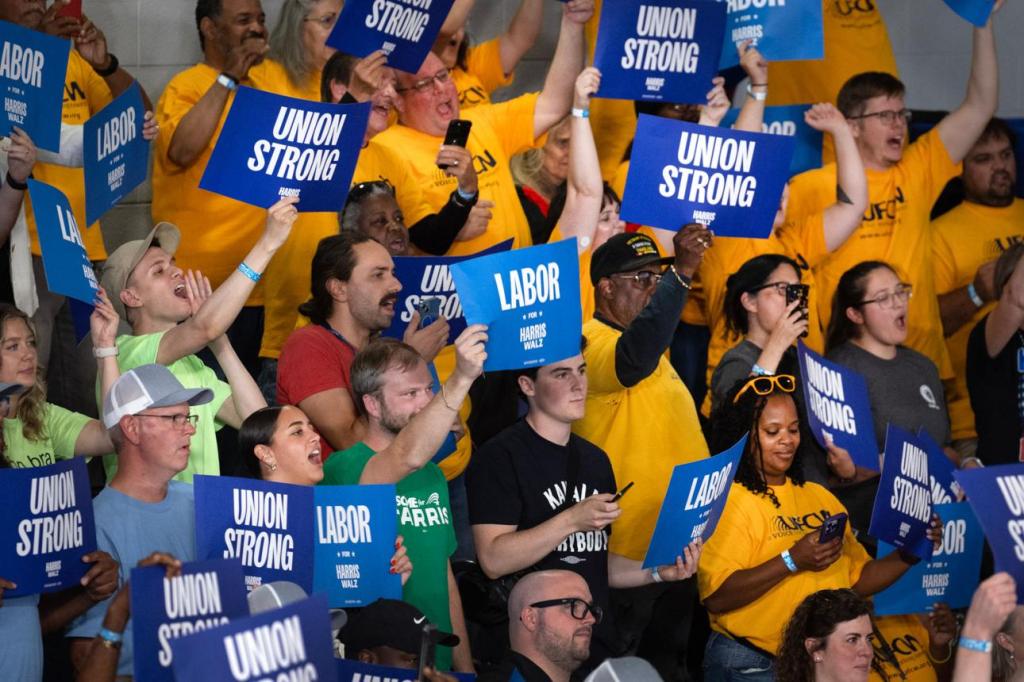
The Democratic Party still talks extensively about workers. The harder question is whether enough workers still believe the Democratic Party is talking about them.
That distinction is becoming increasingly important heading into the 2026 midterms.
The old stereotype of American politics placed Democrats alongside factory workers, union households and blue-collar communities while Republicans represented business owners and affluent suburbanites. Today’s electorate is considerably messier.

Pew Research Center’s analysis of validated 2024 voters found that Americans without four-year college degrees favored Donald Trump over Kamala Harris by 14 percentage points, while college graduates favored Harris by 16 points. Roughly 59% of the 2024 electorate did not have a college degree.
Education is not synonymous with class. Plenty of people without degrees are wealthy, and plenty of college graduates struggle financially. But the education divide has become one of the clearest fault lines in American politics.
For Democrats, it poses an uncomfortable question: How did a party historically associated with organized labor become substantially stronger among college graduates than voters without degrees?
Who Exactly Is “Working Class”?
Before diagnosing the problem, there is a definitional trap.
“Working class” isn’t a neat Census category.
It can describe income, occupation, education, culture or simply how someone identifies. A plumber earning $90,000 may consider himself working class while an office employee earning considerably less may not.

Pew recently approached the question by simply asking Americans whether the description fit them.
In a January 2026 survey, 67% of Republicans and Republican-leaning adults said “working class” described them extremely or very well, compared with 55% of Democrats and Democratic leaners.
Among people without bachelor’s degrees, the gap remained: 72% of Republicans and 61% of Democrats identified strongly with the term.
That’s fascinating because the divide isn’t purely economic.
Even after accounting for factors including education, occupation and financial circumstances, Pew found partisanship remained associated with whether Americans saw themselves as working class.
“Working class” has become an economic identity and a political identity simultaneously.
The College Divide Didn’t Appear Overnight
The partisan realignment has been developing for years.
Pew found in 2024 that Republicans held a 51%-45% advantage in party affiliation among registered voters without bachelor’s degrees, while Democrats enjoyed a 55%-42% advantage among college graduates.
Two decades earlier, the relationship looked strikingly different. In 2007, Democrats enjoyed a double-digit advantage among voters without four-year degrees.
Meanwhile, the Democratic coalition itself became substantially more educated.
White voters without college degrees represented 59% of Democratic and Democratic-leaning voters in 1996. By 2023, they represented just 26%. White college graduates grew from 18% to 30% of the Democratic coalition during that period.
That does not mean Democrats simply exchanged workers for professors.
Race complicates the picture enormously.
Black voters without college degrees have remained strongly Democratic. Pew found no meaningful education-based difference among Black voters in the 2024 presidential election, even while substantial education gaps existed among White and Hispanic voters.
Any discussion of Democrats’ “working-class problem” that treats working class as shorthand for white people without college degrees therefore misses a huge portion of America’s actual working class.
Republicans Have Changed Too
The Republican coalition isn’t frozen in amber either.
Trump’s 2024 electorate was more racially diverse than his 2016 coalition. Hispanic voters represented 10% of Trump voters in 2024, up from 6% in 2016, while the combined share of Trump voters who were Hispanic, Black, Asian or another race roughly doubled compared with 2016.
At the same time, white noncollege voters remain extraordinarily important to Republican politics. They constituted 51% of Trump’s 2024 coalition.
Two-thirds of Trump voters overall lacked four-year college degrees.
That gives Republicans an increasingly powerful claim to working-class political identity, even while the party’s actual economic policies remain subjects of fierce disagreement.
The political transformation is therefore not merely about policy.
It is also about who voters believe understands their lives.
Democrats Are Trying to Rebuild the Connection
There are signs Democratic strategists recognize the vulnerability.
Some 2026 Democratic candidates are leaning heavily into occupational and working-class identities rather than traditional political résumés.
In Wisconsin, Democratic congressional candidate Mitchell Berman is campaigning as a longtime emergency-room nurse and union member, emphasizing healthcare, manufacturing losses and household costs in his challenge to Republican Rep. Bryan Steil.
Montana Democrat Sam Forstag, meanwhile, has foregrounded his background as a smokejumper, firefighter and union official while campaigning on affordability and healthcare.
House Democratic leadership is also developing an agenda centered heavily on affordability. Associated Press reporting says Democratic priorities include healthcare costs, tariffs and broader cost-of-living concerns if the party wins control of the House.
The strategy appears straightforward:
Make politics sound less like Washington and more like somebody’s monthly bills.
Affordability May Be the Bridge
That may be where Democrats have their clearest opportunity to reconnect with economically stressed voters.
Working-class politics becomes considerably less abstract when translated into rent, mortgages, groceries, electricity, childcare, healthcare and wages.
A voter may never read a 40-page economic platform.
They know exactly what happened to their grocery receipt.
This is also where Democrats and Republicans are likely to collide most intensely during the closing months of the midterm campaign.
Republicans are emphasizing their own economic agenda while simultaneously attempting to associate Democratic candidates with the party’s progressive wing. Reuters reports that the GOP’s midterm strategy combines economic messaging with attacks portraying Democrats as excessively left-wing.
Democrats therefore face a two-front challenge.
They must persuade voters that Republican economic policies are ineffective while also explaining what Democratic economic policies would materially change.
Simply saying the other party is worse doesn’t create a working-class political identity.
The Latino Vote Demonstrates How Fluid Economics Can Make Politics
One of the more interesting developments of 2026 is occurring among Latino voters.
Trump made substantial gains with Latino voters in 2024. But a new survey of Latino registered voters across 17 competitive House districts found Democrats leading the generic congressional ballot 58%-35%.
More importantly for the working-class debate, the economy ranked as those voters’ top issue.
That should discourage both parties from assuming recent demographic shifts are permanent.
Voters can move.
They can move Republican because they dislike Democratic economic management.
They can move Democratic because they dislike Republican economic management.
And they can stay home because neither party convinces them.
The working-class electorate isn’t a trophy sitting permanently on either party’s shelf.
Labor Isn’t the Entire Working Class Anymore
Democrats also face a structural problem that campaign messaging alone cannot solve.
The traditional Democratic working-class model was deeply intertwined with organized labor.
Factories, unions and Democratic politics reinforced one another across large parts of industrial America.
Today’s working class is much broader.
It includes warehouse employees, nursing assistants, retail workers, delivery drivers, restaurant employees, home-health aides, construction workers, call-center employees, independent contractors and gig workers.
Many aren’t unionized.
Many don’t work in factories.
Some live in cities. Others live in suburbs or rural communities.
Some are Black, white, Latino or Asian. Some have associate degrees or technical certifications. Others attended college but never graduated.
Building a modern working-class coalition therefore requires more than recreating the politics of a 1970s union hall.
The economy changed.
The coalition has to change with it.
Democrats Also Have a Turnout Problem Hiding Inside the Class Problem
There is another statistic that deserves attention.
Among Americans who didn’t vote in 2024, nearly half had a high-school education or less, compared with 28% of actual voters.
College graduates represented 41% of voters but only 22% of nonvoters.
And unlike in 2016 and 2020, 2024 nonvoters weren’t overwhelmingly waiting in the wings as a Democratic reserve army.
Pew found them relatively divided: 44% preferred Trump and 40% Harris.
That means Democrats cannot solve their working-class problem merely by finding disengaged voters and turning them out.
They have to persuade them.
The Party’s Problem Is Bigger Than Trump
It would be easy for Democrats to interpret their working-class erosion primarily as a Trump phenomenon.
The longer-term numbers suggest otherwise.
The educational realignment predates Trump’s presidency. The Democratic coalition has gradually become more educated while Republicans have become increasingly dominant among white voters without college degrees.
Trump accelerated and reshaped those trends, particularly by expanding Republican support among some nonwhite constituencies.
But eventually Trump will leave electoral politics.
The voters will remain.
Democrats therefore face a question extending beyond 2026:
What does a 21st-century working-class Democratic Party actually look like?
It cannot simply mean recovering every white industrial voter who left the party.
It cannot mean assuming Black and Latino workers will remain Democratic regardless of economic conditions.
And it cannot mean treating a college degree as the dividing line between voters who understand progressive politics and voters who need it explained to them.
The potential coalition is sitting in plain sight: workers concerned about housing, healthcare, wages, job security, retirement, childcare and the basic cost of maintaining a household.
Republicans are competing for those voters too.
Neither party owns them.
The Democratic Party’s working-class problem isn’t that workers disappeared.
It’s that millions of them stopped believing Democrats were unquestionably their political home.
Whether Democrats can rebuild that relationship may depend less on resurrecting the coalition they once had and more on demonstrating what a new one would actually deliver.
—Barrington Williams, B1Daily




Leave a Reply