—Vanessa Edwards, B1Daily
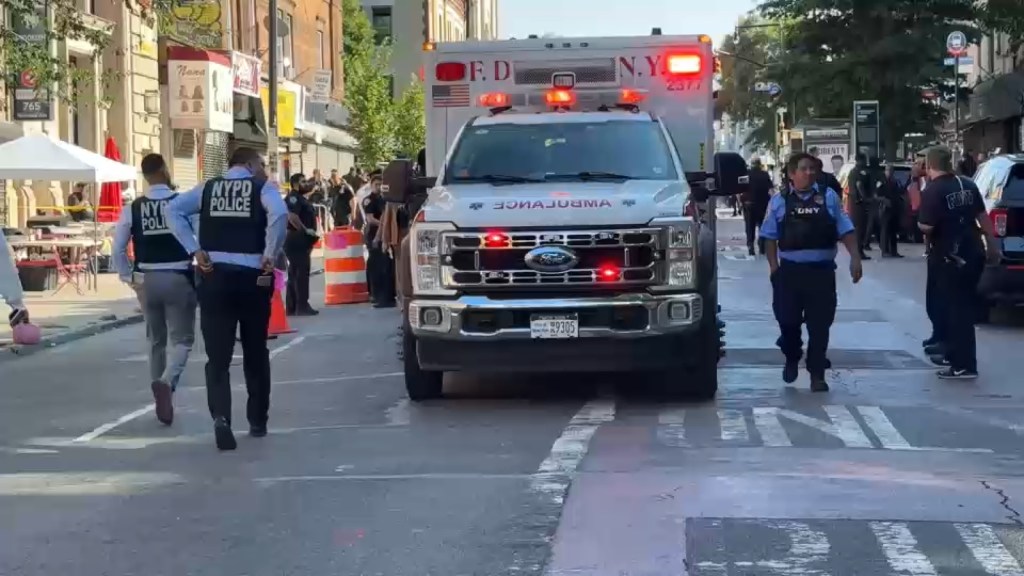
Brooklyn’s West Indian American Day Parade was supposed to be a massive celebration of Caribbean culture, music and heritage. Instead, the surrounding streets became the scene of six separate violent incidents that left 10 people injured, including three people shot, six stabbed and one slashed. One victim was critically wounded.

The particularly frustrating part is that New York City knew violence was a risk.
Thousands of NYPD officers had been deployed, spectators were screened at 13 entrances, helicopters and drones watched from above, and officials deliberately moved the parade’s closing time to 5:30 p.m. because shootings had erupted around that time in previous years.
Yet the violence began before the parade even started.
The Trouble Started Before 6 A.M.
At approximately 5:45 a.m., police responded to the area around Utica Avenue and Carroll Street.
Multiple men were attacked with knives during what witnesses described as a chaotic scene involving a large crowd and an apparent fight. Victims suffered wounds to the neck, face and chin, with one man reported in critical condition.
Then came another attack.
Around 6 a.m., a 25-year-old man was slashed in the face near Eastern Parkway, according to police accounts reported by local media.
The main parade wouldn’t begin until 11 a.m.
Brooklyn already had multiple people headed to hospitals.
Then the Gunfire Started
The parade itself drew hundreds of thousands of people to Eastern Parkway, filling the street with flags, elaborate costumes, steel drums, Caribbean food and music.
But around 4 p.m., violence erupted again.
A 24-year-old man was shot near 800 Nostrand Avenue, just off the parade corridor. Witnesses described people fighting before suddenly hearing gunshots and watching the crowd scatter.
Police took a person of interest into custody and recovered a firearm. The wounded man was hospitalized.
Only minutes later came another shooting.
At approximately Eastern Parkway and Kingston Avenue, a 37-year-old woman was shot in the leg while a 19-year-old man suffered graze wounds to both legs. Both were hospitalized in stable condition.
Police began searching for two people reportedly seen fleeing the area.
In the space of several minutes, three people had been hit by gunfire near one of New York City’s largest cultural celebrations.
Another Stabbing Followed
The violence wasn’t finished.
Shortly after 5:30 p.m., police responded to Brooklyn Avenue and Eastern Parkway, where a 32-year-old man had been stabbed in the leg.
About half an hour later, shots were reportedly fired near 1572 Pitkin Avenue, although nobody was wounded in that incident.
By the time police began piecing everything together, the tally had climbed to 10 injured across six incidents, according to NY1’s later accounting.
Three were shot.
Six were stabbed.
One was slashed.
One victim remained in critical condition while the others were reported stable. Police said there had been one arrest as of the latest NY1 report.
This Happened Despite an Enormous Security Operation
That is what makes this year’s violence especially troubling.
The NYPD wasn’t caught unaware.
Police Commissioner Jessica Tisch announced beforehand that thousands of officers would be deployed around J’Ouvert and the parade, describing it as one of the department’s largest annual deployments.
The city established 13 screened entry points for J’Ouvert. Weapons, alcohol, backpacks, drones and other prohibited items were restricted. Aviation units, mounted officers, counterterrorism personnel, the bomb squad and NYPD drones were deployed. More than 300 emergency personnel and community safety volunteers were also assigned to hotspot locations.
Even the schedule had been changed.
The parade was ordered to end promptly at 5:30 p.m. because officials had identified late-afternoon and evening violence as a recurring problem.
Tisch said that in 2025, three shooting incidents around 5:35, 6:15 and 6:30 p.m. resulted in six people being shot and forced police to shut down the celebration.
Yet in 2026, the trouble simply arrived earlier.
This Is Becoming a Pattern
That is the uncomfortable part of the conversation.
The violence surrounding the West Indian Day celebration isn’t appearing out of nowhere.
In 2024, a shooting during the parade killed one person and wounded four others.
In 2025, five people were shot and two people were slashed in violence after the parade.
Then came 2026, with another collection of shootings, stabbings and assaults around the festivities.
That doesn’t mean the hundreds of thousands of peaceful attendees should be blamed for the actions of a tiny number of violent people.
Quite the opposite.
Those attendees are the people being endangered.
The West Indian American Day Parade is one of the country’s largest celebrations of Caribbean culture. Families shouldn’t have to wonder whether somebody’s street fight is going to turn into gunfire while they’re watching a masquerade band march down Eastern Parkway.
Don’t Blame the Parade. Fix the Security Problem Around It.
Calls to simply cancel the parade would punish hundreds of thousands of peaceful Caribbean New Yorkers for crimes committed by a comparatively tiny number of people.
That’s the easy answer.
It isn’t necessarily the smart one.
The more difficult question is why violence continues breaking out around the perimeter and surrounding neighborhood even when the parade itself is heavily secured.
Screening people entering controlled areas only accomplishes so much if fights, knives and guns remain several blocks outside those checkpoints.
That distinction matters because reporting repeatedly describes many of these incidents as occurring near or around the parade route, rather than establishing that every attack occurred inside the secured parade itself.
The city should analyze precisely where each attack occurred relative to checkpoints, which incidents involved parade participants, whether weapons bypassed screening, and whether violence migrated into less-secured neighboring streets.
Otherwise, New York risks building an armored bubble around Eastern Parkway while trouble simply moves around the corner.
Ten Injured Is Ten Too Many
The West Indian American Day Parade shouldn’t become synonymous with violence.
It represents Caribbean New Yorkers whose families come from Jamaica, Trinidad and Tobago, Haiti, Barbados, Grenada, Guyana and across the region. The overwhelming majority came to dance, march, eat, wave flags and celebrate their heritage.
They deserved better than this.
So did the people who ended Labor Day in hospital beds.
New York threw thousands of officers, checkpoints, helicopters, drones and an altered schedule at the problem.
Ten people were still injured.
That doesn’t prove security was useless. Officers may have prevented considerably worse violence, and investigators have not established that all six incidents were connected to one another or directly caused by the parade.
But after three consecutive years of serious violence around this celebration, city officials need something more sophisticated than repeating the same security plan with another layer of police tape.
Protect the parade. Protect the culture. But above all, protect the people who came to celebrate it.
—Vanessa Edwards, B1Daily



Leave a Reply