—Jermichael Evers, B1Daily
Canada’s wildfire smoke has become an unwelcome summer export.
Massive fires ignite across Canadian forests, smoke pours south across the border, and millions of Americans hundreds or even thousands of miles away can wake beneath hazy skies.
But buried underneath today’s wildfire emergency is an uncomfortable piece of Canadian history: Indigenous peoples had been deliberately managing many of these landscapes with fire long before modern Canada existed. Then governments pushed them out and suppressed the practice.

Canada’s own national parks agency now acknowledges the consequences.
Parks Canada says Indigenous peoples used cultural burning for thousands of years to manage vegetation, improve wildlife habitat, encourage medicinal plants and maintain healthier landscapes. When the modern park system arrived, authorities began aggressively suppressing fires and cultural burning was banned in national parks.
The result was predictable.
The little fires disappeared.
The fuel didn’t.
Canada Tried to Remove Fire From a Landscape Built Around Fire
The old philosophy was straightforward:
Fire is dangerous. Put it out.
That sounds reasonable until you understand that many Canadian ecosystems evolved alongside recurring fire.
Indigenous communities understood this.

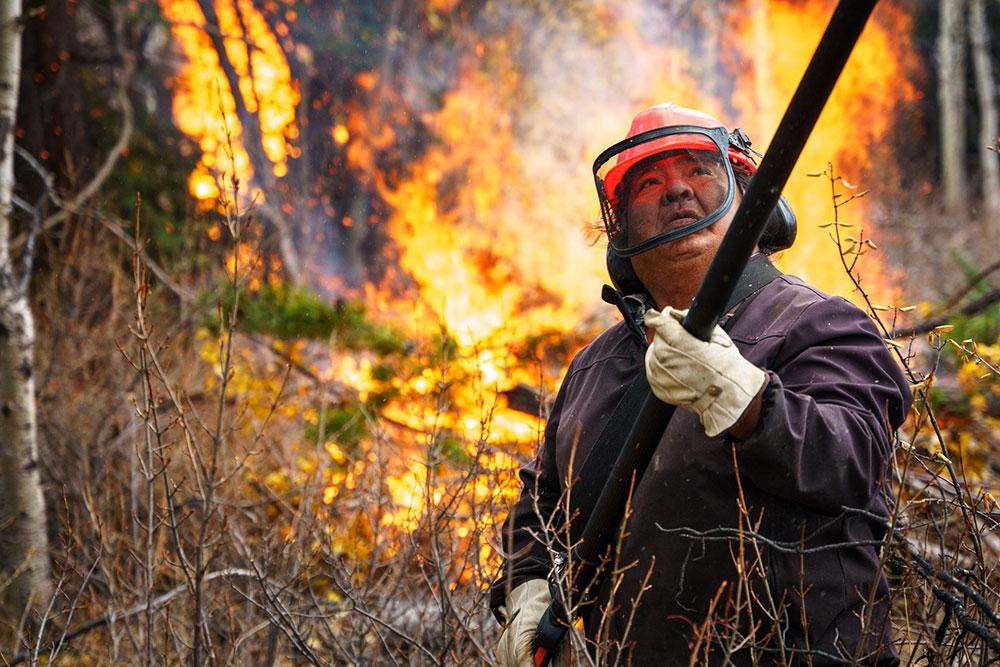
Rather than waiting for enormous fires to erupt under the worst possible conditions, cultural burning frequently involved deliberately setting relatively small, low-intensity fires under carefully selected conditions.
Parks Canada describes many cultural burns as slow, cool fires based on generations of Indigenous knowledge about when, where and how landscapes should burn.
Then came Canada’s suppression era.
Parks Canada acknowledges that wardens were instructed to extinguish wildfires and Indigenous people were prevented from practicing cultural burning within national parks.
Banff offers a particularly striking example. After the national park was created in 1885, Indigenous cultural burning was banned and Indigenous people were forcibly removed from the park. Fire was then largely excluded from the landscape for almost a century.
That policy didn’t eliminate fire forever.
It postponed it.
The Forest Became a Fuel Depot
Imagine refusing to empty a building’s wastebasket for 80 years because throwing away garbage seems disruptive.
Eventually you haven’t eliminated the problem.
You’ve built a mountain of fuel.
Something similar happened in forests.
Without regular fire, dead wood, shrubs, small trees and other vegetation accumulated.
Parks Canada now explicitly acknowledges that its early fire-suppression policies produced unnaturally large fuel loads that increased the risk of severe wildfires.
Banff’s modern fire-management program reaches essentially the same conclusion. Fire exclusion contributed to dense vegetation and similarly aged forests covering valley bottoms. Combined with a warming climate, that accumulated vegetation increases the potential for larger and more intense fires.
Canada spent decades treating fire as the enemy.
It eventually discovered that the absence of fire could become an enemy too.
Indigenous Fire Keepers Already Knew This
This is where the history becomes particularly bitter.
Canada didn’t stumble onto a completely new ecological discovery.
Indigenous communities had already developed sophisticated systems for living with fire.
Cultural burning isn’t simply another term for a government prescribed burn. Parks Canada itself distinguishes the two.
Cultural burns are Indigenous-led, guided by Indigenous knowledge and often serve cultural purposes alongside ecological ones. Government prescribed burns are agency-driven operations generally designed around ecological restoration or hazard reduction using Western fire-management systems.
Different Indigenous nations also possess different traditions. There is no single universal “Indigenous burning method.”
But the underlying principle is powerful:
Fire can be a tool instead of merely a disaster.
Small, carefully managed burns can remove vegetation that might otherwise become fuel for something much larger.
And Indigenous Fire Practitioners Still Face Barriers
Canada has changed course significantly.
Parks Canada now says it supports restoring Indigenous-led cultural burning, works with Indigenous partners and established an Indigenous Fire Circle in 2023 to help identify opportunities and barriers.
That deserves acknowledgment.
But saying “we support cultural burning” doesn’t mean a century of restrictions instantly disappeared.
A peer-reviewed Canadian study examining Indigenous-led fire stewardship found continuing legal and institutional barriers. First Nations retain rights to conduct cultural burning on reserve lands, but wildfire agencies can still exercise significant oversight. The barriers become larger across traditional Indigenous territories legally classified as Crown land under provincial or federal authority.
The researchers described persistent colonial barriers that can interfere with Indigenous peoples’ ability to lead cultural burning even while wildfire agencies increasingly recognize its value.
That creates a maddening contradiction.
Governments spent generations restricting Indigenous fire management.
Those restrictions contributed to ecological fire deficits.
Now governments recognize Indigenous fire knowledge as part of the solution, while Indigenous communities can still encounter regulatory barriers when trying to put that knowledge back onto the landscape.
Canada Is Finally Trying to Reverse Course
There are encouraging examples.
Parks Canada is now working with First Nations on prescribed and cultural burns. At Waterton Lakes National Park, Kainai Nation members worked alongside Parks Canada crews on prescribed fire, and Parks Canada later supported Indigenous practitioners returning cultural fire to nearby First Nation land.
In Kluane National Park and Reserve, Parks Canada has been working with Champagne and Aishihik First Nations and Kluane First Nation on restoring fire to a landscape suffering from a historic fire deficit.
Parks Canada also says it has used prescribed fire for more than 40 years.
So it would be inaccurate to claim modern Canada simply refuses to conduct controlled burns.
The more legitimate criticism is that Canada spent roughly a century creating the problem and is only gradually rebuilding the fire-management systems it dismantled.
And the scale of restoration remains important.
Parks Canada reported coordinating 44 wildfire-risk-reduction projects across 20 parks and sites in 2025, treating 719 hectares.
Meanwhile, the country contains forests on an almost continental scale.
Then Climate Change Turned Up the Furnace
Fire suppression isn’t the only explanation for Canada’s enormous wildfires.
That point matters.
Climate change is making fire seasons longer and creating hotter, drier conditions capable of producing more severe fires. Drought can leave enormous quantities of vegetation ready to ignite. Parks Canada itself identifies climate change as a major factor increasing future wildfire severity.
Lightning also ignites enormous numbers of Canadian wildfires.
So blaming Canada’s wildfire crisis entirely on restrictions against Indigenous burning would be wrong.
The real problem is more combustible:
A warming climate is interacting with landscapes where generations of fire suppression allowed fuels to accumulate.
Climate change loads the weather dice.
Historical fire suppression helped load parts of the forest.
Together they can produce catastrophic conditions.
And America Gets the Smoke
Wildfires don’t recognize international borders.
Once enormous Canadian fires begin pumping smoke high into the atmosphere, prevailing winds can transport that pollution deep into the United States.
Americans hundreds of miles from the flames can experience hazy skies and deteriorating air quality without seeing a single burning tree.
That makes Canada’s fire-management decisions more than a Canadian concern.
When smoke repeatedly crosses the border, wildfire resilience becomes an international environmental issue.
The United States cannot dictate how Canada manages its forests.
But Americans have every reason to care whether Canada is using every scientifically and culturally credible tool available to reduce catastrophic wildfire risk.
Indigenous fire stewardship should be one of those tools.
Canada Should Give More Fire Back to the People Who Understand It
There is something almost painfully ironic about Canada’s current predicament.
Government authorities once looked at Indigenous people intentionally setting fires and concluded that the practice was dangerous.
They suppressed those fires.
They suppressed Indigenous knowledge.
Vegetation accumulated.
Forests became denser.
Then increasingly severe wildfire seasons arrived.
Now the Canadian government itself says restoring fire can create healthier, more resilient landscapes and acknowledges that historical suppression produced ecological damage and increased wildfire risk.
Canada cannot undo a century of policy.
But it can learn from it.
That means expanding Indigenous-led cultural burning where ecologically appropriate, reducing unnecessary regulatory barriers, investing in Indigenous fire practitioners, combining traditional knowledge with modern fire science and treating controlled fire as preventative infrastructure rather than an eccentric historical practice.
Nobody should pretend cultural burning will magically eliminate Canada’s wildfire crisis.
It won’t.
Climate change, drought, lightning, forest conditions and human ignition will continue producing fires.
But when a country admits that suppressing fire helped create dangerous fuel accumulation, continuing to underuse carefully managed fire makes little sense.
Canada spent much of the twentieth century telling Indigenous people to stop burning the land.
In the twenty-first century, it may need those same communities to help teach the country how to burn it properly again.
—Jermichael Evers, B1Daily


 B1Daily
Leave a comment