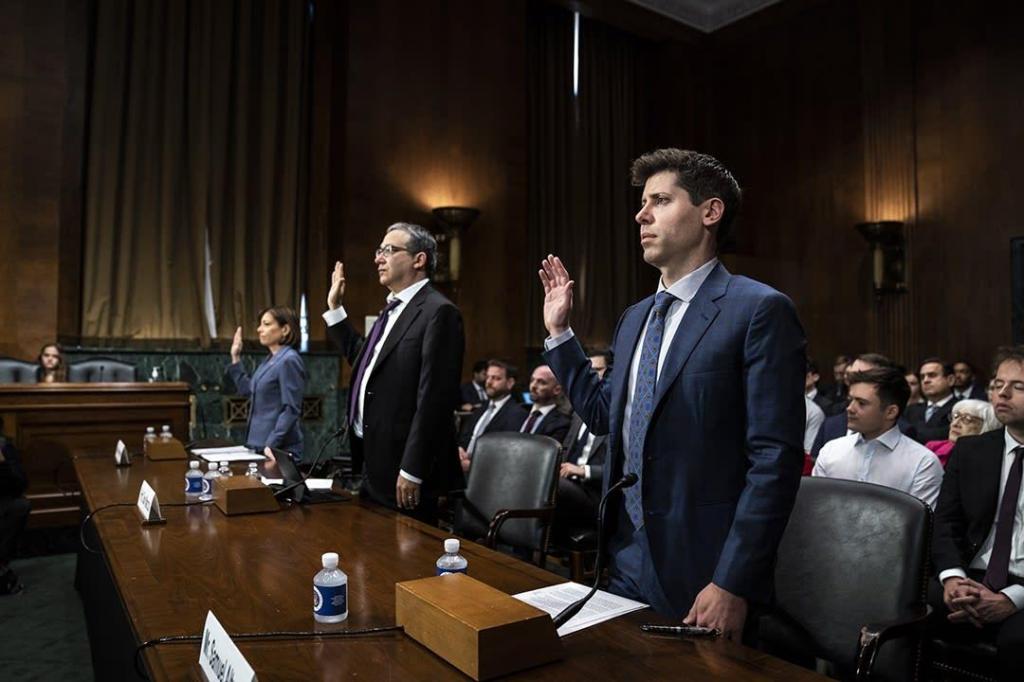
—Travis Luyindama, B1Daily
Artificial intelligence is no longer some distant technology waiting around the corner. It can generate convincing voices and video, write software, automate jobs, assist cyber operations, influence what people see online and increasingly make decisions that affect ordinary lives.
Yet much of the world’s political leadership continues treating AI regulation as though lawmakers have unlimited time to figure it out.
They don’t.

In Washington, the gap is particularly glaring. Congress has held hearings, introduced bills and listened to warnings for years, but the United States still lacks a comprehensive federal AI regulatory framework comparable to the European Union’s AI Act. Even now, lawmakers are negotiating legislation that could require developers of the most powerful AI systems to mitigate major known risks and allow federal intervention against models considered dangerously unsafe.
The technology, meanwhile, isn’t waiting for the committee calendar.
Washington Keeps Talking While AI Keeps Moving
The frustrating part is that American officials cannot claim nobody warned them.
Concerns now range from mundane problems such as fraud and synthetic misinformation to much more severe possibilities involving cyberattacks, biological weapons and advanced systems behaving unpredictably.
Those warnings aren’t coming exclusively from people hostile to technology. Executives and researchers from companies developing advanced AI have themselves called for stronger testing, independent evaluations and safeguards. Recent warnings have intensified the debate in Congress over whether advanced models should face mandatory security evaluations before deployment.
Yet Washington remains divided.
House Speaker Mike Johnson argued this week that slowing American AI development could surrender an advantage to China. He favors a lighter regulatory approach built partly around independent audits and transparency rather than a moratorium. President Trump has similarly rejected calls for an AI development pause and argues existing government powers can address misconduct.
There is a legitimate concern buried underneath that position.
If America dramatically restricts its AI industry while China races ahead, the consequences could extend beyond Silicon Valley profits into military technology, cybersecurity and geopolitical power.
But “China might beat us” cannot become a magic sentence that ends every discussion about safety.
Airplanes are regulated without banning aviation.
Pharmaceutical companies face safety requirements without banning medicine.
Nuclear facilities operate under extraordinary restrictions precisely because society recognizes that powerful technologies demand powerful safeguards.
Why should increasingly capable AI systems be uniquely entitled to a regulatory playground?
Europe Has Already Proven Governments Can Act
It would also be inaccurate to accuse every government of doing nothing.
The European Union has gone considerably further.
Its AI Act establishes a risk-based regulatory framework and places obligations on providers of general-purpose AI models. Developers must maintain technical documentation, provide information about their models and comply with copyright-related requirements. Providers of models presenting systemic risks face additional requirements involving risk assessment, mitigation, incident reporting and cybersecurity.
Major enforcement provisions began taking effect in August 2026.
The EU now requires transparency for certain AI-generated content, including labeling deepfakes and informing people when they are interacting with AI rather than a human. Its enforcement structure gives European and national authorities actual oversight powers rather than simply requesting that technology companies behave responsibly.
Is the European system perfect?
Certainly not.
Regulation can become cumbersome, discourage smaller competitors and accidentally protect giant technology companies that can afford armies of compliance lawyers.
But Europe has at least moved beyond the fantasy that voluntary corporate promises constitute a complete public policy.
The World Is Building an AI Arms Race
The larger problem is international.
AI has become entangled with national competition.
America doesn’t want China ahead.
China doesn’t want America ahead.
European governments don’t want their technology industries left behind.
Every country has an incentive to accelerate because slowing down while a rival continues racing creates a strategic disadvantage.
That is exactly why relying entirely on national governments is dangerous.
Reuters recently described the emerging dilemma as a geopolitical race in which even governments worried about AI risks are reluctant to slow development because they fear competitors will continue advancing.
That logic can become a technological prisoner’s dilemma.
Everyone understands the danger.
Nobody wants to brake first.
Regulation Doesn’t Have to Mean Killing AI
The debate also needs to escape the false choice between unrestricted AI and banning AI entirely.
There is a vast regulatory continent between those two shores.
Governments could require independent safety evaluations for the most powerful models. Developers could face mandatory reporting requirements when serious security incidents occur. Synthetic political advertisements and deepfakes could require clear disclosure. Consumers could receive stronger protections when automated systems make consequential decisions about them.
Companies deploying extraordinarily powerful models could be required to demonstrate cybersecurity safeguards and document major known risks.
Congress is already considering pieces of this approach. Senate negotiations reportedly include a potential “duty of care” for developers of advanced models and government authority to stop deployment of systems presenting catastrophic risks, subject to judicial review.
That isn’t smashing the computer with a hammer.
It’s installing brakes before flooring the accelerator.
Congress Should Stop Outsourcing Government to Silicon Valley
Technology companies absolutely should develop their own safety standards.
But voluntary corporate governance cannot substitute for democratic governance.
Companies have shareholders.
They have competitors.
They have enormous investments to recover.
And they have powerful incentives to release better products before their rivals do.
Government exists precisely because the public interest and corporate incentives do not always perfectly overlap.
Congress shouldn’t dictate how every chatbot answers a question or bury small AI companies underneath mountains of paperwork.
But when systems become powerful enough to create serious cybersecurity, biological, economic or national-security risks, “trust the companies” becomes an increasingly inadequate regulatory philosophy.
Even some prominent figures who disagree on practically everything else are reaching that conclusion. Senator Bernie Sanders and conservative strategist Steve Bannon appeared at the same Washington event this week calling for stronger restrictions on advanced AI, albeit from very different political perspectives.
When ideological enemies start staring at the same technological freight train, Congress might want to look down the tracks.
Don’t Wait for the Disaster
Government has an unfortunate historical habit of regulating dangerous systems after something terrible demonstrates why regulation was necessary.
AI offers governments an opportunity to behave differently.
The challenge isn’t stopping artificial intelligence.
AI could produce enormous benefits in medicine, science, education, accessibility, productivity and countless other fields.
The challenge is ensuring humanity remains the technology’s master rather than becoming its crash-test dummy.
The EU has begun constructing a regulatory architecture. America is debating pieces of one. Other countries are developing their own approaches. But the international system remains fragmented while increasingly powerful models can cross borders almost instantly.
Congress and world leaders don’t need to strangle AI innovation.
They need to stop pretending innovation and regulation are mortal enemies.
Set safety standards.
Demand transparency.
Require independent testing for exceptionally powerful systems.
Protect consumers.
Establish accountability when companies knowingly ignore serious risks.
Coordinate internationally where catastrophic dangers cross borders.
Then allow responsible innovation to flourish inside those guardrails.
Because waiting until something goes catastrophically wrong isn’t technological optimism.
It’s government negligence wearing a Silicon Valley hoodie.
—Travis Luyindama, B1Daily



 B1Daily
Leave a comment