—Kerry Hill, Travis Luyindama, B1Daily
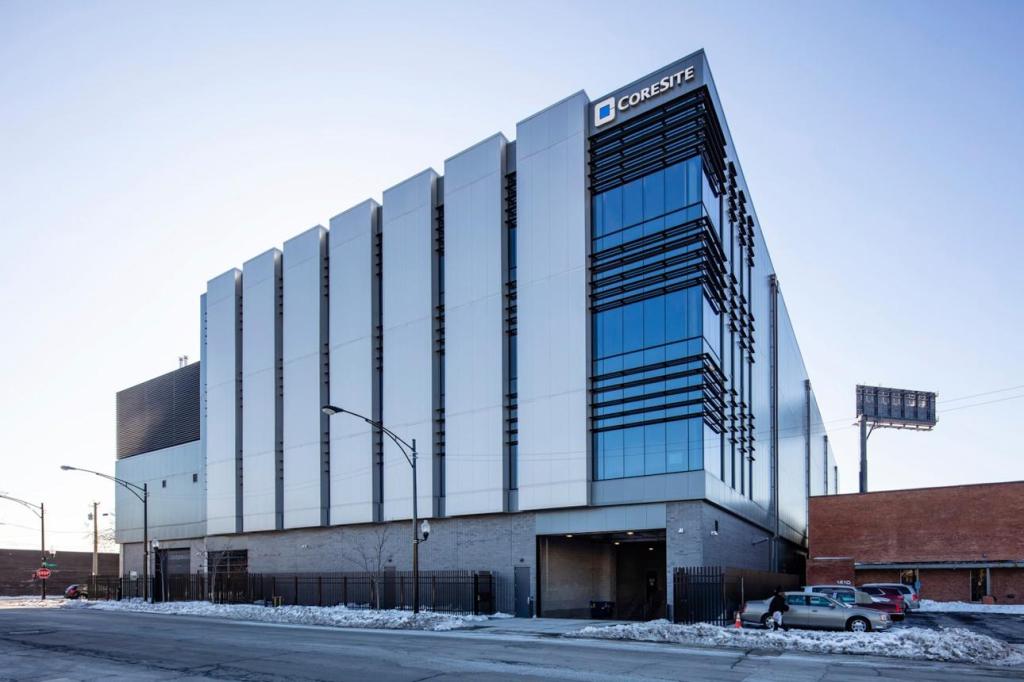
Illinois is quietly transforming into one of America’s biggest data-center construction zones.
The numbers are already enormous. One statewide tracker updated in September counts 66 planned facilities representing roughly 9,647 megawatts of additional capacity, compared with about 1,400 MW currently operating. Another tracker using a narrower definition counts 20 projects that are planned or under construction with approximately 9,821 MW in its pipeline. The disagreement illustrates how quickly proposals are changing and why no single public database can literally guarantee every speculative project.

What is clear is that Illinois isn’t talking about a handful of server warehouses anymore. Several proposed campuses would individually consume power on the scale of major power stations.
The Illinois Data Center Boom
Chicago has long been attractive to data-center operators because of its fiber infrastructure, financial markets, central location and enormous metropolitan economy. But the new generation of projects is spilling far beyond Chicago into farmland and smaller communities.
Among the largest publicly tracked projects are the Joliet Technology Center, approximately 1,800 MW; Project Cardinal near Yorkville, approximately 1,800 MW; T5 Chicago IV in Grayslake, as much as 1,550 MW of site power; the proposed Monarch Rock Air project near Rockford/Davis Junction, approximately 1,400 MW; and Tract’s Morris Technology Park, approximately 1,000 MW.

Project Cardinal alone demonstrates the extraordinary scale involved. Yorkville records describe a roughly 1,037-acre campus containing 14 data-center buildings totaling more than 17 million square feet, along with two electrical substations and a utility switchyard.
Then Yorkville has another monster in the pipeline.
Project Steel, proposed by Prologis, covers approximately 540 acres. The plan was revised in March 2026 to contain 16 data-center buildings. That means one Illinois community could eventually host multiple enormous technology campuses rather than a solitary data center.
And Those Aren’t the Only Ones
The current Illinois pipeline also includes a 636 MW CyrusOne campus in Sangamon County, a proposed 600 MW first phase of another CyrusOne campus around Yorkville, the 500 MW Hut 8 Logan County project, the Prime Data Centers campus in Elk Grove Village, Stream Data Centers’ Chicago III, Equinix’s Minooka campus, Edged’s Project Vector in DeKalb County, and a possible Savion campus near Plano.
Other statewide databases identify still more projects, including a proposed 500 MW Cloverleaf Infrastructure campus near Troy, a 500 MW Cielo project around Minooka, a roughly 300 MW Cielo New Lenox project, and CloudHQ’s large Mount Prospect development.
T5’s Grayslake development is especially striking. The approved site encompasses as much as 472 acres and more than 10 million square feet. Construction began after the first building permit was issued around September 1, although residents are challenging the project’s approvals in court.
Central Illinois is getting pulled into the boom as well. CyrusOne’s Sangamon County proposal calls for four approximately 450,000-square-foot buildings near Springfield and roughly 630 MW of electricity. Earlier estimates suggested the complex would take several years to complete.
Why Is Illinois Suddenly So Attractive?
AI changed the mathematics.
Traditional cloud computing already required enormous server farms. Generative AI and increasingly powerful models dramatically increase demand for high-performance computing infrastructure, while Chicago provides access to an established technology market and electrical infrastructure.
Illinois also deliberately encouraged the industry through its data-center incentive program, which offered qualifying projects exemptions from various state and local taxes. But even Springfield is reconsidering how aggressively it should subsidize the boom. Following a June 5, 2026 directive, the Illinois Department of Commerce and Economic Opportunity stopped processing new applications for the state’s data-center incentive program beginning July 1.
That policy shift is important because Illinois is beginning to confront the other side of the equation.
Gigawatts Don’t Materialize Out of Thin Air
Data centers may create construction work, investment and tax revenue, but the largest campuses demand extraordinary amounts of electricity.
Consider the scale.
Joliet: 1,800 MW.
Project Cardinal: 1,800 MW.
Grayslake: up to 1,550 MW of site power.
Morris: 1,000 MW.
Sangamon County: 636 MW.
Those five projects alone represent roughly 6.8 gigawatts of proposed or approved electrical demand based on their published figures.
That doesn’t mean every facility will constantly consume its maximum published capacity, and different databases sometimes report IT load, utility service or total site power, which aren’t interchangeable measurements. But the direction is unmistakable: Illinois utilities are being asked to prepare for an entirely new class of industrial electricity consumer.
And residents are beginning to notice.
Some communities have responded with moratoriums or temporary restrictions while officials reconsider zoning, power infrastructure, noise, water consumption and other effects. Recent tracking shows restrictions or moratoriums in places including Effingham, Mattoon, Ottawa, West Chicago, La Salle County, Lake County, Lee County, Morgan County and Normal.
Illinois Has a Decision to Make
The debate shouldn’t collapse into “data centers good” versus “data centers bad.”
These facilities are becoming essential infrastructure for cloud computing and artificial intelligence. Illinois has legitimate reasons to want that investment.
But when individual private developments start requesting hundreds or even thousands of megawatts of electrical capacity, their effects cease to be purely private business decisions.
Illinois needs to know who pays for new transmission and generation. Communities deserve reliable estimates of water consumption. Residents need enforceable noise standards. Utilities need to explain how massive new loads could affect reliability and rates. Developers should disclose realistic power requirements rather than leaving communities to decipher wildly different megawatt figures.
Most importantly, Illinois needs a statewide strategy.
Because the state isn’t deciding whether to approve a data center anymore.
It is staring at a pipeline potentially approaching 10 gigawatts of additional data-center capacity, with campuses spreading from Chicago’s suburbs to Yorkville, Joliet, Morris, Grayslake, Springfield, Logan County, DeKalb and communities farther south and west.
The server farms are coming.
The real question is whether Illinois builds the infrastructure and regulations around them before the concrete, substations and power lines arrive first.
—Kerry Hill, Travis Luyindama, B1Daily


 B1Daily
Leave a comment