—Sylvester Loving, B1Daily
Before the Tuskegee Airmen became legends of World War II, John C. Robinson was already proving that Black Americans belonged in the cockpit.
Born in Florida in 1903 and raised in Mississippi, Robinson entered aviation when racial segregation made becoming a Black pilot extraordinarily difficult. After studying at Tuskegee Institute, he moved to Chicago, became an accomplished pilot and instructor, and helped train a generation of Black aviators. Robinson and Cornelius Coffey organized the Challenger Air Pilots’ Association and helped establish an airfield at Robbins, Illinois. The National Park Service credits their Chicago aviation community with training Black pilots, mechanics and navigators who helped form the foundation of African American aviation before World War II.
Robinson’s influence also reached Tuskegee. He pushed his alma mater toward aviation education and helped demonstrate that Black pilots could master the technical demands of flight. Because of this pioneering work, Robinson is sometimes called the “Father of the Tuskegee Airmen,” although the Tuskegee Airmen program itself was created later and involved many other important figures.
But Robinson’s most extraordinary chapter unfolded thousands of miles from America.
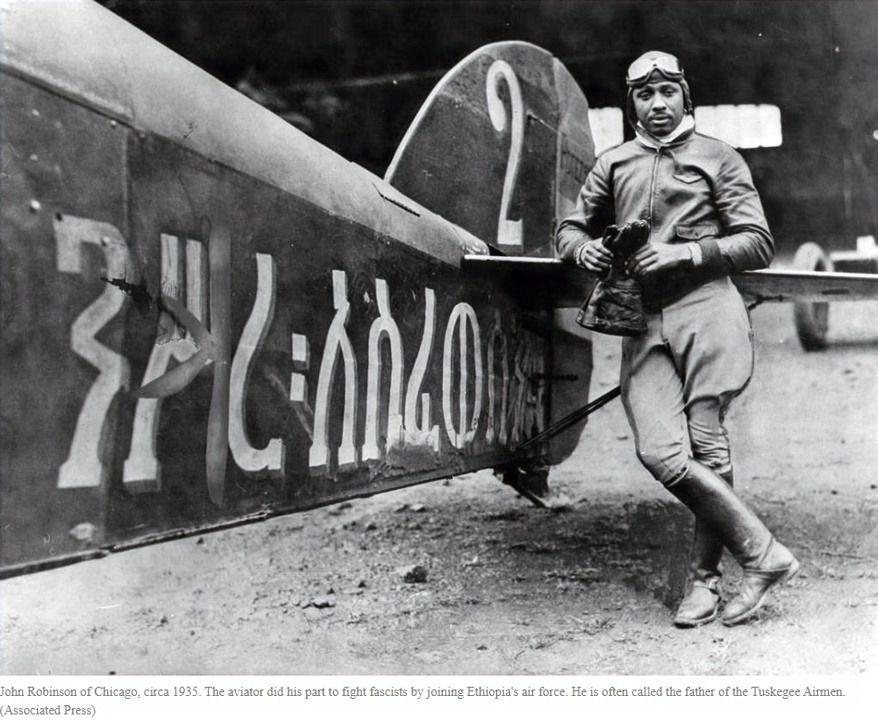
In 1935, as Benito Mussolini’s Fascist Italy prepared to invade Ethiopia, one of the few independent African nations remaining, Robinson volunteered his aviation expertise to Emperor Haile Selassie. He was commissioned as a colonel and placed in command of Ethiopia’s tiny air force.
The mismatch was staggering. Italy possessed a modern air force while Ethiopia had only a handful of aircraft. Robinson nevertheless flew reconnaissance and courier missions, transported supplies and served as one of Haile Selassie’s pilots. Smithsonian recounts that he flew unarmed aircraft near the front, was pursued by Italian fighters, suffered a gunshot wound and was exposed to mustard gas during the conflict. His exploits earned him the nickname “Brown Condor of Ethiopia.”

Robinson’s relationship with Ethiopia didn’t end with the Italian occupation.
After Ethiopia was liberated during World War II, Robinson returned in the 1940s and helped rebuild Ethiopian aviation, recruiting American aviation personnel and training Ethiopian pilots and technicians. His work contributed to the development of the postwar Imperial Ethiopian Air Force and Ethiopia’s emerging civil aviation industry.
There is an important historical distinction here: Robinson trained Ethiopian aviators before and during the 1935-36 war against Fascist Italy, and then returned years later to train a new generation of Ethiopian pilots and mechanics after liberation. His later training work therefore wasn’t during the war itself, but part of rebuilding the aviation force that Fascist occupation had devastated.
John C. Robinson’s story connects two remarkable chapters of Black aviation history. He helped break barriers that contributed to the world that produced the Tuskegee Airmen, then crossed the Atlantic and placed his skills at the service of an African nation fighting fascist conquest.
The Brown Condor didn’t merely dream about Black people taking to the skies.
He build the runway.
—Sylvester Loving, B1Daily



 B1Daily
Leave a comment