—Barrington Williams, B1Daily
Rural America has been one of the Republican Party’s strongest political fortresses. But underneath those election maps painted deep red, something increasingly uncomfortable is happening.
The relationship is showing cracks.
Farmers are confronting shrinking margins. Rural hospitals remain financially vulnerable. Food, fuel and fertilizer costs are squeezing household and agricultural budgets. Meanwhile, some of the policies coming out of Republican-controlled Washington are colliding directly with institutions rural communities depend upon.
That doesn’t mean rural America has suddenly become Democratic territory. Far from it.
But Republicans would be foolish to mistake loyalty for unlimited patience.
The Farm Economy Is Squeezing People
Agriculture provides perhaps the clearest warning.
Reuters reported in August that American farmers are confronting high operating costs, expensive financing and weak profit margins, while tariffs and international instability have added additional uncertainty. Reuters also identified at least 30 candidates with agricultural backgrounds running for federal office, including Democrats and independents challenging Republicans in heavily rural areas.
Some farmers have become increasingly vocal about trade policy.
Kansas farmer Matt Ubel told ABC News that high diesel and fertilizer costs were already hurting his operation before criticizing the administration’s decision to temporarily lift tariffs on a large quantity of imported beef. His complaint was remarkably simple: Washington should make American farming sustainable rather than forcing domestic producers to compete against additional imports while their costs remain elevated.
That frustration doesn’t automatically translate into changing political parties.
But it does create political tinder.
Rural Health Care Could Become an Even Bigger Problem
Then there is Medicaid.
Rural America depends heavily on the program. About one-quarter of rural adults receive Medicaid, while the program finances nearly half of births and roughly one-fifth of inpatient hospital discharges in rural communities.
The Republican reconciliation law enacted in 2025 is estimated to reduce federal Medicaid spending by roughly $911 billion over ten years. KFF estimates approximately $137 billion of those reductions could occur in rural areas. Congress simultaneously created a $50 billion Rural Health Transformation Program intended to help rural health systems adjust.
Republicans argue the changes are intended to reduce waste, fraud and abuse while encouraging able-bodied recipients to work. The Congressional Budget Office nevertheless estimates that millions more Americans will ultimately become uninsured because of the Medicaid changes.
For rural communities, that debate isn’t theoretical.
When a metropolitan hospital loses revenue, patients might have another hospital several miles away.
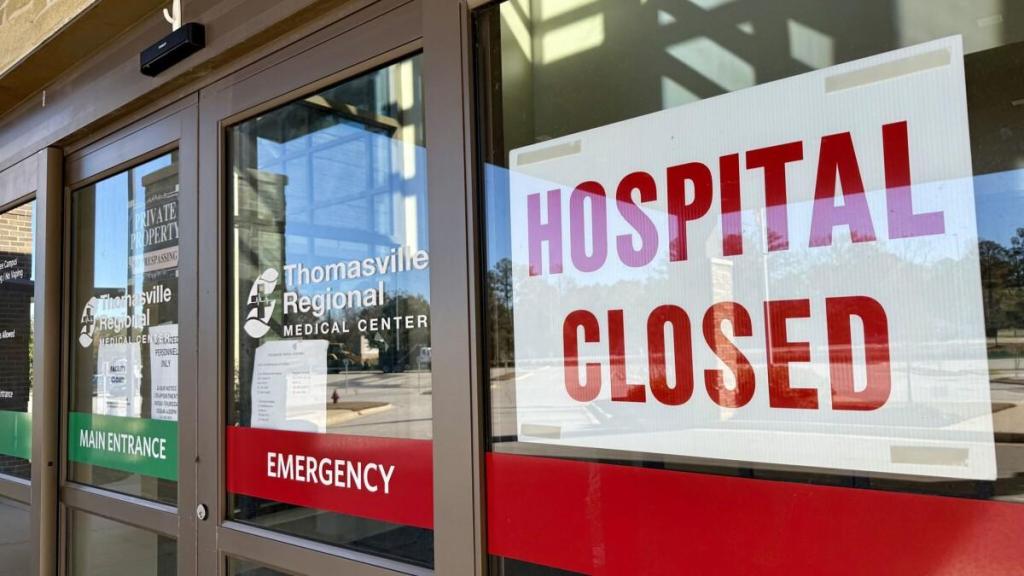
When the only hospital serving several rural counties eliminates a service or closes, the next emergency room can suddenly become a very long drive.
Rural maternity care is already disappearing. KFF reports that almost half of rural counties lacked a hospital providing obstetric services in 2023.
That makes health care potentially explosive rural politics.
Rural Voters Don’t Necessarily Want Washington to Gut Medicaid
Perhaps the most revealing numbers concern what rural residents themselves say.
A KFF survey conducted in 2025 found only 23 percent of rural residents favored reducing Medicaid spending, while 75 percent considered Medicaid very important to their communities. Even among rural Trump voters, 66 percent described Medicaid as very important locally.
That illustrates an important distinction often lost in national politics.
A voter can dislike “big government” in the abstract while desperately wanting the local hospital, nursing home, ambulance service and medical clinic to remain open.
Politics becomes considerably less ideological when the nearest emergency room disappears.
The Cost of Living Is Eating Into the Relationship
Economic anxiety extends beyond farms.
A March 2026 survey of 600 rural voters in competitive Senate states found widespread concern about food and gasoline prices. The Center for Rural Strategies described respondents as unusually pessimistic about the country’s direction. Trump remained above water in that particular poll at 52 percent approval and 46 percent disapproval, but that represents dissatisfaction within communities that have otherwise provided Republicans enormous electoral strength.
Tariffs create another complicated divide.
Nationally, Pew found 71 percent of Republicans and Republican-leaning independents approved of the administration’s increased tariffs in January 2026. But tariffs can simultaneously create costs for farmers dependent upon imported fertilizer, machinery and other inputs or expose agricultural exports to retaliation.
That leaves some rural voters caught between supporting the broader policy and absorbing its consequences.
Republicans Still Dominate Rural America
None of this proves that rural voters are abandoning Republicans.
That would be getting several miles ahead of the evidence.
Republicans continue to enjoy substantial rural political strength, and conservative positions on guns, immigration, energy, cultural issues and regulation continue to resonate with many rural voters. Republican lawmakers also point to tax provisions, agricultural legislation, rural development programs and the new rural health fund as evidence that their policies benefit these communities.
But political loyalty isn’t a blank check.
The emerging tension is less about rural Americans suddenly embracing Democrats than about whether Republicans can continue winning enormous rural margins while pursuing economic policies that some farmers, hospitals and working-class residents believe make their lives harder.
That is the crack worth watching.
Rural America has spent years telling Washington that it feels forgotten.
Republicans successfully turned that resentment into one of the most dependable political coalitions in modern American politics.
Now they face a different challenge:
When you become the party that rural America trusts to run Washington, eventually rural America expects Washington to deliver.
—Barrington Williams, B1Daily



 B1Daily
Leave a comment