—Matt Gwinta, B1Daily
The world believes that South Africa has a serious murder problem. Farmers claim to be attacked. The nation’s ethnic white population claims many things.
But none of those facts establish that Afrikaners are experiencing a genocide.
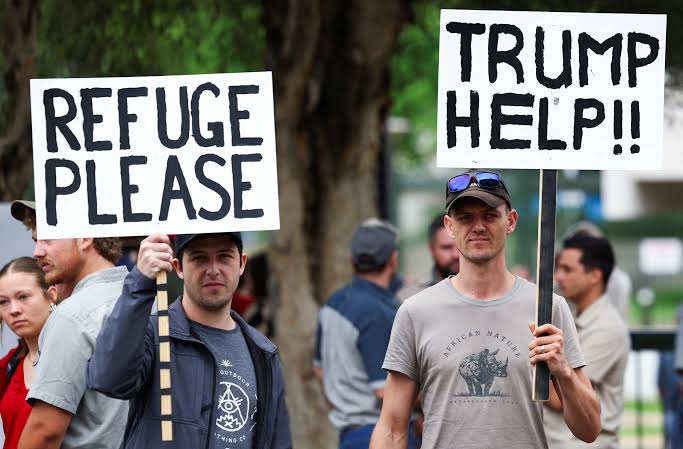
The claim has circulated internationally for years and has recently become even more politically consequential. President Donald Trump has repeatedly alleged that white South Africans are being subjected to genocide, while his administration has cited alleged discrimination against Afrikaners in its policies toward South Africa. On September 15, 2026, Secretary of State Marco Rubio announced new visa restrictions targeting certain South Africans accused by the U.S. government of supporting racial discrimination, uncompensated land seizures or violence against minorities.
But when the genocide allegation is separated from the politics and compared with available evidence, the case falls apart.
Genocide Has a Meaning
Genocide isn’t simply another word for racial hostility, discrimination or even murder.
Under international law, genocide requires acts committed with the intent to destroy, in whole or in part, a national, ethnic, racial or religious group. That requirement of destructive intent is critical.
Researchers at South Africa’s Institute for Security Studies examined farm attacks and concluded that there is no credible evidence of systematic or organized targeting of white people or farmers with the intention of destroying them as a racial or ethnic group. Earlier investigations, including a government inquiry into farm attacks and a South African Human Rights Commission investigation into safety in farming communities, similarly failed to establish such a campaign.
A South African court went even further in 2025, describing claims of a white genocide as “clearly imagined and not real” while deciding a case involving a bequest to an extremist organization.
The Murder Statistics Tell a Different Story
South Africa’s violent-crime problem is staggering.
Police recorded 26,232 murders nationwide in 2024, according to figures cited by Reuters. Of those, 44 were associated with farming communities, and eight victims were farmers. Data collected by TLU-SA, a farmers’ union representing primarily Afrikaner interests, counted 1,363 white farmers murdered since 1990, averaging roughly 40 annually.
Every one of those murders matters.
But they do not demonstrate genocide.
Even organizations focused specifically on Afrikaner interests report farm-murder numbers that constitute a tiny fraction of South Africa’s overall homicide toll. FactCheck.org reported that AfriForum’s figures showed 32 farm murders in 2024, compared with 50 in 2023 and 43 in 2022.
And “farm murder” does not automatically mean “white farmer murdered.”
Farm workers, residents and other people killed on agricultural properties can also appear in the statistics. During April through December 2024, government figures recorded 19,696 murders nationally, with 36 connected to farms. Only seven of those victims were farmers, while the remaining 29 were farm workers, who are predominantly Black.
That doesn’t make attacks against white farmers insignificant.
It makes them part of a much larger South African violent-crime crisis.
Even the Infamous White Crosses Weren’t Graves
One of the most dramatic pieces of supposed evidence for genocide also illustrates how misinformation can distort this debate.
During Trump’s May 2025 meeting with South African President Cyril Ramaphosa, footage showing rows of white crosses was presented while Trump discussed the alleged killing of white farmers.
Those crosses weren’t thousands of graves.
They came from a 2020 protest against farm murders, where crosses were erected symbolically. Reuters also found that another image presented in the discussion, showing body bags, actually originated from the Democratic Republic of Congo rather than South Africa.
The underlying farm murders were real.
The presentation of those images as evidence of mass killing was not.
Afrikaners Can Face Crime Without Facing Genocide
This distinction shouldn’t be difficult.
A person can believe South Africa needs to do far more to protect farmers without claiming farmers are being exterminated.
Someone can criticize affirmative-action policies without calling them genocide.
Someone can debate land reform without pretending white-owned farms are currently being systematically seized through a government extermination campaign.
And someone can condemn inflammatory racial rhetoric against Afrikaners without converting every crime against a white South African into evidence of an organized racial purge.
In fact, exaggerating the situation can make addressing actual rural crime harder. If every farm murder becomes ammunition for an international genocide narrative, discussion shifts away from practical questions about policing, rural security, organized robbery and South Africa’s extraordinary national homicide rate.
South Africa Has a Violence Crisis, Not Evidence of an Afrikaner Genocide
South Africa doesn’t need propaganda to make its crime situation frightening.
The country’s homicide rate is already severe enough.
Farmers deserve protection. Farm workers deserve protection. Afrikaners deserve protection. Black South Africans deserve protection. And perpetrators of rural murders should be prosecuted regardless of the victim’s race.
But genocide is among the gravest accusations that can be made against a country. It requires evidence proportionate to the accusation.
So far, the statistical evidence, independent investigations and available crime data do not demonstrate an organized effort to physically destroy South Africa’s Afrikaner or white population. Even investigations specifically examining farm violence have failed to establish that conclusion.
South Africa has plenty of genuine problems worth arguing about.
An unsupported genocide narrative doesn’t need to be invented to make them serious.
—Matt Gwinta, B1Daily


 B1Daily
Leave a comment